What Happens If Catalytic Converter Fails While Driving? Signs
A catalytic converter failure may cause anything from a Check Engine light with little immediate change in driving to severe power loss, overheating, stalling, or an engine that eventually will not run. The outcome depends on how the converter fails. A loss of catalyst activity is very different from a converter whose internal material has melted and blocked exhaust flow.
The biggest concern while driving is a restricted converter. Exhaust gases cannot leave the engine normally, backpressure rises, and acceleration may become progressively weaker. A heavily plugged converter can make maintaining highway speed difficult and, in severe cases, cause stalling or prevent the engine from restarting.
Heat creates another concern. Misfires and overly rich combustion can send unburned fuel into the converter, where it may burn and drive converter temperatures high enough to damage or melt the internal substrate. Walker notes that excessive temperatures can melt the catalyst structure and eventually block exhaust flow.
For U.S. drivers, the EPA classifies catalytic converters as specified major emission-control components. Eligible light-duty vehicles receive federal emissions warranty coverage for these components for 8 years or 80,000 miles, whichever comes first, subject to the applicable warranty conditions.
So, what happens if catalytic converter fails while driving depends on the failure mode. A converter that has simply lost emission-cleaning ability may let the car continue to feel normal, while a melted, collapsed, or severely clogged converter can cause dramatic loss of power and enough heat to make continued driving a bad idea.
Pay attention to how quickly the symptoms appear. A steady Check Engine light with normal performance is different from a flashing light, severe misfire, sudden power loss, burning smell, smoke, glowing exhaust, or repeated stalling. Those stronger symptoms call for stopping rather than trying to finish a long trip.
The sections below explain what you may feel behind the wheel, which symptoms require immediate attention, why converters fail during driving, how a clogged converter affects the engine, what diagnostic checks matter, and when towing makes more sense than driving to a repair shop.
What Happens If Catalytic Converter Fails While Driving?
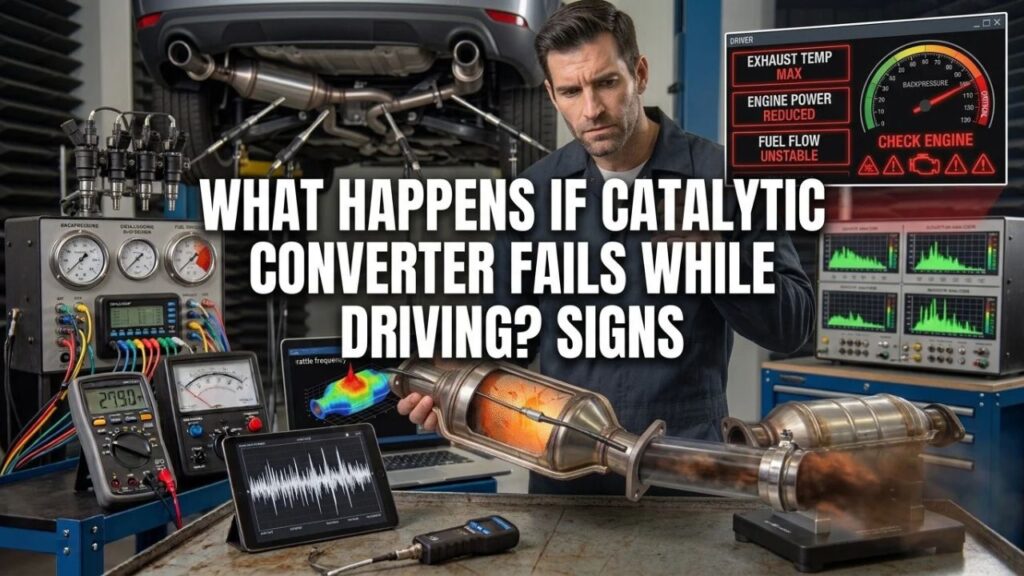
A catalytic converter can fail chemically, mechanically, or through restriction. Each type produces different driving symptoms.
The Check Engine Light May Turn On
One of the mildest scenarios is loss of catalyst efficiency.
The converter may no longer clean the exhaust well enough for the engine computer’s catalyst monitor, which can trigger a code such as P0420 or P0430.
In that case, the vehicle may:
- Start normally
- Accelerate normally
- Idle normally
- Show little change in fuel economy
- Continue driving with a steady Check Engine light
AutoZone notes that catalyst-efficiency faults may produce few noticeable driving symptoms until the warning light appears.
That does not mean the problem should be ignored. The cause still needs diagnosis, and the car may fail an emissions inspection where one is required.
The Car May Suddenly Lose Power
A physically clogged converter creates a more noticeable problem.
The engine is an air pump: air enters, fuel burns, and exhaust must leave. If the converter restricts the exhaust path, pressure builds upstream and the engine has difficulty moving gases out of the cylinders.
You may notice:
- Weak acceleration
- Poor response when pressing the gas pedal
- Trouble climbing hills
- Difficulty maintaining highway speed
- Engine that feels stronger at low speed but weak at higher RPM
RepairPal notes that a severely restricted converter can reduce engine output and, in extreme cases, eventually block exhaust flow enough that the engine will not run.
The Engine May Stall
Severe exhaust restriction can interfere with combustion enough to make the engine stall.
It may restart after cooling, run briefly, and then lose power again as exhaust pressure rises.
Stalling in traffic creates an immediate driving risk because power-assisted steering and braking behavior may change once the engine stops.
Key Takeaway: A failed converter may cause only a warning light, or it may restrict exhaust enough to cause weak acceleration, stalling, and eventual inability to keep the engine running.
Can a Bad Catalytic Converter Cause Sudden Power Loss?
Yes. Sudden or rapidly increasing power loss is one of the more serious converter-related symptoms.
The usual reason is restricted exhaust flow.
Melted Catalyst Material Can Block the Exhaust
Inside the converter is a catalyst-coated structure with many small passages.
Extreme heat can damage or melt that structure. Once passages collapse or fuse together, exhaust flow becomes restricted.
Walker states that an overheated converter can melt internally and become a solid restriction, producing sluggish driving and loss of power.
Broken Material Can Shift Inside the Converter
The catalyst substrate can also break apart.
Loose pieces may:
- Rattle inside the housing
- Move and partially block flow
- Travel farther down the exhaust
- Create intermittent restriction
This can produce symptoms that come and go rather than remaining constant.
You may hear rattling from underneath the vehicle during startup, idle, or acceleration.
Power Loss Often Gets Worse Under Load
A partly restricted exhaust may seem almost normal at idle because the engine is producing a small volume of exhaust.
Press the accelerator hard and exhaust volume rises sharply. The restriction becomes much more obvious.
That is why a clogged converter may show itself first during:
- Highway acceleration
- Passing
- Hill climbing
- Towing
- High-RPM operation
I would treat a sudden inability to accelerate safely as a reason to get out of traffic and stop rather than trying to force the vehicle to maintain speed.
Key Takeaway: Converter restriction often feels worse under acceleration because increased exhaust volume cannot pass through the damaged catalyst fast enough.
Can a Failed Catalytic Converter Make the Engine Overheat?
A converter problem can be associated with extreme exhaust heat, though not every bad converter makes the engine coolant temperature rise.
The more immediate concern is often converter overheating itself.
Misfires Can Overheat the Converter
A misfiring cylinder may send unburned fuel and oxygen into the exhaust.
That mixture can react inside the catalytic converter instead of burning normally inside the cylinder.
Walker lists engine misfires among the conditions that can raise converter temperature enough to melt the catalyst, and notes that catalyst damage may occur at temperatures above 1,600°F.
This is why a flashing Check Engine light deserves more attention than a steady one.
A Rich Mixture Can Create Excess Heat
Too much fuel entering the engine can have a similar effect.
Possible causes include:
- Leaking fuel injector
- Excessive fuel pressure
- Ignition failure
- Faulty sensor input
- Poor spark
- Cylinder compression problems
The converter may be the damaged part, but the engine fault is often what caused the damage.
Replacing the converter without repairing that fault can ruin the replacement.
A Restriction Can Increase Under-Hood Heat
A severely blocked exhaust keeps more heat in the exhaust system and increases pressure upstream.
You may notice:
- Strong hot-metal odor
- Excess heat under the floor
- Engine bay that feels unusually hot
- Heat near the converter
- Reduced power after several minutes of driving
Do not reach underneath the vehicle to check the converter by hand. Exhaust parts can remain hot long after the engine has been switched off.
Key Takeaway: Misfires and rich fueling can overheat and melt a converter, while a resulting restriction can trap more exhaust heat and cause severe drivability problems.
When Should You Stop Driving Immediately?
Some converter symptoms permit a short, cautious drive for diagnosis. Others are signs to pull over safely and arrange towing.
The Check Engine Light Is Flashing
A flashing Check Engine light commonly indicates an active severe misfire.
RepairPal warns that this condition can rapidly damage the converter and recommends stopping the engine and arranging a tow.
Do not continue driving hard hoping the light will stop flashing.
The Car Cannot Maintain Speed
If pressing the accelerator produces little response and the vehicle cannot maintain a safe speed, leave traffic as soon as it is safe.
A severely restricted converter may continue getting worse as exhaust flow and temperature rise.
Trying to push the car harder can add more heat.
The Engine Keeps Stalling
Repeated stalling is not a symptom to test on a highway.
Move to a safe location and stop driving.
The converter may be heavily restricted, though fuel delivery, ignition, sensors, electrical faults, and other engine problems can create similar behavior.
You See Smoke or a Red-Hot Converter
A converter or exhaust section glowing red points toward extreme temperature.
AutoZone warns that a clogged converter can create major heat buildup beneath the vehicle.
Park away from:
- Dry grass
- Leaves
- Cardboard
- Fuel spills
- Other combustible material
Switch the engine off and arrange transport.
You Smell Strong Exhaust Inside the Cabin
A failed converter does not automatically cause an exhaust leak, but damaged exhaust parts can coexist with converter trouble.
Strong exhaust entering the passenger compartment is a reason to stop driving and inspect the system.
Carbon monoxide has no reliable warning smell, so an obvious exhaust odor should not be treated as the only measure of cabin risk.
Key Takeaway: Stop driving for a flashing Check Engine light with misfire, severe power loss, repeated stalling, smoke, glowing exhaust, or fumes entering the passenger compartment.
Can You Keep Driving With a Bad Catalytic Converter?
Sometimes for a short distance, but the answer depends entirely on symptoms.
Steady Check Engine Light With Normal Driving
If the Check Engine light is steady and the vehicle:
- Accelerates normally
- Has no severe misfire
- Is not overheating
- Has no smoke
- Has no strong exhaust odor inside
- Does not stall
a short trip to a repair facility may be reasonable.
That does not mean the converter has been proven faulty. The code should be scanned and diagnosed first.
Mild Rattle With No Performance Loss
A converter with damaged internal material may rattle before it creates major restriction.
Driving may still be possible, but loose catalyst material can shift and create a blockage later.
Schedule inspection rather than assuming the rattle will stay harmless.
Significant Power Loss
Do not plan a long trip with obvious restriction symptoms.
A car that struggles to accelerate today may stall tomorrow if the converter continues to collapse or clog.
Active Misfire
An active misfire is a different situation.
Raw fuel entering the converter can raise temperature very quickly. Continuing to drive may turn a repairable ignition problem into an expensive converter replacement.
My preference is towing when the vehicle has a flashing warning light or obvious severe misfire.
Key Takeaway: A steady warning light with normal drivability may permit a short trip for diagnosis, while misfire, heat, stalling, or major power loss should shift the plan toward towing.
Why Do Catalytic Converters Fail While Driving?
Converters usually fail because another problem damages them over time.
The converter is often the victim rather than the original fault.
Engine Misfire
Misfire is one of the most damaging causes.
Fuel that should have burned in the cylinder enters the exhaust and can burn in the converter instead.
Common misfire causes include:
- Worn spark plugs
- Failed ignition coil
- Injector fault
- Low compression
- Wiring problem
- Incorrect air-fuel mixture
Excess Fuel
An overly rich engine can overwhelm and overheat the catalyst.
Possible sources include a leaking injector, incorrect fuel-pressure control, sensor error, or ignition problem.
Oil Burning
An engine burning excessive oil can coat the catalyst with deposits.
This may gradually reduce converter activity or contribute to restriction.
Coolant Entering the Engine
Internal coolant leaks can contaminate the converter.
Head-gasket problems, cracked engine components, or other cooling-system faults may allow coolant into the combustion chamber.
Physical Damage
Road debris can strike the converter and damage the internal structure.
Severe corrosion can also weaken the housing or nearby pipes.
Key Takeaway: Misfires, rich fueling, oil consumption, coolant contamination, and physical damage are common reasons a converter fails; correcting the original cause matters before replacement.
What Does a Failing Converter Feel Like While Driving?
The driving feel changes with the stage and type of failure.
Early Failure
You may notice:
- Check Engine light
- Sulfur or rotten-egg smell
- Slight fuel-economy drop
- Occasional rattle
- No obvious performance change
A catalyst-efficiency code often appears at this stage.
Moderate Restriction
Symptoms may progress to:
- Hesitation
- Slower acceleration
- Weak hill climbing
- Reduced high-RPM power
- More throttle needed to maintain speed
- Increasing exhaust heat
Walker lists sluggish acceleration, hard starts, loss of power, and stalling among possible effects of converter trouble.
Severe Restriction
A nearly blocked converter may cause:
- Extreme power loss
- Engine that will not rev freely
- Stalling
- Hard starting
- Engine starting and dying
- No-start condition after shutdown
At this stage, continuing to drive is not sensible.
Key Takeaway: Converter failure can progress from a warning light and odor to hesitation, severe restriction, stalling, and eventually a no-start condition.
Will a Failed Catalytic Converter Damage the Engine?
The converter does not always damage the engine directly, but severe restriction and excessive heat can create secondary problems.
Backpressure Can Hurt Engine Operation
A plugged exhaust prevents cylinders from clearing exhaust gases normally.
That reduces engine output and can disturb combustion.
Long-term severe restriction places the engine under conditions it was not designed to run against.
Heat Can Affect Nearby Parts
An overheated converter sits close to:
- Exhaust piping
- Wiring
- Heat shields
- Underbody components
- Floor structure
Extreme temperature can damage nearby parts.
The Original Engine Problem May Be the Bigger Threat
A misfire, rich mixture, oil-burning issue, or coolant leak can damage the converter and engine at the same time.
This is one reason the failed converter should not be diagnosed in isolation.
If a new converter is installed without correcting the upstream problem, Walker warns that the replacement can melt too.
How Is a Catalytic Converter Failure Diagnosed?
Diagnosis should establish both whether the converter has failed and why it failed.
Read OBD-II Codes
Start with stored and pending diagnostic trouble codes.
Codes that may appear include:
- P0420
- P0430
- Misfire codes such as P0300–P0308
- Fuel-trim codes
- Oxygen-sensor codes
A P0420 or P0430 code does not automatically prove that a new converter is needed.
Exhaust leaks, engine faults, sensor issues, and fuel-mixture problems can affect catalyst-monitor results.
Check for Misfires and Fuel Problems
Active misfires should be corrected first.
A technician may check:
- Spark plugs
- Ignition coils
- Injectors
- Fuel pressure
- Fuel trims
- Compression
- Air-fuel sensor data
Check Exhaust Restriction
For major power loss, a shop may test exhaust backpressure or use another manufacturer-approved method to confirm restriction.
This separates a clogged converter from other causes of weak acceleration.
Inspect the Converter and Exhaust
Physical inspection may reveal:
- Impact damage
- Rattle
- Discoloration from extreme heat
- Exhaust leaks
- Cracked welds
- Damaged heat shields
A proper diagnosis avoids replacing an expensive converter based only on one code.
Key Takeaway: Converter diagnosis should include fault codes, misfire and fuel checks, exhaust inspection, and restriction testing when power loss is present.
What Should You Do if the Converter Fails During a Trip?
Your next move depends on how the car is behaving.
Move Out of Traffic
If power drops suddenly, signal early and move to the shoulder, a parking lot, or another safe location.
Do not wait until the vehicle can no longer maintain speed in a travel lane.
Watch the Warning Lights
A steady Check Engine light is less urgent than a flashing one.
A flashing light paired with rough running points toward a misfire severe enough to threaten the converter.
Check for Heat, Smoke, and Odor From a Safe Position
Do not crawl underneath the vehicle.
From outside and at a safe distance, look for smoke and notice any unusually strong burning or sulfur odor.
Shut the Engine Off if Symptoms Are Severe
Turn the engine off for:
- Severe misfire
- Flashing Check Engine light
- Smoke
- Extreme power loss
- Repeated stalling
- Glowing exhaust
- Strong exhaust fumes entering the cabin
Arrange Diagnosis
A tow is the safer option when the car cannot drive normally.
If symptoms are mild and the vehicle remains stable, a short direct trip to a repair facility may be possible.
Conclusion
What happens if catalytic converter fails while driving can range from a simple Check Engine light to serious power loss, overheating, stalling, or a vehicle that eventually cannot run. The difference depends on whether the converter has only lost catalyst efficiency or has physically melted, broken, or become clogged.
The symptoms that matter most are severe acceleration loss, a flashing Check Engine light, active misfire, repeated stalling, extreme heat, smoke, or exhaust entering the cabin. Those signs make continued driving a poor choice.
A converter failure also needs a cause. Misfires, excess fuel, oil burning, coolant contamination, and physical damage can ruin the catalyst, so replacing the converter alone may not solve the problem.
If the vehicle still drives normally with only a steady warning light, arrange diagnosis soon. If it cannot maintain speed or shows severe heat or misfire symptoms, I would stop driving and have it towed rather than risk a larger repair.
FAQs About Catalytic Converter Failure While Driving
Can a Catalytic Converter Fail Suddenly?
Yes, though many converters deteriorate gradually.
Internal material can break or shift suddenly, creating a restriction that causes rapid power loss. Severe misfire or excess fuel can also overheat and damage the catalyst in a relatively short period.
Will a Bad Catalytic Converter Make the Car Stop Running?
A severely clogged converter can.
If exhaust flow becomes restricted enough, the engine may lose power, stall, become difficult to start, or eventually fail to run. A converter that has only lost emissions-cleaning ability may not cause any immediate drivability problem.
Can a Bad Catalytic Converter Cause the Car to Stall While Driving?
Yes. Severe exhaust restriction can interfere with engine breathing enough to cause stalling.
Stalling may also come from fuel, ignition, electrical, sensor, or mechanical faults, so the converter should be tested rather than assumed to be the cause.
Is It Safe to Drive With a P0420 Code?
A P0420 code with a steady Check Engine light and otherwise normal driving does not usually mean the vehicle will stop immediately.
The cause still needs diagnosis. If the vehicle also has a flashing warning light, severe misfire, loss of power, smoke, or overheating, stop driving and address those symptoms first.
How Far Can You Drive With a Bad Catalytic Converter?
There is no dependable mileage limit.
A converter with reduced efficiency may allow normal driving for some time, while a partly melted converter can become heavily restricted within a much shorter distance. Base the decision on symptoms rather than trying to reach a specific number of miles.
Can a Bad Catalytic Converter Catch Fire?
An overheated converter can reach extremely high temperatures, especially when unburned fuel enters the exhaust during a severe misfire or rich-running condition.
A glowing converter, smoke, or intense heat under the vehicle is a reason to shut the engine off in a safe area away from dry vegetation and arrange towing.
Will the Car Restart After a Catalytic Converter Failure?
It may.
A mildly failed converter usually does not prevent starting. A severely restricted unit may let the engine start and then stall, or it may prevent normal starting if exhaust flow is almost completely blocked. The underlying engine problem can also affect restart behavior.