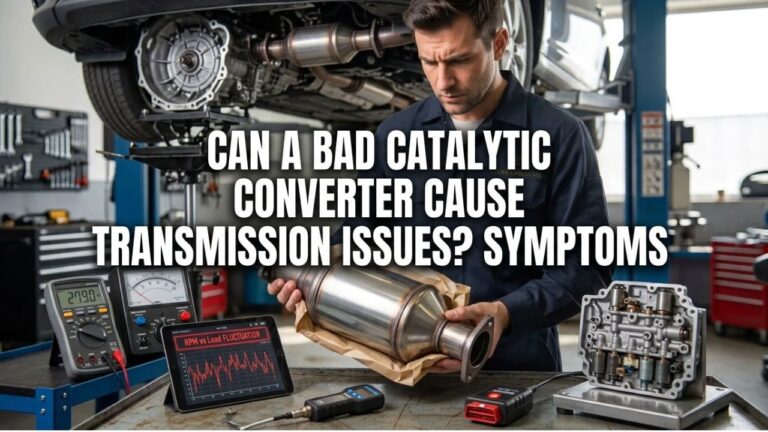
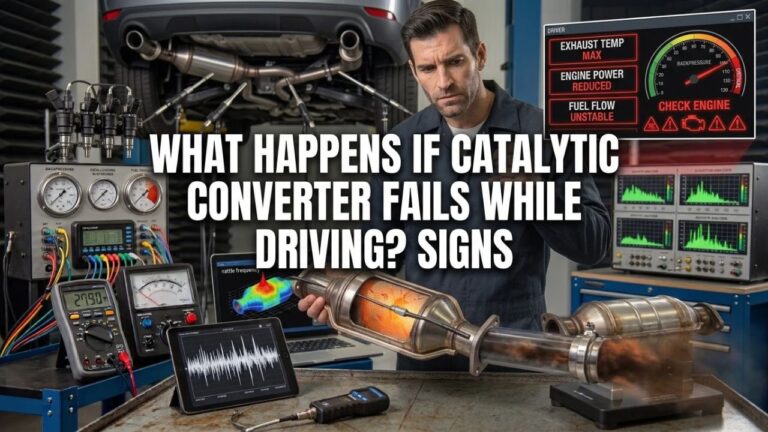
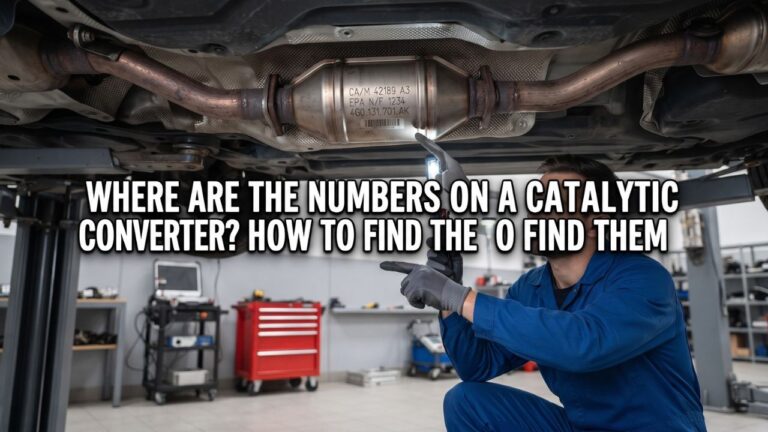
Can a Clogged Catalytic Converter Cause Overheating? Symptoms
Yes, a severely clogged converter can contribute to engine overheating. A blockage restricts exhaust flow, raises backpressure, traps extra heat upstream, and makes the engine work harder to expel burned gases. Mild catalyst failure usually will not raise coolant temperature; a physical exhaust restriction is the condition most likely to create a heat problem.
This distinction matters because a catalytic converter can fail in more than one way. It may lose its ability to control emissions while still flowing normally, or its internal honeycomb can melt, collapse, break apart, or become contaminated enough to restrict exhaust.
A true blockage often causes other problems before the temperature gauge reaches the hot zone. Sluggish acceleration, loss of power at higher RPM, hard starting, stalling, and unusually high exhaust heat make converter restriction more likely than overheating alone.
Catalytic converters naturally operate at very high temperatures. Walker states that a properly running converter typically stays below about 1,200°F, while prolonged temperatures above roughly 1,600°F can damage the catalyst coating. Melted substrate and damaged internal matting commonly occur around 1,700°F and above.
The answer to can a clogged catalytic converter cause overheating is therefore yes, but the converter should not automatically be blamed every time the coolant gauge rises. Low coolant, radiator-fan failure, thermostat trouble, a restricted radiator, water-pump problems, and internal engine faults are often more direct causes of coolant overheating.
I would pay close attention to how the vehicle behaves under load. A car that gets hot while also losing power on hills or refusing to rev freely gives a stronger case for exhaust restriction than a car that overheats at idle while still accelerating normally.
The sections below explain how a blockage creates heat, the symptoms that separate a clogged converter from a cooling-system fault, why converters become blocked, how restriction is tested, and when driving should stop.
Can a Clogged Catalytic Converter Cause Overheating?
Yes. A sufficiently restricted converter can raise engine and exhaust temperatures by making it harder for exhaust gases to leave the cylinders.
The engine relies on a clear exhaust path after combustion. When the converter becomes blocked, pressure builds upstream and the piston has to push against greater resistance during the exhaust stroke.
Exhaust Backpressure Rises
Exhaust backpressure is pressure resisting the movement of exhaust gases out of the engine.
Some backpressure exists in any exhaust system, but excessive pressure indicates a restriction.
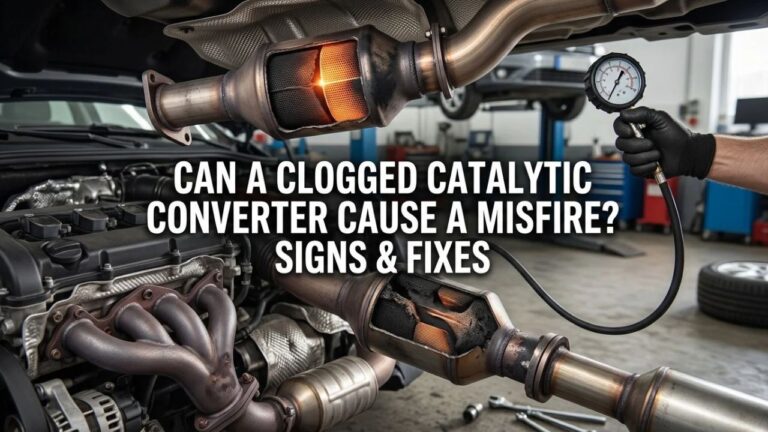
Walker gives a general diagnostic reference of less than about 1.5 psi at idle and 3 psi at 2,000 RPM, while stating that exact limits vary by application. High pressure ahead of the converter points toward a restricted converter, while high pressure farther downstream can indicate a blocked muffler or resonator.
A blocked converter can therefore act like a bottleneck in the exhaust.
Hot Exhaust Cannot Leave Freely
Exhaust gases carry heat away from the combustion chambers.
If the converter creates a severe restriction, exhaust evacuation becomes harder. More residual exhaust may remain in the cylinders, and temperatures can increase in the exhaust manifold, cylinder head, and surrounding components.
The engine also has to use more of its own output to push gases past the blockage.
That added load is one reason a badly plugged exhaust can produce both poor performance and excess heat.
The Problem Often Gets Worse Under Load
A minor restriction may not produce dramatic symptoms at idle.
Pressing the accelerator changes the situation. Higher engine load creates greater exhaust flow, which forces more gas toward the same restricted passage.
Symptoms may become much stronger during:
- Highway acceleration
- Steep hills
- Higher RPM
- Heavy loads
- Towing
- Long periods of driving
A car may idle reasonably well but feel badly restricted once road speed and engine load rise.
Key Takeaway: A severe converter blockage increases exhaust backpressure and retains heat upstream. Overheating becomes more plausible when rising temperature appears together with major loss of power under load.
Why a Catalytic Converter Becomes Clogged
Catalytic converters do not normally plug up just from processing ordinary exhaust.
A blockage often develops after another engine fault damages or contaminates the internal substrate.
Misfires Can Melt the Converter
A misfire leaves some of the air-fuel mixture unburned inside the cylinder.
That unburned fuel can enter the exhaust and reach the converter. Once inside the hot catalyst, it can burn and create temperatures much higher than the converter sees during normal engine operation.
EPA material on catalyst operation states that ignition misfires can send enough unburned fuel into a converter to raise its temperature sharply and cause permanent catalyst damage.
Repeated overheating can melt portions of the internal honeycomb.
Once melted material collapses across exhaust passages, the converter can change from an emissions problem into a physical blockage.
A Rich Fuel Mixture Can Cause Similar Damage
An engine running excessively rich receives more fuel than it can burn properly.
Extra fuel may enter the exhaust and burn inside the converter.
Possible reasons include:
- Leaking fuel injector
- Incorrect fuel pressure
- Faulty airflow measurement
- Ignition problems
- Sensor faults
- Other fuel-control problems
Walker identifies rich operation and misfires among conditions that can push converter temperature high enough to damage or melt the substrate.
Oil Can Contaminate the Honeycomb
An engine that burns large amounts of oil sends oil-derived deposits through the exhaust.
These deposits can coat the catalyst and small passages inside the converter.
Oil consumption may come from worn piston rings, valve seals, turbocharger problems, or another engine fault.
Simply installing another converter without correcting heavy oil consumption can expose the replacement to the same contamination.
Coolant Can Damage the Catalyst
Coolant entering the combustion chambers can also reach the exhaust.
A failed head gasket, cracked cylinder head, or another internal coolant leak may contaminate the converter.
This creates an added diagnostic complication: the same engine fault may be responsible for coolant loss, overheating, and converter contamination.
The Substrate Can Break Apart
The ceramic structure inside a converter can also break from:
- Road impacts
- Extreme heat
- Age
- Severe vibration
- Previous thermal damage
Loose material may rattle inside the shell.
A broken section can rotate or shift and partially cover the exhaust outlet, causing an intermittent restriction.
Key Takeaway: Misfires, rich operation, oil burning, coolant contamination, and physical damage can destroy the internal converter structure. Repairing the original fault matters before a replacement converter is installed.
Signs a Clogged Converter Is Causing the Heat Problem
Engine overheating by itself does not identify an exhaust blockage.
Look for a group of symptoms that points toward restricted exhaust flow.
Severe Loss of Acceleration
Poor acceleration is one of the strongest clues.
AutoZone lists reduced acceleration and engine performance among the common symptoms of a clogged converter because exhaust cannot flow through the restricted substrate normally.
The vehicle may feel acceptable at low throttle but lose much of its power during hard acceleration.
The Engine Struggles at Higher RPM
A restricted engine may rev to a certain point and then struggle to go higher.
More RPM produces more exhaust volume. The restriction becomes a greater obstacle as flow demand increases.
This pattern can feel as though the engine is being held back.
Fuel-delivery, ignition, turbocharger, airflow, and transmission faults can create similar complaints, so the symptom needs testing rather than guesswork.
Hard Starting or Stalling
A very severe blockage can prevent exhaust from leaving fast enough for the engine to keep running.
The engine may:
- Take longer to start
- Start and die
- Stall after running briefly
- Idle poorly
- Refuse to rev normally
AutoZone also identifies hard starting and stalling as possible signs of a severely clogged converter.
Excessive Heat Under the Vehicle
A converter normally gets hot.
Extreme heat, discoloration, scorching, or a converter glowing red is different.
A glowing converter may indicate internal overheating, but it does not prove that clogging caused the heat. An active misfire or rich mixture can make the converter extremely hot even before it becomes blocked.
Rotten-Egg Smell
A sulfur-like or rotten-egg odor may occur with catalyst and fuel-control problems.
Do not diagnose a clogged converter from smell alone.
Fuel composition and rich operation can also affect exhaust odor.
Poor Fuel Economy
Restricted exhaust can force the engine to work harder.
The driver may press the accelerator farther to produce the same road speed, causing fuel consumption to rise.
Poor gas mileage can also be caused by the rich mixture or misfire that damaged the converter, so fuel economy needs to be interpreted with the rest of the symptoms.
Check-Engine Light
A converter problem can trigger:
- P0420
- P0430
These codes indicate catalyst-system efficiency below the expected threshold.
They do not prove that the converter is physically blocked.
A converter can set an efficiency code and still flow exhaust normally.
Key Takeaway: A clogged converter becomes more likely when overheating occurs with power loss, restricted RPM, hard starting, stalling, abnormal exhaust heat, or poor fuel economy.
Clogged Converter vs Cooling-System Overheating
Cooling-system faults remain common reasons for a temperature gauge to rise.
Comparing symptoms can point the diagnosis in a more useful direction.
| Symptom | Clogged Converter More Likely | Cooling-System Fault More Likely |
| Major acceleration loss | Yes | Less typical |
| Engine cannot rev freely | Yes | Less typical |
| Hard starting with exhaust restriction | Yes | Less typical |
| Very high converter heat | Yes | Not a direct sign |
| Low coolant | No | Yes |
| Visible coolant leak | No | Yes |
| Radiator fan does not run | No | Yes |
| Overheats mainly while idling | Less typical | Often |
| Heater suddenly blows cold | Less typical | Often coolant-related |
| Power stays normal as temperature rises | Less likely | More likely |
| Overheating under heavy load plus major power loss | Possible | Possible |
Low Coolant
Low coolant reduces the cooling system’s ability to carry engine heat to the radiator.
A leak may come from:
- Radiator
- Hose
- Water pump
- Reservoir
- Heater system
- Head gasket
- Another sealed cooling-system connection
Check coolant only according to the vehicle manufacturer’s cold-engine procedure.
Never remove a pressurized radiator or expansion-tank cap from a hot cooling system.
Failed Thermostat
A thermostat controls coolant flow between the engine and radiator.
If it sticks closed, hot coolant may remain trapped in the engine instead of circulating through the radiator.
This can cause a rapid temperature rise without any exhaust restriction.
Radiator-Fan Failure
Electric cooling fans become very important when the vehicle is stopped or moving slowly.
A car that overheats in traffic but cools once highway airflow increases may have a fan, relay, fuse, wiring, temperature-sensor, or fan-control problem.
That pattern points much more strongly toward cooling airflow than a catalytic converter.
Restricted Radiator
Internal deposits can reduce coolant flow through the radiator.
External blockage from debris can also reduce airflow across the fins.
The engine can then run hot even though exhaust flow remains normal.
Water-Pump Problems
A worn, damaged, or slipping water pump may fail to circulate enough coolant.
Some pumps can also leak through their shaft seal or housing.
Internal Engine Problems
A head-gasket failure or cracked cylinder head can force combustion gases into the cooling system.
Possible clues include:
- Repeated coolant loss
- Rapid cooling-system pressure
- Bubbles in the reservoir
- White exhaust smoke in some cases
- Coolant contamination
- Repeated overheating
A converter replacement will not correct those faults.
Key Takeaway: Overheating with normal engine power points more strongly toward the cooling system. Overheating combined with severe high-load power loss makes exhaust restriction more worthy of testing.
Can the Catalytic Converter Overheat Without the Engine Overheating?
Yes.
This difference is easy to miss.
The converter can become extremely hot while engine coolant remains within its normal temperature range.
Misfire Can Superheat the Converter
If an ignition fault sends unburned fuel into the exhaust, that fuel can oxidize inside the catalyst.
The Texas Commission on Environmental Quality states that converter surfaces may approach 800–1,000°F under very high engine loads, while ignition faults can push converter and downstream exhaust temperatures to roughly 1,200–1,400°F.
The dashboard coolant gauge may still remain normal during part of this event.
A Glowing Converter Is a Serious Warning
A converter glowing red or orange should not be treated as normal.
Possible causes include:
- Severe misfire
- Excessively rich mixture
- Internal restriction
- Air-fuel control fault
Do not keep driving to see if it clears itself.
Continued heat can destroy the substrate, damage nearby components, and increase fire risk around combustible material.
Converter Heat and Coolant Heat Are Measured Differently
The dashboard temperature gauge generally represents engine-coolant temperature.
It does not measure catalytic-converter shell temperature.
That means:
Hot converter ≠ automatic coolant overheating
and
High coolant temperature ≠ automatic converter failure
Each system needs to be diagnosed on its own evidence.
Key Takeaway: A converter can become dangerously hot without moving the coolant gauge. A glowing converter often points toward misfire or rich operation and needs prompt diagnosis.
How to Test for a Clogged Catalytic Converter
Do not replace an expensive converter from symptoms alone.
Several tests can provide much stronger evidence.
Scan for Trouble Codes
Use an OBD-II scanner to check stored and pending codes.
Look beyond P0420 and P0430.
Codes related to these areas may reveal why the converter failed:
- Misfires
- Fuel trim
- Oxygen sensors
- Airflow
- Fuel mixture
- Coolant temperature
Fixing an upstream engine fault may be required before installing a new converter.
Test Exhaust Backpressure
An exhaust backpressure test is one of the more direct ways to confirm a restriction.
A pressure gauge can be installed at an upstream oxygen-sensor port or another suitable test point.
Walker gives general reference readings below about:
- 1.5 psi at idle
- 3 psi at 2,000 RPM
Vehicle-specific specifications take priority.
Pressure testing at more than one location can help separate a blocked converter from a restricted muffler or another exhaust component.
Check Engine Vacuum
A vacuum gauge can provide another clue.
With some exhaust blockages, intake-manifold vacuum starts normally but falls as the engine is held at elevated RPM.
Vacuum readings can also be affected by valve timing, leaks, engine wear, and other faults, so this test works best as part of a larger diagnosis.
Inspect for Heat Damage
Look for:
- Blue or bronze discoloration
- Scorched surroundings
- Dented converter shell
- Rattling substrate
- Signs of impact damage
Walker notes that a bronze/blue rainbow color on the shell can indicate excessive temperature and that melted internal passages may not be obvious from looking only at either end of the substrate.
Temperature Testing Has Limits
An infrared thermometer can compare converter inlet and outlet temperatures.
Temperature alone should not be used as the final proof of a blockage because catalyst activity, engine load, mixture, ambient temperature, and test conditions all change the readings.
For suspected clogging, pressure testing gives more direct evidence of exhaust restriction.
Key Takeaway: OBD data, exhaust-backpressure measurement, vacuum behavior, and physical inspection provide a much stronger diagnosis than replacing the converter based on heat or a catalyst code alone.
Can You Drive With a Clogged Catalytic Converter?
A vehicle with a minor catalyst-efficiency fault may still drive normally.
A severely restricted converter is different.
Stop driving if the vehicle shows:
- Temperature gauge entering the hot zone
- Red temperature warning
- Severe loss of power
- Repeated stalling
- Glowing converter
- Smoke beneath the vehicle
- Strong active misfire
- Flashing check-engine light
The combination of overheating and restricted exhaust can place extra thermal stress on the engine and exhaust components.
A flashing check-engine light also deserves quick attention because EPA OBD guidance associates flashing with a severe misfire capable of damaging the catalytic converter in a short period.
If the engine itself is overheating, safely stop and shut it down rather than continuing to drive until the gauge reaches the red zone.
Will Cleaning a Clogged Catalytic Converter Stop Overheating?
It depends on what is causing the restriction, but a physically melted converter cannot be restored with a cleaner.
Light Deposits Are Different From Melted Substrate
Some products are marketed for reducing deposits in the fuel and exhaust system.
They cannot repair:
- Melted ceramic
- Collapsed honeycomb
- Broken substrate
- Severe physical blockage
AutoZone notes that a converter already badly clogged commonly needs replacement rather than relying on attempts to clean the internal structure.
Fix the Root Cause First
Before a replacement converter is installed, diagnose conditions such as:
- Misfire
- Rich mixture
- Oil burning
- Coolant entering the cylinders
- Fuel-injector faults
- Ignition problems
Skipping this step can damage the replacement converter.
Cooling-System Problems Still Need Their Own Repair
If testing confirms both a converter restriction and a cooling-system fault, both problems need attention.
Replacing a clogged converter will not repair a leaking radiator or stuck thermostat.
Replacing a thermostat will not open a melted converter.
Treat each confirmed fault separately.
Key Takeaway: Chemical cleaning cannot rebuild melted or collapsed converter material. Confirm the restriction, repair the fault that damaged the converter, and replace the converter when its internal structure has failed.
Conclusion
Yes, can a clogged catalytic converter cause overheating has a qualified but clear answer: a severe restriction can increase exhaust backpressure, retain heat upstream, make the engine work harder, and contribute to rising engine temperature.
Look for accompanying symptoms before blaming the converter. Weak acceleration, poor high-RPM power, hard starting, stalling, abnormal converter heat, and high exhaust backpressure make a blockage much more convincing.
If the engine overheats while performance remains normal, I would check coolant level, radiator fans, thermostat operation, radiator flow, water-pump condition, and internal engine problems before purchasing a catalytic converter.
Do not keep driving a vehicle with a rising temperature gauge, glowing converter, severe misfire, or major power loss. Confirm the root cause first, then repair both the failed converter and any engine problem that caused the damage.
FAQs About a Clogged Catalytic Converter and Overheating
How Does a Clogged Catalytic Converter Make an Engine Overheat?
A blockage restricts exhaust flow and raises pressure upstream of the converter.
The engine has to work harder to push exhaust gases out, and heat can remain concentrated around the engine and exhaust manifold. A severe restriction can add enough thermal load to contribute to engine overheating.
Can a Clogged Catalytic Converter Cause Overheating at Idle?
It can if the blockage is severe, but overheating mainly at idle more often points toward a cooling-fan or coolant-flow problem.
If the temperature drops once the vehicle starts moving, check radiator-fan operation and cooling-system condition before assuming exhaust restriction.
Can a Clogged Catalytic Converter Cause a Car to Run Hot on the Highway?
Yes. Highway speed creates higher exhaust flow, and a restriction may become more noticeable as engine load increases.
A vehicle with a clogged converter may run hot while also losing acceleration, struggling on hills, or refusing to reach higher RPM normally.
Does P0420 Mean the Catalytic Converter Is Clogged?
No.
P0420 indicates catalyst-system efficiency below the expected threshold. A converter can lose emissions-cleaning ability while still allowing exhaust gases to flow normally.
A backpressure test is much more useful when the specific concern is a physical blockage.
Can a Misfire Clog a Catalytic Converter?
Yes. A severe or prolonged misfire can send unburned fuel into the exhaust.
That fuel may burn inside the converter and raise its temperature enough to melt or damage the ceramic substrate. Melted material can collapse across the internal passages and restrict exhaust flow.
Can a Clogged Catalytic Converter Cause Coolant Loss?
Not directly. The converter does not normally connect to the engine cooling system.
If overheating becomes severe, coolant may boil or escape from another weak point, but repeated coolant loss should lead to a cooling-system and engine inspection rather than assuming the converter is the direct source.
Will a New Catalytic Converter Fix an Overheating Engine?
Only if a confirmed exhaust restriction is causing or contributing to the heat problem.
A new converter will not fix low coolant, a failed radiator fan, stuck thermostat, bad water pump, restricted radiator, or head-gasket trouble. Those faults need separate repair.
What Is the Best Test for a Clogged Catalytic Converter?
An exhaust-backpressure test is one of the strongest direct checks for restriction.
Pressure is measured upstream and, when needed, downstream of the converter. High pressure ahead of the converter supports a blockage, while the exact acceptable reading should come from service information for the vehicle being tested.