How Long Can You Drive With a Clogged Catalytic Converter Safely?
There is no safe number of miles or days you can count on with a restricted catalytic converter. A mildly restricted car may still reach a nearby repair shop, while a severe blockage can cause major power loss, stalling, excessive heat, or a no-start condition. If acceleration drops sharply or the converter overheats, stop driving.
A clogged converter blocks exhaust flow leaving the engine. As the restriction increases, exhaust backpressure rises and the engine has more trouble moving fresh air through the cylinders. What begins as sluggish acceleration can progress to poor high-RPM power, hard starting, overheating, or stalling.
Continuing to drive also risks making the restriction worse. Converter material can melt or break apart, and loose substrate can block exhaust passages. Walker Exhaust notes that excessive converter temperature can melt the internal substrate and turn it into a solid restriction that causes noticeable power loss.
For U.S. drivers, it is also worth checking warranty coverage before paying for a replacement. The EPA states that catalytic converters are among the major emission-control components covered for 8 years or 80,000 miles, whichever comes first, under the federal emissions warranty when applicable.
The answer to how long can you drive with a clogged catalytic converter therefore depends on the degree of restriction, not a fixed mileage figure. A car with mild loss of power may remain mobile for a short period, but a vehicle that struggles to accelerate, stalls, smells extremely hot, or has a glowing converter should not be treated as safe for continued driving.
A useful approach is to judge the situation from symptoms and testing rather than trying to stretch the car to a certain mileage. The sections below explain which symptoms mean you should stop, what happens if you keep driving, how clogging differs from a simple efficiency failure, and how a shop confirms that the converter is actually restricted.
How Long Can You Drive With a Clogged Catalytic Converter?
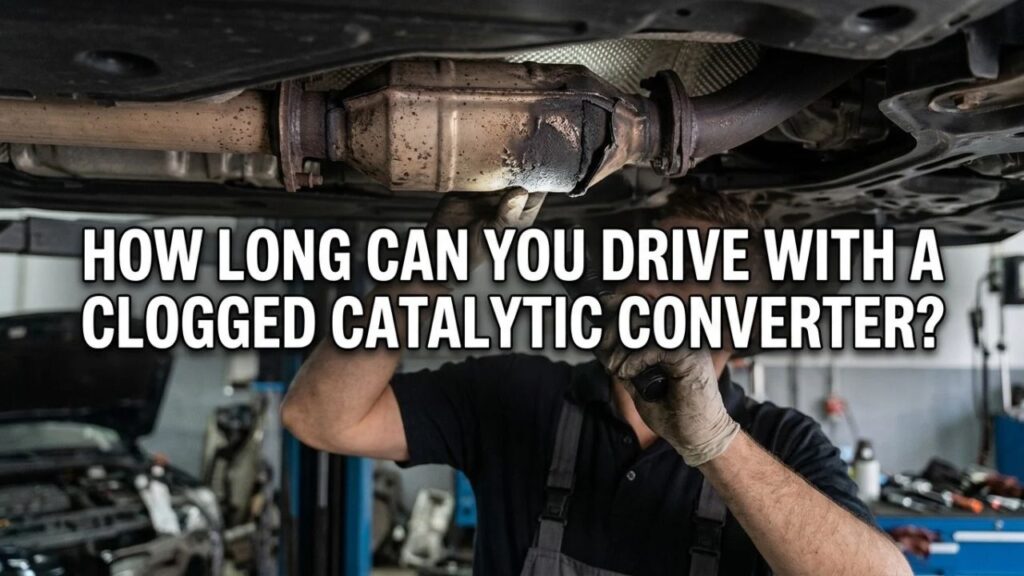
There is no dependable mileage limit.
A partially restricted converter may still allow the car to drive around town, while a nearly blocked converter can make the engine stall or refuse to rev within a very short distance. AutoZone notes that severe restriction can cause hard starting, poor acceleration, stalling, excessive heat, and other driveability problems.
A practical way to judge urgency is:
| What the car is doing | Driving recommendation |
| Slight power loss, no overheating, no stalling | Drive only as needed to arrange diagnosis |
| Noticeably weak acceleration | Avoid unnecessary driving |
| Power drops badly at higher RPM | Have it inspected promptly |
| Repeated stalling | Stop normal driving |
| Converter or exhaust glows red | Shut the vehicle off safely |
| Strong burning smell or extreme underbody heat | Stop driving |
| Flashing check engine light with misfire | Reduce driving immediately and repair the misfire |
| Engine cannot rev or restart normally | Tow the vehicle |
The difference between a mild restriction and a severe blockage can change quickly if the converter’s internal material continues to melt or break apart.
Mild Restriction
A mild restriction may first show up as slower acceleration or a feeling that the engine cannot breathe freely at higher speeds.
The car may still idle normally and feel acceptable under light throttle.
That does not mean the converter can be ignored for weeks or months. Schedule diagnosis before the restriction progresses or the fault causing the converter damage creates another problem.
Moderate Restriction
As blockage increases, the engine may struggle under load.
Common examples include:
- Trouble climbing hills
- Weak highway acceleration
- Poor response above a certain RPM
- Increased fuel consumption
- Excess heat from the exhaust
- Harder starting
At this point, I would avoid using the vehicle for long trips, towing, heavy loads, or highway driving until the exhaust restriction is checked.
Severe Restriction
A severely clogged converter can prevent exhaust gases from leaving the cylinders fast enough.
The engine may:
- Stall
- Refuse to accelerate
- Start and then shut off
- Run very roughly
- Overheat
- Fail to restart
MagnaFlow states that severe exhaust restriction can interfere directly with engine operation and may create a hard-start or no-start condition.
Key Takeaway: A mild restriction may allow a short trip for diagnosis, but severe power loss, stalling, overheating, or a glowing converter means continued driving should stop.
Why a Clogged Catalytic Converter Makes the Car Lose Power
Exhaust Cannot Escape Fast Enough
An engine works by drawing air in, burning fuel, and pushing exhaust gases out.
If the converter becomes blocked, exhaust cannot leave at the normal rate. Pressure builds upstream of the restriction.
That pressure makes it harder for each cylinder to clear exhaust before the next combustion cycle.
Power Loss Is Often Worse Under Load
At idle, the engine produces relatively little exhaust.
Under acceleration, engine speed and airflow rise sharply. A restriction that seems minor at idle can become much more obvious when you press the accelerator.
This is why a clogged converter can produce:
- Normal or nearly normal idle
- Acceptable low-speed driving
- Weak acceleration
- Poor high-RPM power
- Trouble maintaining highway speed
Backpressure Can Be Measured
A repair shop may test exhaust backpressure through an oxygen-sensor port or another approved test point.
Walker notes that high backpressure ahead of the converter points toward a restricted converter and gives typical reference figures of less than about 1 psi at idle and 3 psi at 2,500 RPM on many applications. Vehicle-specific specifications still take priority.
That type of measurement is much stronger evidence than simply replacing the converter because the car feels slow.
Key Takeaway: A clogged converter reduces engine power because exhaust backpressure prevents the cylinders from clearing gases normally, and the problem becomes more noticeable as engine load rises.
What Happens If You Keep Driving With a Clogged Converter?
The Blockage Can Become Worse
A converter may become restricted when its internal ceramic structure melts, collapses, or breaks apart.
If the engine continues producing the condition that damaged the converter, more substrate can melt and reduce exhaust flow further.
A vehicle that still drives today may become far harder to drive later.
Heat Can Build Up
A converter runs hot during normal operation, but abnormal fuel burning or severe restriction can raise temperatures much further.
Walker states that properly operating converters typically remain below about 1,200°F, while repeated operation over roughly 1,600°F can damage the catalyst coating and temperatures above about 1,700°F can melt or damage the substrate.
Those figures are diagnostic references, not temperatures a driver should attempt to measure underneath a running vehicle.
If the converter housing is glowing red, shut the vehicle off in a safe location away from dry grass, fuel, or other combustible material.
Engine Performance Can Continue to Decline
Restricted exhaust flow can lead to:
- Slower acceleration
- Poor fuel economy
- Rough running
- Stalling
- Hard starting
- Reduced maximum RPM
The engine may feel as if it is running out of air even though the intake system is open.
The Root Cause May Still Be Damaging the Converter
Converters often become clogged after another fault creates excess heat or contamination.
Common causes include:
- Repeated misfires
- Rich fuel mixture
- Burning engine oil
- Coolant entering the cylinders
- Broken converter substrate
- Debris from an upstream converter
Walker states that misfires and rich-running conditions can overheat a converter enough to melt its internal material, while oil or coolant can contaminate the catalyst.
Replacing the converter without correcting that cause can lead to another failed converter.
Key Takeaway: Continued driving can turn a partial restriction into a severe blockage, raise exhaust temperatures, reduce engine power, and damage a replacement converter if the original engine fault remains.
Stop Driving If You Notice These Symptoms
Some converter symptoms justify much faster action than a simple check engine light.
Severe Loss of Acceleration
If the car cannot keep up with traffic or struggles to climb a mild hill, the restriction may already be substantial.
A vehicle that cannot accelerate normally can also create a traffic hazard when merging or crossing an intersection.
Repeated Stalling
A badly blocked exhaust can interfere with engine operation enough to cause stalling.
If the engine repeatedly stalls and becomes hard to restart, driving farther is a poor choice.
Glowing Converter
A converter that glows red or orange is abnormally hot.
Excess fuel from a misfire or rich mixture can burn inside the converter, raising temperatures enough to damage its substrate.
Do not reach under the car or touch the exhaust to investigate.
Flashing Check Engine Light
A flashing check engine light commonly points to a severe misfire.
Unburned fuel from a misfiring cylinder can enter the converter and burn there, creating enough heat to melt the internal structure.
If the light is flashing and the engine is shaking or misfiring, address that fault before worrying about how many miles remain.
Burning Smell or Excessive Floor Heat
Strong heat under the floor or a burning odor can indicate an overheated exhaust system.
Park safely and inspect the vehicle rather than continuing a long trip.
Key Takeaway: Severe power loss, repeated stalling, a glowing converter, a flashing check engine light, or extreme exhaust heat are stop-driving symptoms rather than wait-and-see symptoms.
Clogged Converter vs Bad Converter: They Are Not Always the Same
A catalytic converter can fail in more than one way.
Efficiency Failure
A converter may lose its ability to process exhaust pollutants while exhaust flow remains fairly normal.
This often produces:
- P0420
- P0430
- Check engine light
- Failed emissions inspection
- Few noticeable driving symptoms
A vehicle with only an efficiency code may still drive normally.
Physical Restriction
A clogged converter physically blocks exhaust flow.
This more often produces:
- Weak acceleration
- High-RPM power loss
- Hard starting
- Stalling
- Excessive heat
- High exhaust backpressure
The distinction matters because P0420 is not a direct “converter clogged” code.
A car can have a severe restriction without immediately setting P0420, and a car can have P0420 without a major exhaust blockage.
Broken Substrate
The ceramic material inside the converter can also crack or break.
Loose pieces may rattle inside the housing and shift position. A fragment can sometimes move into a position that blocks flow intermittently.
That can make symptoms appear and disappear as the vehicle is driven.
Key Takeaway: An inefficient converter mainly causes emissions problems, while a clogged converter creates a physical exhaust restriction that can directly affect engine operation.
Can a Clogged Catalytic Converter Damage the Engine?
A restricted exhaust can place abnormal operating stress on the engine.
The most immediate effects are poor breathing, loss of power, higher exhaust pressure, and excess heat.
A severe restriction can also contribute to poor combustion and difficult starting.
The bigger concern is often the fault that caused the converter to clog in the first place. A strong misfire, rich mixture, oil consumption, or coolant leak can damage the converter and create separate engine problems at the same time.
Do not assume that replacing the converter repairs the engine fault.
A proper diagnosis should determine:
- Why the converter became restricted
- How severe the restriction is
- If the engine has misfire codes
- If fuel trims are abnormal
- If the engine burns oil
- If coolant is entering the cylinders
- If another exhaust component is blocked
How to Confirm a Catalytic Converter Is Clogged
Scan for Trouble Codes
Start with an OBD-II scan.
Look for:
- P0420
- P0430
- P0300-series misfire codes
- Rich or lean mixture codes
- Oxygen-sensor faults
- Fuel-system faults
A catalyst-efficiency code alone does not confirm restriction.
Check Exhaust Backpressure
Backpressure testing is one of the more direct ways to identify an exhaust blockage.
Pressure can be measured at different points in the exhaust to narrow down where the restriction sits.
High pressure before the converter with lower pressure after it points toward a clogged converter.
Check Engine Vacuum
A vacuum test can also reveal signs of exhaust restriction.
Walker describes a pattern where vacuum drops substantially as engine speed is held higher when a blockage is present.
Vacuum readings can also be affected by ignition timing, valve timing, and other engine conditions, so this test is usually interpreted with other evidence.
Inspect Converter Condition
Physical clues can include:
- Rattling substrate
- Heat discoloration
- Visible shell damage
- Melted internal passages
- Broken material inside the converter
Do not strike a hot converter or crawl beneath an unsupported vehicle.
Check the Cause Before Installing a New One
This step is easy to skip.
If the engine has an active misfire, rich mixture, oil-burning problem, or coolant leak, correct it before installing another converter.
A new converter exposed to the same fault may fail again.
Key Takeaway: Trouble codes, backpressure testing, vacuum behavior, physical inspection, and engine-condition checks together provide a much stronger diagnosis than symptoms alone.
Can a Clogged Catalytic Converter Be Cleaned?
A severely melted or collapsed converter cannot be restored with a fuel additive.
If the ceramic substrate has physically melted into a solid mass or broken apart, the damaged structure remains inside the housing.
Some products are sold as catalytic-converter cleaners, but they cannot rebuild:
- Melted ceramic
- Broken substrate
- Collapsed passages
- Missing catalyst material
If deposits are minor and the converter structure is intact, correcting the engine fault may prevent further buildup.
A confirmed physical blockage usually leads to converter replacement.
Do not remove the converter, hollow it out, or replace it with straight pipe for a road vehicle. EPA guidance treats removing or bypassing required emissions equipment as tampering under federal law.
Should You Drive to a Repair Shop or Have the Car Towed?
A short drive to a nearby repair shop may be reasonable if:
- The engine runs smoothly
- Acceleration is only mildly reduced
- There is no flashing check engine light
- The converter is not glowing
- There is no severe burning smell
- The engine is not overheating
- The vehicle is not stalling
Towing is the safer option when:
- Power loss is severe
- The car cannot keep up with traffic
- The engine repeatedly stalls
- The converter glows
- The check engine light flashes
- The engine misfires badly
- Exhaust heat is extreme
- The car struggles to start or restart
I would choose towing over trying to predict how many more miles a severely restricted converter has left. Once exhaust flow is badly limited, there is no dependable way to know when the vehicle will become undrivable.
Check Warranty Coverage Before Paying for Replacement
Catalytic converters can be expensive, so U.S. owners should check the federal emissions warranty before approving the repair.
The EPA states that catalytic converters, the emissions-control computer, and the onboard diagnostic computer are specified major emission components covered for 8 years or 80,000 miles, whichever comes first, under applicable federal warranty rules.
Coverage depends on vehicle age, mileage, maintenance, failure circumstances, and warranty terms.
Check the owner’s warranty booklet and contact the manufacturer or dealer with the VIN if the vehicle may still qualify.
Conclusion
How long can you drive with a clogged catalytic converter has no safe mileage answer. A slight restriction may still allow a short trip for diagnosis, while a badly blocked converter can cause severe loss of power, stalling, overheating, or a no-start condition with little warning.
Watch the vehicle’s behavior rather than the odometer. Mild power loss calls for prompt diagnosis. Severe acceleration problems, repeated stalling, a flashing check engine light, extreme heat, or a glowing converter are reasons to stop driving.
I would repair the cause of the clog before installing another converter. Misfires, excess fuel, oil consumption, coolant contamination, and other engine faults can destroy the replacement if they remain unresolved.
FAQs About Driving With a Clogged Catalytic Converter
Can I Drive 100 Miles With a Clogged Catalytic Converter?
There is no way to promise that 100 miles is safe. A mildly restricted converter may allow the trip, while a severe blockage can cause stalling or major power loss much sooner. If acceleration is noticeably weak, arrange repair locally rather than planning a long drive.
Can a Clogged Catalytic Converter Cause the Car to Stop Running?
Yes. A severe exhaust restriction can prevent the engine from clearing exhaust gases normally. The vehicle may lose power, stall, become hard to start, or fail to restart until the restriction is addressed.
Can I Drive With a P0420 Code?
A P0420 code alone does not prove the converter is clogged. It indicates catalyst efficiency below the programmed threshold on Bank 1. If the car drives normally, the situation is different from a vehicle with severe exhaust restriction. Diagnose the cause before replacing parts.
Will a Clogged Catalytic Converter Get Worse?
It can. Melted or broken substrate may continue blocking exhaust flow, and an unresolved misfire or rich mixture can create more heat and damage. A mild restriction can progress into severe power loss or stalling.
Can a Clogged Converter Cause Engine Overheating?
A severe exhaust restriction and an overheated converter can contribute to abnormal engine and exhaust temperatures. If the vehicle is running hot, losing power, or producing extreme underbody heat, stop driving and have the problem diagnosed.
How Do I Know if My Catalytic Converter Is Fully Clogged?
A nearly complete blockage may cause severe acceleration loss, inability to reach normal RPM, stalling, hard starting, or a no-start condition. Backpressure testing is one of the better ways to confirm that exhaust flow is physically restricted.
Can a Clogged Catalytic Converter Clear Itself?
A physically melted or collapsed substrate will not repair itself. Minor deposits are different, but a confirmed structural blockage normally requires replacement after the fault that caused the damage has been corrected.
Is It Better to Tow a Car With a Clogged Catalytic Converter?
Tow the car if it has major power loss, repeated stalling, a flashing check engine light, severe misfire, extreme exhaust heat, or a glowing converter. Those symptoms indicate a much higher-risk situation than a mild restriction with normal engine operation.