Do All Cars Have a Catalytic Converter? Exceptions Explained
No, not every car has a catalytic converter. Most modern gasoline cars and gasoline-electric hybrids use one or more catalytic converters to reduce harmful exhaust emissions. Battery-electric cars do not need them because they have no combustion engine or exhaust pipe, while many older vehicles built before catalytic converters became common also lack them.
The confusion comes from how common converters have become. If you look underneath almost any modern gasoline-powered passenger car in the United States, some form of catalytic exhaust treatment is likely to be present. That does not make the part universal across every age and powertrain.
The distinction matters for repairs, theft concerns, emissions testing, and buying exhaust parts. A hybrid may still have a converter even though an electric motor moves the car part of the time, while a fully electric vehicle has no exhaust converter at all.
EPA records show that catalytic converters became widely used on U.S. vehicles beginning with the 1975 model year as manufacturers worked to meet tighter hydrocarbon and carbon-monoxide standards. EPA also says most 1975-and-newer passenger cars and light-duty trucks were fitted with converters.
The short answer to do all cars have a catalytic converter is therefore no. Most modern combustion-powered passenger cars do, full battery-electric vehicles do not, and older cars can fall on either side depending on model year and original emissions equipment.
I would check the vehicle’s powertrain and model year first if there is any doubt. Those two details usually narrow the answer quickly, though diesel aftertreatment and older emissions systems can require a closer look.
The sections below explain which gasoline, diesel, hybrid, electric, and older cars use catalytic converters, why some vehicles have several converters, where to find them, and how to confirm what your specific car has.
Do All Cars Have a Catalytic Converter Today?
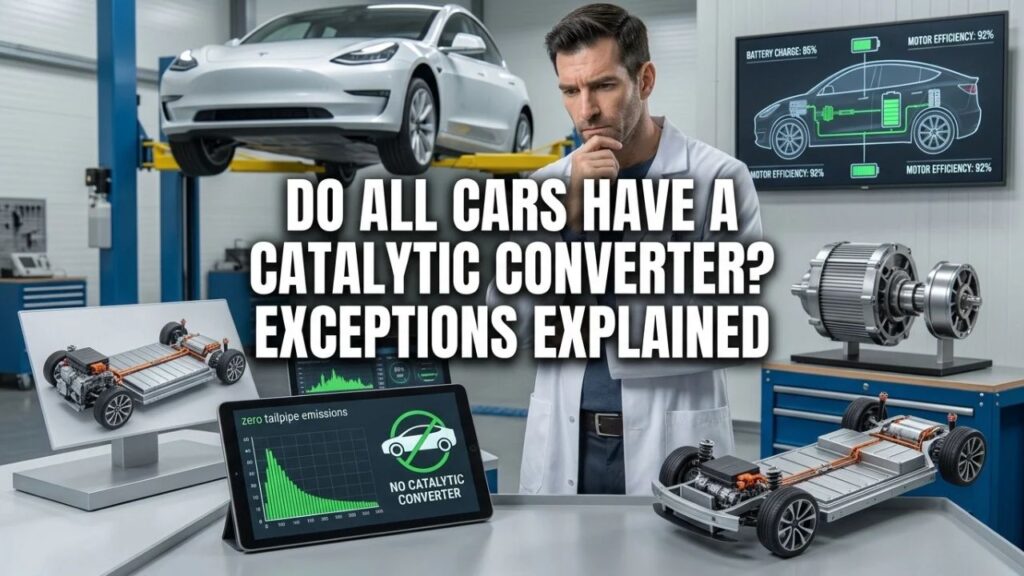
No. Modern cars use several different powertrains, and only vehicles that produce combustion exhaust need exhaust-emissions treatment.
Most gasoline-powered vehicles have a catalytic converter. Many diesel vehicles use catalysts too, though the diesel exhaust system can look quite different from a gasoline setup.
Battery-electric vehicles are the clear exception because they do not burn gasoline or diesel.
Modern Gasoline Cars
Almost every modern gasoline passenger car sold for normal road use in the United States uses at least one catalytic converter.
A gasoline engine produces pollutants including:
- Carbon monoxide
- Unburned hydrocarbons
- Oxides of nitrogen
A modern three-way catalytic converter helps transform these pollutants into less harmful gases through chemical reactions inside the catalyst.
EPA notes that sophisticated three-way catalysts, oxygen sensors, and electronic engine controls became common on new cars in the early 1980s.
Modern gasoline engines rely heavily on precise fuel control because the catalyst works best when the air-fuel mixture stays close to its intended range.
Battery-Electric Cars
A battery-electric vehicle does not use a conventional catalytic converter.
There is no gasoline or diesel engine producing combustion exhaust, so there is no exhaust stream that needs to pass through a converter.
EPA states that electric vehicles have no tailpipe emissions and do not even require a conventional tailpipe.
Examples include battery-only versions of vehicles from Tesla, Rivian, Lucid, Nissan, Hyundai, Kia, Chevrolet, Ford, and other manufacturers.
An EV may use catalysts in unrelated chemical or manufacturing processes, but it does not have the exhaust-system catalytic converter people normally mean when discussing cars.
Hybrid Cars
Gasoline-electric hybrids normally do have catalytic converters.
A hybrid such as a Toyota Prius can drive on electric power under some conditions, but its gasoline engine still runs during other parts of the trip.
Whenever the engine burns fuel, it creates exhaust gases that need emissions treatment.
The same principle applies to most conventional hybrids:
- Toyota Prius
- Toyota Camry Hybrid
- Honda Accord Hybrid
- Hyundai Sonata Hybrid
- Ford Escape Hybrid
The electric motor does not eliminate the catalytic converter because the car still has an internal-combustion engine.
Plug-In Hybrids
Plug-in hybrid electric vehicles generally use catalytic converters too.
A PHEV may cover short trips entirely on battery power when charged, but it also carries a combustion engine for longer trips or higher-load conditions.
EPA notes that plug-in hybrids produce tailpipe emissions when gasoline is being used as fuel.
As soon as the combustion engine is part of the drivetrain, exhaust-treatment hardware remains necessary.
Key Takeaway: Most modern gasoline cars, hybrids, and plug-in hybrids use catalytic converters. Battery-electric cars do not because they produce no combustion exhaust.
Do Older Cars Have Catalytic Converters?
Many older cars do not, especially vehicles built before emissions regulations pushed catalytic converters into widespread use.
Cars Built Before 1975
Many U.S.-market passenger cars built before the 1975 model year left the factory without catalytic converters.
Those vehicles relied on older engine designs and emissions controls that did not use the catalyst systems common today.
Examples can include many classic American cars from the 1950s, 1960s, and early 1970s.
Do not use age alone as absolute proof. Some vehicles may have been modified, retrofitted, engine-swapped, or fitted with different exhaust equipment during restoration.
Why 1975 Is Commonly Mentioned
The 1975 model year marked the widespread introduction of catalytic converters in the United States.
EPA’s historical records state that the first catalytic converters appeared in 1975 as automakers responded to federal hydrocarbon and carbon-monoxide emissions requirements.
EPA documentation from the period estimated that more than 70% of 1975 model cars would use catalysts. That detail is useful because it shows why saying “every car after 1974 had one” is too broad.
Catalytic converters became much more widespread as emissions standards tightened further.
Cars From the Late 1970s and 1980s
Converter use increased rapidly during this period.
Early systems often used a two-way oxidation catalyst that targeted hydrocarbons and carbon monoxide.
By the early 1980s, three-way systems capable of reducing nitrogen oxides as well became common on new gasoline cars. Electronic fuel control and oxygen sensors helped those converters operate correctly.
A classic vehicle from this era needs model-specific checking because exhaust technology changed quickly from one model year to the next.
Key Takeaway: Many cars built before 1975 have no catalytic converter. Converter use expanded sharply during the mid-to-late 1970s and became standard on most modern gasoline cars.
Do Diesel Cars Have Catalytic Converters?
Many diesel vehicles use catalytic technology, but the exhaust system differs from a gasoline car.
Modern diesels often combine several aftertreatment devices rather than relying on one conventional three-way converter.
Diesel Oxidation Catalyst
A diesel oxidation catalyst, commonly called a DOC, performs a catalytic function in diesel exhaust.
EPA describes DOCs as precious-metal-coated flow-through honeycomb devices that reduce emissions from diesel engines.
A DOC can reduce pollutants such as carbon monoxide and hydrocarbons.
In simple terms, it is a type of catalytic converter, though it works in a different emissions environment from a gasoline three-way catalyst.
Diesel Particulate Filter
Many modern diesels also use a diesel particulate filter, or DPF.
The DPF is not the same thing as a conventional catalytic converter. Its main job is to capture soot particles from diesel exhaust.
EPA explains that DPF systems trap particulate matter and periodically burn accumulated material during regeneration.
Some DPFs have catalytic coatings, which can make the distinction less obvious when looking at the complete aftertreatment assembly.
Selective Catalytic Reduction
Many newer diesels also use selective catalytic reduction, or SCR.
SCR uses diesel exhaust fluid to support chemical reactions that reduce nitrogen-oxide emissions.
EPA identifies SCR as another catalyst-based exhaust technology used in diesel systems.
A modern diesel exhaust may therefore include several components:
DOC → DPF → SCR → additional catalyst or sensor stages
The exact layout changes by manufacturer and model.
Older Diesel Cars
Older diesel vehicles may not have all of these systems.
Some early diesel cars lacked a catalytic converter entirely, while later designs added oxidation catalysts before DPF and SCR systems became common.
The year alone does not provide a reliable answer for every diesel vehicle. Check the emissions label or service information for the exact engine.
Key Takeaway: Many diesel cars use catalytic exhaust treatment, but their systems may include a DOC, DPF, SCR catalyst, or a combination rather than the familiar gasoline three-way converter.
Which Cars Do Not Have Catalytic Converters?
Several vehicle groups may legitimately have no conventional catalytic converter.
Full Battery-Electric Vehicles
This is the clearest category.
Battery EVs have:
- No gasoline engine
- No diesel engine
- No conventional exhaust system
- No exhaust catalytic converter
EPA confirms that battery-electric vehicles produce no tailpipe emissions.
That also means catalytic-converter theft is not a concern on a true battery EV.
Many Pre-1975 Cars
A large number of older gasoline cars built before widespread converter adoption have no catalytic converter from the factory.
Classic-car owners should still verify the specific model because emissions equipment changed rapidly during the 1970s.
Certain Older Diesel Vehicles
Older diesel engines can use very simple exhaust systems with no catalyst.
Later diesel emissions regulations drove the adoption of DOCs, particulate filters, and SCR systems.
Some Purpose-Built or Nonroad Vehicles
Not every machine with an engine follows passenger-car emissions architecture.
Agricultural equipment, construction equipment, racing vehicles, off-road machines, and specialty applications may use different exhaust controls based on their certification category and age.
That does not mean emissions equipment can legally be removed from a road car simply because a different class of machine lacks it.
Do Hydrogen Cars Have Catalytic Converters?
A hydrogen fuel-cell electric vehicle does not need the normal exhaust catalytic converter found on a gasoline car.
A fuel-cell vehicle creates electricity through an electrochemical reaction rather than burning gasoline in cylinders.
EPA states that hydrogen fuel-cell vehicles do not produce conventional tailpipe pollutants.
There is an important terminology detail.
Fuel cells themselves use catalytic materials to support their chemical reaction. That catalyst is not the same component as an automotive exhaust catalytic converter mounted underneath a gasoline car.
Hydrogen internal-combustion engines are a separate technology. Those engines actually burn hydrogen, so their emissions-control requirements can differ from fuel-cell vehicles.
Why Do Some Cars Have More Than One Catalytic Converter?
Finding two, three, or even more catalyst units does not necessarily mean parts have been added.
Manufacturers position catalysts based on engine layout, emissions requirements, warm-up needs, packaging, and exhaust routing.
V6 and V8 Engines
Engines with two cylinder banks may have separate exhaust paths.
Each bank can have its own converter close to the engine.
The two exhaust paths may later merge or remain separate farther underneath the vehicle.
That is why a V6 or V8 can have more than one catalytic converter.
Close-Coupled Catalysts
Modern vehicles often place a catalyst close to the exhaust manifold.
This close-coupled catalyst heats up quickly after a cold start.
A second underfloor catalyst may provide further emissions treatment downstream.
The result is a car with several catalyst bricks even though drivers may refer to all of them collectively as “the catalytic converter.”
Hybrid Exhaust Systems
Hybrid engines can switch off for extended periods, which may let exhaust components cool.
Manufacturers can use catalyst placement and thermal-management strategies to bring emissions hardware back into its working temperature range quickly when the engine restarts.
The exact number and layout differ by model.
Key Takeaway: Cars can have multiple converters because of V-engine exhaust layouts, emissions targets, and catalyst warm-up requirements. The number is vehicle-specific.
How to Tell If Your Car Has a Catalytic Converter
There are several reliable ways to check.
Look Under the Vehicle
On many vehicles, the converter sits between the exhaust manifold and muffler.
It usually looks like an enlarged metal chamber built into the exhaust pipe.
A common exhaust path looks something like:
Engine → Exhaust manifold → Catalytic converter → Resonator or muffler → Tailpipe
Modern designs are not always this simple.
Some converters sit high in the engine bay close to the exhaust manifold, making them difficult to see from underneath.
Check the Emissions Label
Open the hood and look for the vehicle emissions-control information label.
The label may identify the emissions family, certification, catalyst system, and other controls.
Abbreviations vary by manufacturer.
Search the VIN or Parts Catalog
Entering the VIN into a manufacturer or reputable parts system can show the correct converter arrangement.
This is useful because one model can have different exhaust configurations based on:
- Engine option
- Emissions certification
- Federal or California specification
- Two-wheel drive or four-wheel drive
- Model year
- Production date
Check the Owner or Service Information
Factory service diagrams provide the clearest answer when the converter is hidden.
They can show upstream and downstream oxygen sensors, catalyst locations, exhaust flanges, and the number of converter assemblies.
I would use this method before ordering a replacement because two converters can look similar but serve different positions.
Key Takeaway: Visual inspection works on simple exhaust systems, but the VIN, emissions label, or factory exhaust diagram gives a more reliable answer when several catalyst configurations exist.
Why Modern Gasoline Cars Need Catalytic Converters
Combustion engines produce several harmful exhaust compounds.
A three-way converter reduces three major pollutant groups:
- Carbon monoxide
- Hydrocarbons
- Oxides of nitrogen
EPA describes modern three-way catalysts as systems that oxidize hydrocarbons and carbon monoxide while reducing nitrogen oxides.
Inside the converter is a honeycomb-like substrate coated with catalytic materials.
Hot exhaust flows through small passages in the substrate. Metals in the coating support chemical reactions without being consumed in the same way as normal fuel.
The engine computer and oxygen sensors also matter.
A gasoline catalyst performs best when the engine maintains proper fuel mixture. A persistent misfire, rich mixture, oil consumption, or coolant contamination can damage the converter even though the converter itself started in good condition.
Is It Legal to Drive a Car Without Its Catalytic Converter?
If a U.S. road vehicle was originally equipped with required emissions equipment, simply removing the converter is not a legal repair.
EPA states that federal law prohibits removing or rendering emissions-control equipment inoperative.
This rule is different from owning a much older car that never had a converter from the factory.
A pre-catalyst classic does not need a converter simply because a modern car has one.
A modern car with a stolen, hollowed-out, or intentionally removed converter has lost emissions equipment that was part of its certified configuration.
State inspection rules can add further requirements.
California and some other jurisdictions also regulate which replacement converters can legally be installed on specific vehicles.
Does Every Gasoline Car Have One Catalytic Converter?
No.
Most modern gasoline cars use catalytic converters, but the number can vary.
A four-cylinder vehicle may have one primary converter or multiple catalyst sections.
A V6 or V8 can use:
- One converter per cylinder bank
- Close-coupled converters plus downstream units
- Several catalyst bricks inside larger exhaust assemblies
Counting visible canisters underneath the car can therefore give an incomplete answer.
Some catalyst material may be integrated directly into an exhaust manifold assembly.
The parts catalog or service diagram is the better reference if you need the exact number.
Conclusion
No, do all cars have a catalytic converter does not have a universal yes answer. Most modern gasoline-powered passenger cars use catalytic converters, and gasoline-electric hybrids normally do as well because they still burn fuel and produce exhaust.
Battery-electric cars do not need exhaust catalytic converters. Many cars built before widespread U.S. catalyst adoption in the mid-1970s also lack them, while diesel vehicles may use DOC, DPF, SCR, or several aftertreatment devices together instead of a gasoline-style three-way catalyst.
If I needed to confirm a specific car, I would start with its powertrain and model year, then check the underhood emissions label or a VIN-based parts diagram. That avoids guessing on vehicles with multiple converters or less obvious diesel aftertreatment systems.
FAQs About Cars and Catalytic Converters
What Year Did Cars Start Having Catalytic Converters?
Catalytic converters became widely used on U.S. passenger vehicles for the 1975 model year as automakers worked to meet tighter emissions standards.
EPA records show that catalyst use expanded quickly after that point, with three-way converter systems becoming common on new cars in the early 1980s.
Do Electric Cars Have Catalytic Converters?
No. Battery-electric cars do not have conventional exhaust catalytic converters because they have no combustion engine or tailpipe exhaust.
EPA states that EVs have no tailpipe emissions.
Do Hybrid Cars Have Catalytic Converters?
Yes, most gasoline-electric hybrids have catalytic converters.
Their gasoline engines still create exhaust whenever they run. The fact that an electric motor can move the car for part of a trip does not eliminate the need to treat combustion exhaust.
Do Diesel Cars Have Catalytic Converters?
Many do, but the technology differs from gasoline cars.
A modern diesel may use a diesel oxidation catalyst, particulate filter, SCR catalyst, or several devices together. EPA describes diesel oxidation catalysts as catalyst-coated exhaust aftertreatment devices for reducing diesel emissions.
Do Cars From the 1960s Have Catalytic Converters?
Most U.S. cars from the 1960s did not leave the factory with catalytic converters.
Converters became widespread during the 1975 model year. A classic vehicle may have been modified later, so inspect the exhaust if originality is uncertain.
Can a Car Have Two Catalytic Converters?
Yes. Many cars have two or more.
V6 and V8 engines may use separate converters for each cylinder bank, while other vehicles combine close-coupled and underfloor catalysts to meet emissions requirements.
Does a Tesla Have a Catalytic Converter?
No. Tesla vehicles are battery-electric, so they do not have gasoline or diesel exhaust systems and do not require conventional catalytic converters.
They also do not have the underbody exhaust component targeted in catalytic-converter theft.
How Do I Know How Many Catalytic Converters My Car Has?
Check a VIN-based parts catalog, factory service diagram, or the vehicle’s emissions documentation.
Looking underneath can work on simple systems, but some converters are integrated near the exhaust manifold and may not be obvious from below.