Where Can I Sell My Catalytic Converter? Buyers and Legal Tips
You can usually sell an old catalytic converter to a licensed scrap-metal recycler, catalytic-converter recycling company, auto dismantler, or approved core buyer. For a single converter removed from your own vehicle, a licensed local recycler is often the simplest choice. Bring photo ID, vehicle registration or title, the VIN, and the repair receipt because many states require proof that the converter belongs to you.
Do not treat a detached converter like ordinary scrap metal. Catalytic-converter theft led many states to add seller-identification, ownership, recordkeeping, payment, and buyer-license rules. A buyer willing to take an unidentified converter with no questions or documentation is a poor place to do business.
Comparing two or three legitimate buyers can also change your payout. Converters contain platinum, palladium, and rhodium, and different converter designs contain different amounts. An OEM converter with an identifiable serial number may be priced very differently from a low-metal aftermarket replacement.
Theft data explains some of the stricter rules. State Farm recorded more than 3,800 catalytic-converter theft claims during the first half of 2024, with about $11.2 million paid for related claims. That was a 74% drop from the same period in 2023, yet converter theft remained a costly vehicle crime.
For someone asking where can i sell my catalytic converter, the safest route is a documented sale to a buyer legally permitted to purchase detached converters in your state. California, Florida, South Carolina, Massachusetts, and many other states have specific requirements covering ownership records, identification, buyer status, or transaction records.
The best buyer for one converter may be different from the best buyer for a repair shop holding dozens. The sections below compare local recyclers, specialty converter buyers, dismantlers, mail-in services, paperwork, pricing, legal restrictions, and the steps that reduce the chance of accepting a poor offer.
Where Can I Sell My Catalytic Converter Legally?
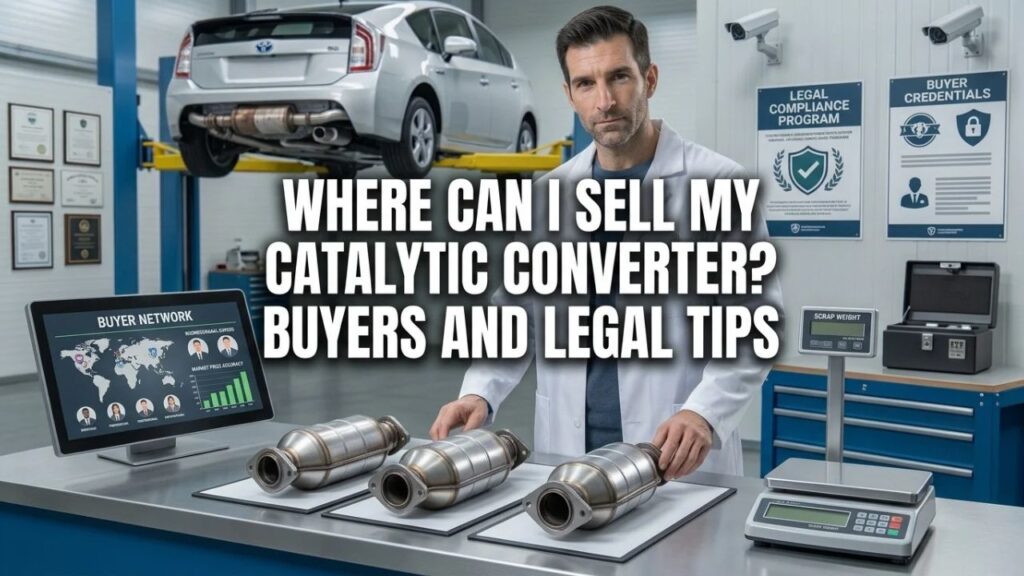
Start with businesses that openly identify themselves as licensed recyclers, secondary-metals dealers, auto dismantlers, or catalytic-converter processors.
A legal buyer should be willing to document where the converter came from rather than trying to avoid a paper trail.
Licensed Scrap Metal Recycler
A local scrap yard or secondary-metals recycler is often the easiest option for a private owner with one old converter.
Before driving there, call and ask:
- Do you buy detached catalytic converters from private owners?
- What ownership documents do you require?
- Do you need the vehicle VIN?
- Do you need the converter serial number?
- What forms of identification do you accept?
- How is payment made?
- Do you price by converter code or give a flat scrap offer?
Some yards that buy steel, aluminum, and copper do not accept detached catalytic converters because their state license does not permit those transactions.
Do not assume every scrap yard will buy yours.
Specialty Catalytic Converter Recycler
A converter recycler focuses specifically on automotive catalysts and precious-metal recovery.
These buyers may identify the converter by its stamped number and use converter databases, sampling, or metal-content analysis to establish a price.
For example, Accurate Converter operates U.S. processing locations and describes its business as buying and processing catalytic converters for platinum, palladium, and rhodium recovery.
A specialty buyer can make more sense when you have:
- An OEM converter
- A unit with a readable part number
- Several converters
- A high-value application
- A repair shop or dismantling business
- A reason to compare a scrap-yard quote
Auto Recycler or Licensed Dismantler
Automotive dismantlers process end-of-life vehicles and often already have systems for tracking converters back to donor vehicles.
Some may purchase a converter from a private owner if state law and company policy permit it.
If the whole vehicle is being scrapped, selling the car intact to a licensed dismantler may be simpler than removing the converter first.
That also preserves a clear connection between the converter and the vehicle VIN.
Catalytic Converter Core Buyer
A core buyer purchases used automotive components for recycling or processing.
Specialty core buyers may handle catalytic converters from:
- Repair shops
- Exhaust shops
- Salvage yards
- Auto recyclers
- Dealers
- Commercial fleets
Some also handle single units from private owners, while others only work business-to-business.
Elemental North America, for example, directs single-converter sellers to contact a nearby location because acceptance can depend on seller type, documentation, and state requirements.
Exhaust or Repair Shop
If a shop replaces your catalytic converter, ask what happens to the old part.
Some repair businesses may:
- Return the old converter to you
- Apply a core credit
- Sell it through their recycling program
- Handle disposal as part of the job
If you want to keep and sell the old converter yourself, discuss that before the repair.
Keep the invoice showing the converter was removed from your vehicle. That document may become useful proof of lawful ownership.
Key Takeaway: Licensed scrap recyclers, specialty converter recyclers, auto dismantlers, and approved core buyers are the main places to sell. Call first because buyer rules and seller-document requirements vary by state.
What Documents Do I Need to Sell a Catalytic Converter?
Expect a legitimate buyer to ask questions.
That is a positive sign rather than unnecessary hassle.
Government-Issued Photo ID
Many regulated scrap transactions require the buyer to record or copy identification.
Depending on state law, acceptable ID may include:
- Driver’s license
- State identification card
- Other government-issued photo identification
California, for example, requires extensive identification and transaction records for core-recycler purchases and places restrictions on who can sell used converters.
Vehicle Registration or Title
Bring documentation linking you to the donor vehicle.
This may be:
- Current registration
- Certificate of title
- Prior registration for a vehicle you recently sold or scrapped
- Other ownership documentation permitted by state law
South Carolina’s rules for detached converter transactions include vehicle make and model, VIN, converter identifying number, and title or registration documentation in covered situations.
Florida also prohibits possession, sale, or purchase of certain detached converters without proof of ownership unless a statutory exception applies.
VIN
The vehicle identification number ties the converter to the car it came from.
Write it down before going to the buyer.
Some jurisdictions require the VIN to appear in the transaction record or require markings on the converter itself.
Repair Receipt
If a mechanic removed the converter, keep the repair order showing:
- Vehicle information
- Date of replacement
- Shop information
- Converter replacement
- Your customer information
This gives the recycler another way to verify where the part came from.
Converter Part or Serial Number
Look at the converter housing for a stamped, etched, or engraved code.
Do not remove identification marks.
A readable code may help:
- Confirm the converter model
- Establish that it is OEM or aftermarket
- Produce a more accurate quote
- Link the unit to recycler databases
Key Takeaway: Bring photo ID, vehicle ownership records, VIN information, the repair invoice, and any readable converter identification number. Better documentation makes a lawful sale much simpler.
Is It Legal to Sell Your Old Catalytic Converter?
Generally, an owner can send a legitimately acquired converter into the recycling stream, but the transaction must follow federal, state, and local rules.
Those rules can be strict.
State Rules Can Limit Who May Buy It
Some states permit purchases only by certain registered or licensed businesses.
Florida states that a person generally may not knowingly purchase a detached converter unless that person is a registered secondary-metals recycler.
California also restricts used-converter purchases to listed businesses and documented lawful owners under its Vehicle Code.
This is why a random private buyer advertising online may not be legally permitted to purchase your converter.
Proof of Ownership May Be Required
States have targeted anonymous converter transactions because stolen parts can otherwise move quickly into the recycling chain.
Massachusetts requires covered buyers to obtain identification plus a bill of sale or another legal document demonstrating ownership.
South Carolina has detailed rules covering detached converter ownership records and recycler transactions.
Check your state’s current law before taking the part to a buyer.
Payment Rules May Be Different From Normal Scrap
Do not assume you will receive cash immediately.
California, for example, requires traceable payment methods for covered converter transactions and imposes additional record and identity requirements.
Other states may have waiting periods, check-payment requirements, electronic-payment rules, or transaction reporting.
Removing a Working Converter Is a Different Issue
Federal law prohibits tampering with required emissions-control equipment.
EPA states that knowingly removing or rendering an emissions-control device inoperative can violate the Clean Air Act.
Selling an old converter after a lawful replacement is very different from removing a functioning converter merely to sell it for scrap and then operating the vehicle without the required emissions equipment.
Key Takeaway: Selling a legitimately owned removed converter for recycling may be lawful, but seller documentation, buyer licensing, payment, and possession rules differ by state.
Should You Sell It for Scrap or as a Used Replacement Part?
For most owners, recycling is the cleaner route.
A used converter cannot automatically be sold as a ready-to-install replacement.
EPA Places Restrictions on Used Converter Reuse
EPA guidance states that used converters from salvage vehicles cannot simply be installed or sold for reuse unless they meet applicable testing and labeling requirements.
EPA specifically says selling an untested used converter for reuse can conflict with its converter policy.
That distinction matters.
Selling your converter to an approved recycler for precious-metal recovery is not the same transaction as selling it to someone who plans to bolt the used unit onto another vehicle.
Avoid Marketplace Listings Claiming It Is Ready to Install
A private listing may create several problems:
- State buyer restrictions
- Ownership-verification issues
- Federal reuse requirements
- Fitment uncertainty
- Unknown catalyst condition
- Fraud and theft concerns
For a normal vehicle owner, recycling through a documented buyer is usually the cleaner path.
How Much Can I Get for My Catalytic Converter?
There is no single scrap price.
Two converters that look similar from the outside can have very different precious-metal content.
OEM vs Aftermarket Converter
An OEM converter is the original or vehicle-manufacturer-equivalent unit.
OEM units often contain more recoverable platinum-group metals than many inexpensive aftermarket converters.
That does not mean every OEM unit is worth the same amount.
Converter Serial Number
A serial or part code can be one of the most useful pricing details.
Specialist buyers may identify the unit from this number and match it with known converter data.
Before requesting quotes:
- Find the code.
- Photograph it clearly.
- Photograph the whole converter.
- Note the donor vehicle year, make, and model.
- Ask the buyer how the quote was calculated.
Platinum, Palladium, and Rhodium Markets
Converter pricing changes with precious-metal markets.
The amount of each metal inside the unit also varies by:
- Vehicle manufacturer
- Engine size
- Emissions standard
- Model year
- Converter position
- Gasoline, diesel, or hybrid application
This is why weight alone is not a good pricing method.
Internal Material Must Still Be Present
An intact converter normally has more recycling worth than an empty shell.
Do not cut it open, remove the honeycomb, crush it, or scrape material out before asking for a quote.
Removing the internal material can also make identification and ownership questions harder.
Buyer Margin Matters
A local yard needs room to resell or process the converter, so its offer may be below what the recovered metals are eventually worth.
A specialty processor may use a different pricing model.
For one converter, convenience may matter more than chasing a small difference across several hours of travel. For multiple high-value units, quote comparison matters more.
Key Takeaway: Converter value depends on the exact unit, precious-metal loading, OEM status, serial number, condition, current metal markets, and the buyer’s pricing method.
How to Get the Best Price for an Old Catalytic Converter
A few preparation steps can reduce guesswork before you sell.
Keep the Converter Intact
Do not open the shell.
An intact unit preserves identifying details and makes it easier for a recycler to classify.
Clean Only the Identification Area
If surface dirt or rust hides the serial number, gently clean enough of the shell to make the code readable.
Do not grind identification markings away.
Photograph the Converter
Take clear photos of:
- Complete unit
- Identification code
- Inlet and outlet
- Any markings
- Damage
A specialist buyer may be able to give you a preliminary quote from these details.
Ask More Than One Licensed Buyer
Get two or three quotes when practical.
Ask each buyer:
- Is this quote based on the converter number?
- Is the quote final?
- Are fees deducted?
- Does the internal substrate need inspection?
- What paperwork do I need?
- How will payment be issued?
Compare the net amount you actually receive, not just the headline quote.
Get a Receipt
A legal transaction should leave a record.
Keep the receipt with:
- Buyer name
- Date
- Converter description
- Amount paid
- Transaction number
That record may matter if ownership questions arise later.
Key Takeaway: Keep the unit intact, photograph the identifying code, compare legitimate quotes, and keep a written transaction record.
Should You Sell a Catalytic Converter Online?
Online quoting can be useful. Selling through an unverified person is more complicated.
Online Specialty Buyers
Some established recycling companies accept photos or converter codes for preliminary pricing and may offer shipping arrangements where the transaction is permitted.
Before shipping anything, verify:
- Physical business address
- Business identity
- State purchasing rules
- Required seller documents
- Shipping insurance
- Quote terms
- Final valuation process
- Payment method
A website alone does not prove a buyer can legally accept your converter.
General Online Marketplaces
A general classified site or marketplace is not my first choice.
The buyer may not be licensed to purchase a detached converter, and selling it for vehicle reuse raises a different set of emissions requirements.
A documented recycler is easier to verify and leaves a clearer transaction record.
Red Flags When Choosing a Catalytic Converter Buyer
Converter theft created a market where seller and buyer behavior matters.
Walk away from a transaction that appears designed to avoid normal ownership checks.
Red flags include:
- No ID requested where local rules require it
- No interest in the converter’s origin
- Buyer asks you to remove or damage identifying marks
- Buyer insists on an undocumented cash-only sale despite state restrictions
- No physical business information
- Refusal to issue a receipt
- Pressure to ship before confirming terms
- Buyer asks you to misstate where the converter came from
A legitimate buyer may actually ask more questions than the buyer offering the fastest deal.
That extra paperwork protects both sides.
Can I Sell the Catalytic Converter From a Junk Car?
Yes, but selling the whole vehicle may be simpler.
If the converter is still attached to an end-of-life car, a licensed auto dismantler can process both the vehicle and converter while maintaining the VIN connection.
Removing the converter first may:
- Reduce the vehicle’s scrap offer
- Create extra ownership paperwork
- Require a separate buyer
- Create state-law complications
Ask the dismantler for quotes both ways before removing anything.
If the converter has already been removed during a legitimate repair, keep the repair invoice and ownership records.
Conclusion
If you are asking where can i sell my catalytic converter, start with licensed scrap-metal recyclers, catalytic-converter processors, approved core buyers, and licensed auto dismantlers. These businesses are set up to document the transaction and send the converter into the precious-metal recycling chain.
Bring photo identification, vehicle title or registration, the VIN, repair records, and the converter’s identifying number when available. State laws differ sharply, so calling the buyer before traveling avoids showing up with missing paperwork or finding out that the business cannot legally purchase from a private seller.
Compare quotes if the converter is an identifiable OEM unit. Pricing can vary because buyers classify converters differently and because platinum, palladium, and rhodium content differs from one model to another.
I would avoid anonymous cash buyers and unverified marketplace offers. A licensed buyer that checks ownership, records the transaction, and explains its pricing gives you a much cleaner sale.
FAQs About Selling a Catalytic Converter
Can I Sell My Own Catalytic Converter to a Scrap Yard?
Yes, if the scrap yard is legally permitted to buy detached converters from private sellers in your state and you meet the required ownership and identification rules.
Call first. Bring photo ID, vehicle registration or title, VIN information, and the repair invoice showing why the converter was removed.
Do I Need a Title to Sell a Catalytic Converter?
In some states, title or registration documentation is specifically required or strongly tied to proof of ownership.
Requirements differ by location. Even when a title is not mandatory, a legitimate buyer may still request vehicle registration, VIN information, a repair receipt, and photo identification.
Can I Sell a Catalytic Converter for Cash?
That depends on state law.
Some states restrict cash payments or require traceable payment methods and waiting periods. California, for example, has specific payment and recordkeeping rules for covered converter transactions.
Check the rule where the sale takes place rather than assuming scrap transactions are always paid in cash.
Can I Sell a Catalytic Converter Without a Serial Number?
Possibly, but missing identification may reduce the buyer’s ability to classify the converter and may create ownership issues under local rules.
Do not intentionally remove, grind off, or alter numbers. Florida, for example, restricts possession, purchase, sale, or installation of detached converters with specified identification numbers removed, altered, or defaced.
Who Pays the Most for Used Catalytic Converters?
A specialty converter buyer may offer more than a general scrap yard for an identifiable OEM unit because it may price the converter using its code or metal content.
No buyer is always highest. Compare net quotes from legitimate businesses after giving each one the same converter number and condition information.
Can I Sell a Used Catalytic Converter to Someone Who Wants to Install It?
Be cautious. EPA guidance places conditions on used catalytic converters sold or installed as replacement emissions equipment, including testing and labeling requirements. Untested salvage converters cannot simply be treated as normal replacement parts.
Selling the old unit to an approved recycler for material recovery is usually simpler.
Is It Legal to Sell a Catalytic Converter I Removed From My Car?
A lawfully owned converter that was legitimately removed can generally enter the recycling chain, but state rules may control possession, documentation, buyer licensing, transaction records, and payment.
Removing a functioning emissions device simply to sell it and continuing to operate the vehicle without required emissions equipment is a separate issue and may violate federal anti-tampering law.