What Is the Purpose of a Catalytic Converter? Uses and Function
A catalytic converter is an emissions-control device that changes harmful gases in engine exhaust into less harmful substances before they leave the tailpipe. On modern gasoline vehicles, a three-way converter mainly targets carbon monoxide, unburned hydrocarbons, and nitrogen oxides through chemical reactions inside a catalyst-coated honeycomb.
Without this exhaust-treatment stage, more harmful pollutants produced during combustion would pass directly into the air. Removing or damaging the converter can also trigger emissions faults, increase pollution, and make the vehicle fail an emissions inspection where testing is required.
A properly operating converter treats exhaust without needing moving parts. Exhaust gases flow through thousands of small passages coated with catalyst materials, allowing chemical reactions to occur across a large surface area.
For U.S. vehicle owners, catalytic converters receive special treatment under federal emissions rules. EPA states that catalytic converters are among the specified major emissions components covered by applicable federal warranty provisions for 8 years or 80,000 miles, whichever comes first.
For what is the purpose of a catalytic converter, the central answer is pollution control rather than noise reduction or engine power. EPA describes catalytic converters as critical emissions components that convert carbon monoxide, hydrocarbons, and nitrogen oxides into less harmful substances before exhaust reaches the atmosphere.
I’d think of the converter as a chemical cleanup stage in the exhaust system. It does not filter pollutants like a household air filter; it uses catalyst-coated surfaces to encourage reactions that change the chemical makeup of the exhaust.
The sections below explain the converter’s main job, the three pollutants it targets, how the catalyst works, why oxygen sensors matter, where the converter sits, what happens when it fails, and why a vehicle may use more than one converter.
What Is the Purpose of a Catalytic Converter in a Car?
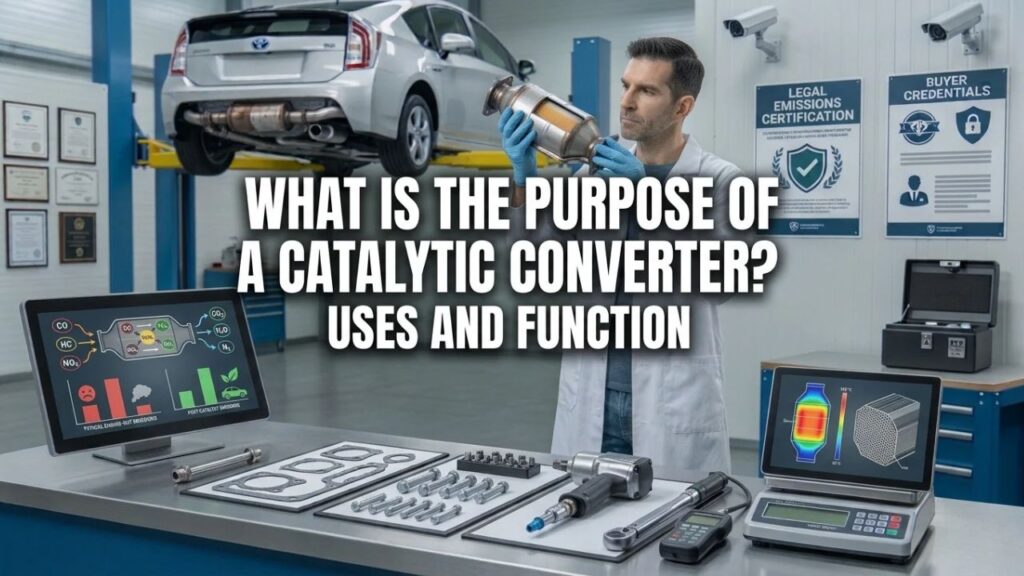
The purpose of a catalytic converter is to reduce harmful exhaust emissions before they leave the vehicle.
Gasoline combustion produces several unwanted gases. A modern three-way catalytic converter treats three major groups:
- Carbon monoxide (CO)
- Hydrocarbons (HC)
- Nitrogen oxides (NOx)
EPA identifies these pollutants as major targets of automotive catalytic converters.
Reduce Carbon Monoxide
Carbon monoxide forms when fuel does not burn completely.
It is a toxic gas that can interfere with the body’s ability to transport oxygen.
Inside the converter, carbon monoxide undergoes an oxidation reaction that changes much of it into carbon dioxide (CO₂).
The converter does not simply trap the carbon monoxide. It changes its chemical form.
Reduce Unburned Hydrocarbons
Hydrocarbons are fuel-related compounds that leave the engine without being fully burned.
A catalytic converter promotes oxidation reactions that convert much of the remaining hydrocarbons into carbon dioxide and water vapor.
EPA’s early catalyst documentation describes this oxidation of hydrocarbons and carbon monoxide as one of the original purposes of automotive converters.
Reduce Nitrogen Oxides
Modern three-way converters also target nitrogen oxides.
NOx forms primarily when very high combustion temperatures cause nitrogen and oxygen in the incoming air to react.
The reduction section of the catalyst helps change nitrogen oxides primarily into nitrogen, along with oxygen-related reaction products.
Three-way converters became common because they could address NOx along with HC and CO.
Key Takeaway: A catalytic converter’s main job is to chemically change carbon monoxide, hydrocarbons, and nitrogen oxides into less harmful exhaust products before they reach the tailpipe.
How Does a Catalytic Converter Work?
A catalytic converter looks fairly simple from the outside, but the internal structure provides a huge reaction surface.
Most units contain a ceramic or metallic substrate formed into many tiny channels.
Exhaust Flows Through a Honeycomb
The internal core commonly uses a honeycomb structure.
Exhaust gases pass through the small open channels as they travel from the engine toward the muffler and tailpipe.
The channel walls are coated with catalyst material.
Using many small passages creates far more surface area than a simple hollow pipe could provide.
Catalyst Materials Speed Up Chemical Reactions
A catalyst is a substance that speeds up a chemical reaction without being consumed in the same way as the reactants.
Automotive converters commonly use precious metals such as:
- Platinum
- Palladium
- Rhodium
Different formulations use these metals in different amounts.
Platinum and palladium are associated mainly with oxidation reactions, while rhodium is strongly associated with NOx reduction in three-way systems.
EPA documentation describes three-way converters as using catalyst materials to control HC, CO, and NOx at the same time.
Oxidation Changes CO and HC
Oxidation reactions add oxygen to certain exhaust compounds.
Carbon monoxide is converted toward carbon dioxide.
Unburned hydrocarbons are converted largely toward carbon dioxide and water.
These reactions require the converter to reach a suitable operating temperature.
Reduction Targets NOx
NOx control uses a reduction reaction.
The catalyst encourages nitrogen oxides to give up oxygen, leaving nitrogen as a major product.
This is one reason modern gasoline engines need tight control of their air-fuel mixture.
Heat Helps the Catalyst Work
Catalytic converters need heat before their chemical reactions become active at the intended rate.
A cold-starting vehicle therefore produces more emissions during the short period before the converter warms.
This is also why many modern vehicles place a converter fairly close to the engine. Exhaust leaving the engine can heat the catalyst sooner.
Key Takeaway: Exhaust passes through a catalyst-coated honeycomb where heat and precious-metal surfaces promote oxidation and reduction reactions that change harmful gases into less harmful compounds.
Why Is It Called a Three-Way Catalytic Converter?
The term three-way refers to the three main pollutant groups the converter treats.
Those are:
- Carbon monoxide
- Hydrocarbons
- Nitrogen oxides
The name does not mean exhaust travels through three separate pipes.
Earlier Oxidation Converters
Early automotive catalytic converters focused mainly on hydrocarbons and carbon monoxide.
They used oxidation reactions to reduce these pollutants.
EPA records show that first-generation catalytic converters became widely associated with U.S. vehicles beginning in the 1975 model year as tighter emissions requirements took effect.
Modern Three-Way Converters
Three-way catalysts added strong NOx control to the existing HC and CO treatment.
EPA documentation notes that three-way catalyst systems became widely used on gasoline vehicles around the early 1980s.
To perform all three reactions correctly, the engine management system must keep the air-fuel mixture within a narrow operating range.
Key Takeaway: “Three-way” refers to simultaneous control of carbon monoxide, hydrocarbons, and nitrogen oxides rather than three separate converter chambers.
Why Do Oxygen Sensors Matter to the Catalytic Converter?
The catalytic converter works closely with the engine-management system.
Oxygen sensors give the powertrain control module information about exhaust oxygen content.
Upstream Oxygen Sensor
The upstream sensor sits before the converter on most gasoline OBD-II systems.
Its readings help the computer adjust the air-fuel mixture.
Three-way catalysts work best when the engine operates close to the intended stoichiometric air-fuel ratio.
A mixture that stays too rich can send excess fuel into the converter and overheat it.
A mixture that stays too lean can interfere with emissions control and engine operation.
Downstream Oxygen Sensor
A downstream sensor is normally positioned after the converter.
One of its major jobs is monitoring catalyst behavior.
The computer compares sensor patterns to determine if the converter is storing and processing exhaust gases as expected.
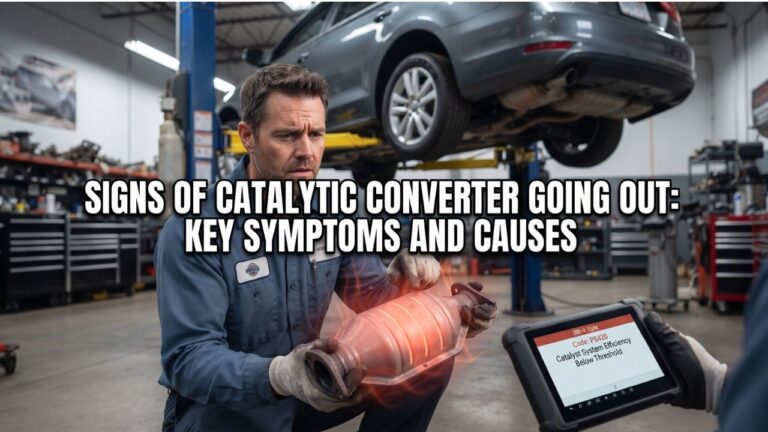
Catalyst Efficiency Codes
If the computer decides catalyst operation has dropped below the programmed threshold, it may set:
P0420 — Catalyst System Efficiency Below Threshold, Bank 1
A vehicle with two cylinder banks may also set:
P0430 — Catalyst System Efficiency Below Threshold, Bank 2
These codes indicate a catalyst-system efficiency problem. They do not automatically prove the converter is clogged.
Key Takeaway: The upstream oxygen sensor supports fuel control, while the downstream sensor helps the computer monitor how well the converter is treating exhaust.
Where Is the Catalytic Converter Located?
The catalytic converter sits somewhere in the exhaust path between the engine and the tailpipe.
Exact position varies by vehicle.
Close-Coupled Converter
Many modern vehicles place at least one converter close to the exhaust manifold.
This position exposes the catalyst to hotter exhaust, helping it warm sooner after startup.
You may see this unit integrated into the exhaust manifold or mounted directly below it.
Underbody Converter
Another design positions the converter farther underneath the vehicle.
Some vehicles use both a close-coupled catalyst and an additional underbody converter.
Vehicles With Multiple Converters
V-type engines may use separate exhaust paths for each cylinder bank.
These vehicles can have a converter for Bank 1 and another for Bank 2.
Some systems use several catalyst stages to meet the emissions targets designed for that model.
The number of converters therefore varies with engine layout, emissions certification, exhaust design, and model year.
Is a Catalytic Converter the Same as a Muffler?
No. The two components perform different jobs.
A catalytic converter controls emissions.
A muffler controls exhaust noise.
The exhaust normally passes through both parts, but their internal designs and functions are different.
Catalytic Converter Function
The converter uses chemical reactions to reduce harmful pollutants.
It usually contains catalyst-coated internal passages.
Muffler Function
The muffler reduces sound pulses created by engine exhaust.
It may use chambers, perforated tubes, resonators, or sound-absorbing materials to reduce noise.
Removing a muffler can make a vehicle much louder without directly replacing the converter’s emissions function.
Removing a catalytic converter eliminates a major pollution-control device and can violate emissions laws for road vehicles.
Key Takeaway: The converter treats exhaust chemistry, while the muffler controls exhaust sound; one cannot perform the other’s job.
Does a Catalytic Converter Improve Engine Performance?
Its main purpose is not to create horsepower.
A healthy converter is designed to provide enough exhaust flow for the engine while still treating pollutants.
A Healthy Converter Should Not Feel Like a Major Restriction
Vehicle manufacturers design the engine, exhaust system, oxygen sensors, and catalytic converter to operate together.
A functioning factory-style converter should allow the engine to run within its intended operating range.
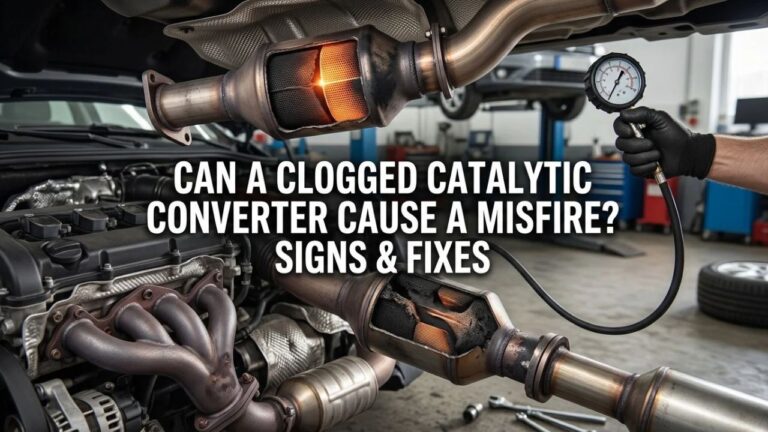
A Clogged Converter Can Reduce Power
The situation changes if the internal honeycomb melts, collapses, or becomes heavily blocked.
A restricted converter creates excess exhaust backpressure.
The engine may then develop:
- Poor acceleration
- Limited high-RPM power
- Rough running
- Hard starting
- Stalling
- Excessive heat
That loss of power comes from converter failure, not from the normal purpose of the converter.
Removing a Healthy Converter Is Not Normal Performance Maintenance
Removing a functioning converter changes the emissions system and may trigger diagnostic faults.
Modern engine controls are calibrated around the original emissions equipment.
For a street vehicle, repair a damaged or restricted converter with a compliant replacement rather than treating catalyst removal as routine performance work.
Key Takeaway: A catalytic converter exists for emissions control, not power production; only a damaged or restricted converter should create major exhaust-flow problems.
What Happens When a Catalytic Converter Goes Bad?
Converter failure can take several forms.
Not every bad converter produces the same symptoms.
Catalyst Efficiency Drops
The internal catalyst coating can stop processing pollutants at the required rate.
The car may still run normally but set P0420 or P0430.
This type of failure does not necessarily mean the converter is physically clogged.
Internal Honeycomb Melts
Misfires or rich fuel mixtures can send unburned fuel into the converter.
That fuel may burn inside the catalyst and create extreme heat.
The honeycomb can melt and partially close the exhaust passages.
Internal Core Breaks
Road impact, overheating, age, or repeated thermal stress can crack the substrate.
Loose pieces may produce a rattle.
If pieces shift across the outlet, they can restrict exhaust flow.
Oil or Coolant Contaminates the Catalyst
An engine that burns oil can coat the catalyst with residue.
An internal coolant leak can contaminate the converter as well.
The original engine problem should be corrected before a replacement converter is installed.
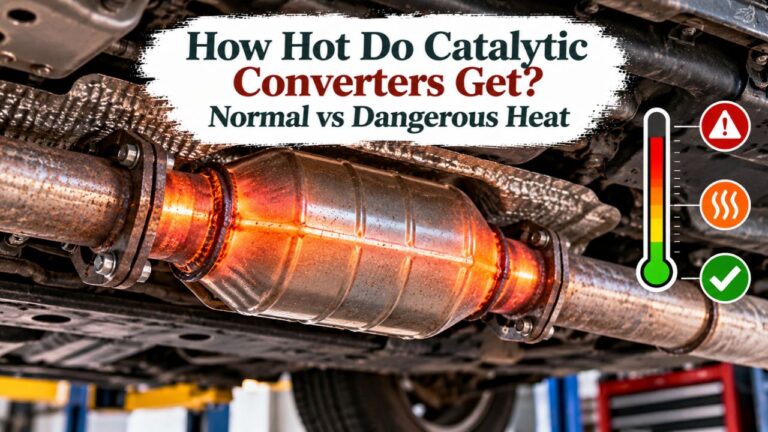
Why Does a Catalytic Converter Get So Hot?
Chemical reactions inside the converter produce heat, and the unit is already exposed to hot exhaust coming directly from the engine.
High temperature is therefore part of normal operation.
Abnormally high temperature is different.
Misfires Can Overheat the Converter
A misfire may send unburned fuel into the exhaust.
If that fuel burns inside the converter, catalyst temperature can rise sharply.
A flashing Check Engine Light can indicate a severe misfire with the potential to damage the converter.
Rich Mixture Can Create Similar Damage
Leaking injectors, incorrect fuel pressure, sensor faults, or other problems can make an engine run too rich.
Excess fuel reaching the converter can produce excessive heat.
A glowing converter should be treated as a serious fault rather than normal catalyst temperature.
Why Is a Catalytic Converter Required on Most Gasoline Cars?
Catalytic converters became widespread because engine-out exhaust contains pollutants that must be controlled for vehicles to meet emissions standards.
EPA describes catalytic converters as critical emissions-control components that have been fitted to most U.S. cars and light trucks since the mid-1970s.
Modern emissions systems combine several technologies rather than relying on the converter alone.
These can include:
- Electronic fuel injection
- Oxygen sensors
- Evaporative emissions controls
- Exhaust gas recirculation
- Onboard diagnostics
- Catalytic converters
The converter deals mainly with pollutants in exhaust after combustion has occurred.
Can a Car Run Without a Catalytic Converter?
An engine may physically run with the converter removed on some vehicles, but that does not mean the vehicle operates as designed or remains legal for road use.
Emissions Increase
Without the catalyst, the exhaust loses a major treatment stage.
More HC, CO, and NOx can leave the tailpipe.
The Check Engine Light May Turn On
The downstream oxygen sensor can detect abnormal catalyst behavior.
Removing the converter may trigger P0420, P0430, or related emissions-monitoring faults.
Emissions Inspection Can Become a Problem
Areas that inspect emissions equipment may fail a vehicle with a missing, modified, or noncompliant converter.
Federal anti-tampering requirements also restrict removal or defeat of emissions-control equipment on covered road vehicles.
How Long Is a Catalytic Converter Supposed to Last?
There is no universal replacement interval for all converters.
A converter does not normally wear like a brake pad or spark plug.
A well-maintained vehicle can keep its original catalyst for a very long time.
EPA has stated that original converters are intended to operate as part of a properly maintained emissions system, and federal warranty rules give specified major emissions components coverage for up to 8 years or 80,000 miles under applicable conditions.
Failures often come from another problem, including:
- Long-term misfires
- Rich air-fuel mixture
- Oil consumption
- Coolant leaks
- Impact damage
- Severe overheating
Fixing those faults early protects the catalyst.
Conclusion
For what is the purpose of a catalytic converter, the primary purpose is to reduce harmful pollutants in engine exhaust before those gases leave the tailpipe.
A modern three-way converter targets carbon monoxide, unburned hydrocarbons, and nitrogen oxides. Catalyst-coated internal passages promote chemical reactions that convert these pollutants mainly into carbon dioxide, water vapor, nitrogen, and related less harmful exhaust products.
The converter works as part of a larger emissions system that includes oxygen sensors and engine fuel control. It is not a muffler, fuel filter, or horsepower-producing component.
I would view converter trouble as a reason to inspect the engine as well as the exhaust. Misfires, rich operation, oil burning, and coolant leaks can damage a replacement converter if the original fault is left in place.
FAQs About Catalytic Converter Purpose
What Does a Catalytic Converter Actually Do?
A catalytic converter treats engine exhaust before it leaves the vehicle.
On a modern gasoline vehicle, it primarily changes carbon monoxide, unburned hydrocarbons, and nitrogen oxides into less harmful substances through catalyst-driven chemical reactions.
Does a Catalytic Converter Reduce Carbon Monoxide?
Yes.
The oxidation section of the converter helps change carbon monoxide into carbon dioxide. It also oxidizes many unburned hydrocarbons into carbon dioxide and water.
Does a Catalytic Converter Reduce NOx?
A modern three-way catalytic converter does.
Its reduction catalyst promotes reactions that convert nitrogen oxides primarily toward nitrogen while the oxidation side handles carbon monoxide and hydrocarbons.
Does a Catalytic Converter Reduce Engine Noise?
That is not its main job.
The muffler is the exhaust component primarily responsible for reducing sound. The catalytic converter’s purpose is controlling harmful exhaust emissions.
Does a Catalytic Converter Affect Fuel Economy?
A healthy converter should work as part of the vehicle’s intended exhaust system without causing a major loss of fuel economy.
A severely clogged converter can restrict exhaust flow, reduce engine power, and force the driver to use more throttle, which may hurt fuel economy.
Why Are Catalytic Converters So Expensive?
Converters use specialized catalyst materials, including precious metals such as platinum, palladium, and rhodium.
Cost also depends on catalyst loading, converter size, vehicle certification requirements, exhaust design, and construction.
Can a Car Have More Than One Catalytic Converter?
Yes.
Vehicles with multiple exhaust banks or multi-stage emissions systems may have two or more converters. Some place smaller units close to the engine and additional catalysts farther downstream.
What Happens if a Catalytic Converter Is Removed?
The vehicle loses a major emissions-treatment component, pollutant output can rise, and catalyst-monitoring codes may appear.
A missing converter can also create emissions-inspection and legal problems for road vehicles subject to emissions-control requirements.