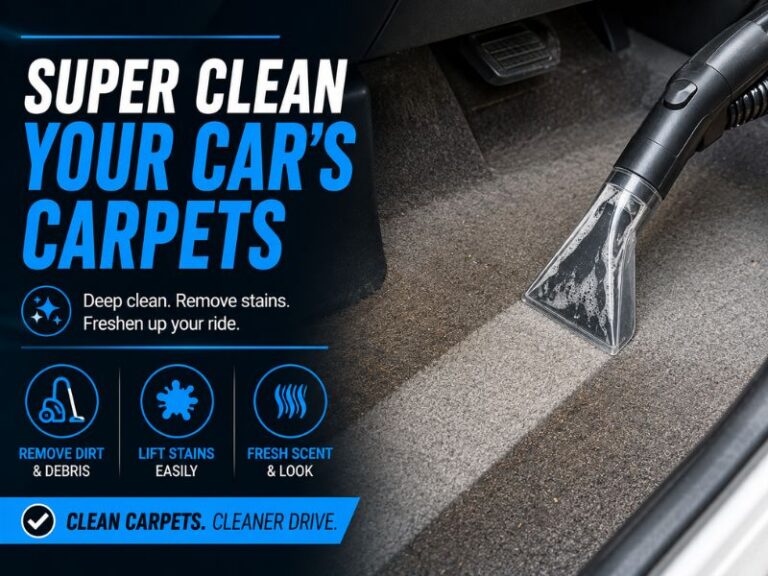
How to Super Clean Your Car Interior: Carpets & Headliner
To super clean your car’s carpets and headliner, remove dry dirt first, treat stains with material-safe cleaners, extract contamination from the carpet without soaking the padding, and clean the headliner with minimal moisture to avoid weakening the adhesive behind the fabric.
Carpets and headliners may both be fabric-covered surfaces, but they should not be cleaned the same way. Automotive carpet can usually tolerate controlled agitation and extraction, while a headliner is much more delicate because its fabric may be bonded to foam and a backing panel with adhesive.
The best approach is to remove as much dry contamination as possible before introducing moisture. Then clean the carpet deeply while treating the headliner as a low-moisture surface.
What Does It Mean to Super Clean Car Carpets and Headliner?
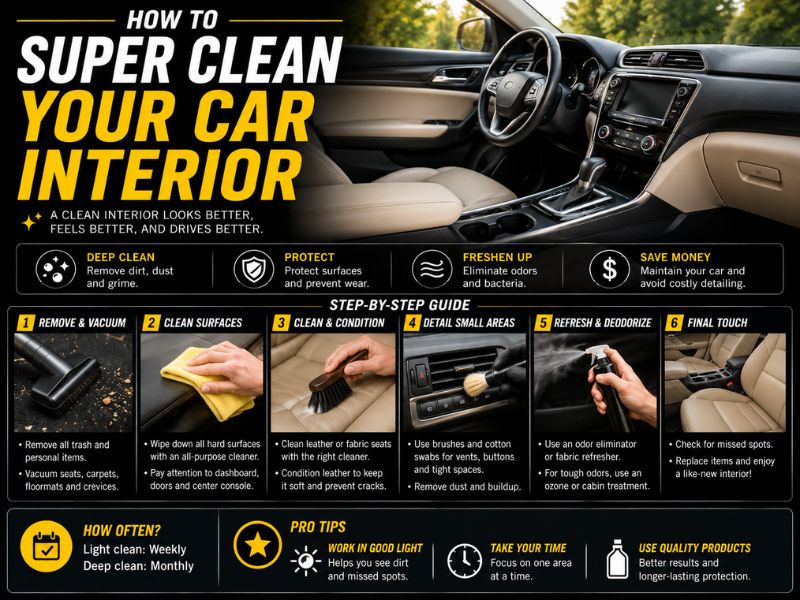
A deep interior clean should remove as much contamination as practical without damaging the materials underneath.
That can include:
- Dust
- Sand
- Mud
- Food debris
- Drink residue
- Road salt
- Light stains
- Body oils
- Odor-causing contamination
The goal is not simply to make the surfaces wet and scrub them.
A good cleaning process should avoid:
- Saturated carpet padding
- Excess detergent residue
- Water rings
- Musty odors
- Sagging headliner fabric
- Damaged upholstery
- Trapped moisture
Deep cleaning means removing contamination, not adding as much product as possible.
What You Need
A practical setup may include:
- Vacuum cleaner
- Crevice attachment
- Carpet brush
- Soft upholstery brush
- Automotive fabric cleaner
- Microfiber towels
- Spray bottle
- Gloves
For carpets, a wet/dry vacuum or upholstery extractor can make the job easier.
Optional tools include:
- Drill brush for durable carpeting
- Blower or compressed air
- Small soft detailing brush for headliner stains
You do not need every tool to get a good result. Technique and moisture control matter more than having a large collection of products.
Step 1: Remove Floor Mats and Loose Items
Start by clearing the interior.
Remove:
- Floor mats
- Trash
- Bottles
- Papers
- Loose tools
- Items under the seats
Move the seats forward and backward to expose the carpet underneath.
Pay attention to:
- Seat rails
- Carpet edges
- Door sills
- Rear footwells
- Areas beside the center console
Removing everything first gives you better access and prevents dirt from being pushed into hidden areas during cleaning.
Step 2: Vacuum Thoroughly
Vacuuming should happen before any wet cleaning.
Focus on:
- Footwells
- Under the seats
- Carpet edges
- Seat rails
- Door-entry areas
- Tight corners
Use the crevice tool where necessary.
For the headliner, only use gentle vacuuming if the material is secure and the attachment is soft.
Avoid dragging a hard vacuum nozzle across the fabric.
Loose or aging headliner material can be damaged by excessive suction or pressure.
How to Super Clean Car Carpets
Carpet cleaning works best in stages.
The more dry contamination you remove first, the easier the wet-cleaning stage becomes.
Step 1: Dry Brush the Carpet
Before applying cleaner, agitate the carpet with a suitable brush.
This helps loosen:
- Sand
- Dried mud
- Fine dirt
- Debris trapped between fibers
Then vacuum again.
For heavily soiled areas, use this sequence:
Brush → vacuum → brush → vacuum
This can remove a surprising amount of contamination before you use any liquid.
It also prevents loose soil from turning into muddy residue later.
Step 2: Identify Carpet Stains
Inspect the carpet before general cleaning.
Common stains include:
- Coffee
- Soda
- Mud
- Grease
- Food
- Road salt
- Pet-related contamination
Do not automatically use the same stain treatment on everything.
Different residues behave differently, and aggressive chemicals can sometimes make a stain harder to remove.
Step 3: Pretreat Stubborn Stains
Apply a suitable automotive fabric or carpet cleaner lightly to stained areas.
Let it work according to the product directions.
Then agitate gently with a brush.
Avoid:
- Flooding the stain
- Scrubbing aggressively immediately
- Mixing cleaning chemicals
- Letting strong products dry on the carpet unless instructed
Several controlled passes are usually safer than one heavily saturated treatment.
Step 4: Apply Carpet Cleaner
Work in manageable sections.
Apply enough cleaner to dampen the fibers and loosen soil.
Do not soak the floor.
Excess liquid may reach:
- Carpet backing
- Padding
- Sound insulation
- Wiring
- Electrical connectors
The carpet should be wet enough to clean, not wet enough to hold standing liquid.
Step 5: Agitate the Carpet Fibers
Use a carpet or upholstery brush to work the cleaner through the material.
Use moderate pressure and several directions.
Pay extra attention to:
- Driver footwell
- Door-entry areas
- Rear passenger footwells
- Areas under the pedals
These high-traffic sections usually contain the deepest contamination.
Can You Use a Drill Brush on Car Carpet?
Yes, on some durable automotive carpets.
A drill brush can speed up agitation, but it should be used carefully.
Choose a soft or medium brush and use:
- Low to moderate drill speed
- Light pressure
- Short passes
Avoid using a drill brush when:
- Carpet is delicate
- Fibers are frayed
- Material is loosely bonded
- Brush is very stiff
The drill brush only loosens dirt.
It does not remove the contaminated solution.
Extraction or blotting is still necessary.
Step 6: Extract the Dirty Solution
Once dirt is suspended in the cleaner, remove it.
Carpet Extractor
An upholstery extractor can pull out:
- Cleaner
- Moisture
- Suspended dirt
Make several recovery passes rather than continuously adding more solution.
Wet/Dry Vacuum
A wet/dry vacuum can also remove much of the loosened moisture and contamination.
Microfiber Towels
If you do not have extraction equipment, use clean microfiber towels.
Blot the carpet repeatedly.
Rotate or replace the towel whenever it becomes dirty.
The goal is to remove contamination rather than spread it around.
How to Clean Car Carpet Without an Extractor
You can still get good results without a machine.
Use this process:
- Vacuum thoroughly.
- Dry brush the carpet.
- Pretreat stains.
- Mist carpet cleaner lightly.
- Agitate with a brush.
- Blot with clean microfiber towels.
- Repeat with fresh towels as needed.
- Allow the carpet to dry completely.
Use less liquid than you would with an extractor because you have fewer ways to recover excess moisture.
How to Remove Mud From Car Carpet
Heavy mud is often easier to remove after it dries.
If possible:
- Let thick mud dry.
- Break it apart with a brush.
- Vacuum the loose material.
- Pretreat the remaining stain.
- Agitate gently.
- Extract or blot.
Wet-cleaning thick mud immediately can turn loose dirt into a slurry that moves deeper into the carpet.
How to Remove Salt Stains From Car Carpet
Road salt and winter residue may leave pale, crusty marks.
Start by removing loose material with a vacuum.
Then apply an automotive carpet treatment suitable for mineral or salt residue.
Work gradually.
Agitate gently and remove the loosened contamination through extraction or blotting.
Do not saturate the carpet in an attempt to remove everything in one pass.
How to Remove Bad Smells From Car Carpet
Odor control begins with finding the source.
Possible causes include:
- Food spills
- Pet contamination
- Wet carpet
- Road debris
- Water leaks
The correct process is:
- Find the source.
- Clean the contamination.
- Extract residue.
- Dry the carpet completely.
A fragrance spray may temporarily cover an odor, but it will not remove contaminated material.
If a musty smell keeps returning, inspect for wet padding or a water leak.
How Wet Should Car Carpet Get?
Car carpet should be damp enough to clean but not saturated.
Too much liquid can cause:
- Slow drying
- Musty odors
- Cleaner residue
- Hidden dampness
- Water reaching electrical areas
If you are using an extractor, make extra dry passes after cleaning to recover as much moisture as possible.
Use the least amount of liquid needed to release and remove the dirt.
How to Dry Car Carpet Properly
Drying is part of the cleaning process.
After cleaning:
- Extract as much moisture as possible
- Blot wet areas with dry towels
- Increase airflow
- Use fans if available
- Keep floor mats out
- Leave doors or windows open only when safe and weather permits
Do not put rubber mats back over damp carpet.
That can trap moisture and greatly slow drying.
How to Super Clean the Headliner
A headliner must be treated differently from floor carpet.
The biggest difference is how it is constructed.
Why the Headliner Requires Extra Care
A typical headliner may contain:
- Decorative fabric
- Thin foam backing
- Adhesive
- Molded structural panel
Too much cleaner or water can reach the adhesive layer.
That may lead to:
- Sagging
- Bubbling
- Delamination
- Loose fabric
This is why aggressive carpet-style shampooing is a poor default for headliners.
Use as little moisture as possible.
Step 1: Inspect the Headliner
Before applying cleaner, look for:
- Dust
- Fingerprints
- Small stains
- Water marks
- Smoke residue
- Sagging
- Loose edges
If the fabric is already sagging, be especially careful.
Cleaning cannot repair failed adhesive and may make the loosened area worse.
Step 2: Remove Loose Dust
Use a clean, soft microfiber towel or very soft detailing brush.
You may also use gentle vacuuming if the headliner is secure.
Avoid:
- Hard scrubbing
- Strong suction
- Pulling on fabric
- Dragging stiff brushes across the material
Headliner fabric is often much thinner and more delicate than seat or carpet material.
Step 3: Spot Clean Small Headliner Stains
For fingerprints, small marks, or isolated stains, use a low-moisture approach.
Apply a small amount of upholstery-safe cleaner to:
- Microfiber towel
- Soft detailing brush
Do not soak the headliner directly.
Blot or gently agitate the stain.
Use several light passes if necessary.
Avoid aggressively scrubbing one small circular area because it can distort the fabric or create a visible ring.
Step 4: Clean Larger Areas Carefully
If a larger section has general grime, lightly dampen a clean microfiber towel with an appropriate cleaner.
Work in manageable sections.
Use gentle overlapping passes.
The goal is to clean the surface fabric without pushing liquid into the foam and adhesive underneath.
This is very different from carpet extraction.
Can You Shampoo a Car Headliner?
Heavy shampooing is generally risky.
The main issue is not whether the fabric itself can tolerate cleaner. The concern is the adhesive and foam behind it.
Too much liquid can weaken those layers.
For routine DIY cleaning, a low-moisture surface-cleaning method is usually safer than deep shampooing.
Can You Use a Carpet Extractor on a Headliner?
A standard carpet-style extractor is generally not a good default for headliner cleaning.
Potential problems include:
- Excess moisture
- Strong suction
- Wet foam backing
- Weakened adhesive
- Fabric separation
Professional detailers may use specialized low-moisture techniques, but that does not mean a headliner should be treated like floor carpet.
Can You Steam Clean a Headliner?
Steam also requires caution.
Both heat and moisture can affect the adhesive behind the fabric.
Avoid concentrated steam or holding heat in one area.
For most DIY cleaning, a soft towel, gentle upholstery cleaner, and minimal moisture provide more control.
How to Remove Fingerprints or Grease From a Headliner
Fingerprints and oily marks commonly appear around:
- Grab handles
- Visors
- Door openings
- Roof edges
Apply an upholstery-safe cleaner to a microfiber towel rather than directly to the roof.
Blot the area gently.
Repeat as necessary.
Avoid strong degreasers because they may discolor the fabric or affect the underlying material.
How to Remove Smoke or Vape Residue
Smoke and vapor residue can cover a large portion of the headliner.
Use several light cleaning passes rather than soaking the entire roof.
Use fresh towels as they become dirty.
Keep in mind that smoke odor can also be trapped in:
- Seats
- Carpet
- Pillars
- HVAC system
Cleaning only the headliner may not completely remove the smell.
How to Remove Water Stains From a Headliner
Water rings on a headliner often indicate more than a cleaning problem.
Possible sources include:
- Roof leak
- Sunroof drainage problem
- Damaged weather seal
- Previous spill
Before focusing on the stain, fix the source of moisture.
Otherwise, the mark may return after the next rain.
Once the leak is repaired, clean the stained area gently using minimal moisture.
What If the Headliner Is Already Sagging?
Do not try to clean it back into place.
Sagging commonly means:
- Foam backing has deteriorated
- Adhesive has failed
Cleaning cannot restore that bond.
Heavy brushing, steam, or wet cleaning may make the sagging area larger.
A severely sagging headliner may need:
- Repair
- Reupholstery
- Replacement
Carpet vs. Headliner Cleaning
| Task | Carpet | Headliner |
| Vacuum | Yes | Gently |
| Strong agitation | Sometimes | Avoid |
| Drill brush | Sometimes | No |
| Extractor | Useful | Generally avoid |
| Moisture | Controlled damp | Minimal |
| Deep shampoo | Possible | Risky |
| Main drying concern | Padding | Adhesive and backing |
The biggest mistake is treating both materials the same way.
Why Do Stains Come Back After Cleaning?
Carpet
A stain may return because:
- Contamination remains deep in padding
- Too much liquid was used
- Dirty moisture wicked back to the surface
- Cleaner residue remains
Headliner
A mark may return because:
- Water leak remains
- Contamination reached the backing
- Spot cleaning was uneven
- Material itself has deteriorated
Wait until everything is completely dry before deciding whether another cleaning pass is needed.
Common Cleaning Mistakes
Avoid these errors:
- Wet-cleaning carpet before vacuuming
- Using too much carpet shampoo
- Leaving dirty solution behind
- Reinstalling mats while carpet is damp
- Treating headliner like floor carpet
- Spraying headliner heavily
- Using a drill brush on headliner
- Extracting aggressively overhead
- Concentrating steam on roof fabric
- Scrubbing sagging material
- Cleaning water stains without fixing leaks
- Closing the vehicle before the carpet dries
Best Cleaning Order
A simple workflow is:
- Remove mats and loose items.
- Vacuum the carpet and interior.
- Dry brush the carpet.
- Vacuum again.
- Pretreat carpet stains.
- Clean and extract the carpet.
- Spot-clean the headliner gently.
- Increase airflow.
- Allow everything to dry completely.
- Reinstall mats only after the carpet is dry.
This sequence prevents unnecessary rework and reduces moisture problems.
Frequently Asked Questions
How Do You Super Clean Car Carpets?
Vacuum thoroughly, dry-brush embedded dirt, pretreat stains, use a controlled amount of carpet cleaner, agitate, extract the dirty solution, and let the carpet dry fully.
How Do You Clean a Car Headliner Safely?
Use minimal moisture, apply cleaner to a microfiber towel or soft brush, and gently blot or wipe the surface without soaking the backing.
Can You Shampoo Car Carpet?
Yes, but avoid saturating the padding and remove as much dirty moisture as possible afterward.
Can You Clean Car Carpet Without an Extractor?
Yes. Use light amounts of cleaner, agitate gently, and repeatedly blot with clean microfiber towels.
Can You Use a Drill Brush on Car Carpet?
Yes, on some durable carpeting. Use a suitable brush, moderate speed, and light pressure.
Can You Shampoo a Car Headliner?
Heavy shampooing is risky because excess moisture can weaken the adhesive and foam backing.
Can You Use a Carpet Extractor on a Headliner?
Generally, avoid using a standard carpet-extraction method on headliner material because the moisture and suction can damage the bonded layers.
Can You Steam Clean a Car Headliner?
Steam should be used cautiously, if at all. Concentrated heat and moisture can weaken headliner adhesive.
How Do You Remove Water Stains From a Headliner?
Fix the water leak first, then clean the stain gently with minimal moisture.
How Do You Remove Bad Smells From Car Carpet?
Find the source, clean the contaminated area, remove residue, and dry the carpet completely.
Why Is My Headliner Sagging After Cleaning?
Excess moisture or heat may weaken already aging adhesive or foam backing. Once the bond fails, cleaning will not restore it.
How Long Does Car Carpet Take to Dry?
Drying time varies depending on how much moisture was used, carpet thickness, padding, temperature, humidity, and airflow.
Conclusion
To super clean the interior of your car’s carpets and headliner, treat the two materials differently: carpets benefit from thorough dry cleaning, controlled agitation, and extraction, while the headliner should be cleaned with minimal moisture to protect the adhesive and backing.
Start with dry contamination. Vacuum and brush the carpet before applying cleaner so sand, dust, and dried mud do not turn into wet residue.
During carpet cleaning, use enough solution to loosen dirt without soaking the padding. Agitate the fibers, then remove the dirty moisture through extraction or careful blotting. Complete drying is essential before floor mats are reinstalled.
The headliner requires a much gentler approach. Apply cleaner to a towel or soft brush, work in light passes, and avoid aggressive shampooing, steam, drill brushes, or heavy extraction. Too much moisture can weaken the adhesive holding the fabric in place.
Water stains on the headliner also deserve extra attention because they may indicate a roof, sunroof, or weather-seal leak. Fix the source before repeatedly cleaning the visible mark.
Deep-clean the carpet by removing dirt from the fibers, but treat the headliner as a delicate bonded surface. The best result comes from strong dry cleaning, controlled moisture, complete residue removal, and enough drying time to leave both surfaces clean without damaging what is underneath.