Cracked Catalytic Converter Symptoms: Signs, Causes, and Fixes
A cracked catalytic converter may cause rattling, ticking or hissing exhaust noise, stronger exhaust odor, visible soot around the damaged area, a check engine light, reduced fuel economy, and sometimes loss of engine power. The exact symptoms depend on whether the outer metal shell is cracked or the ceramic catalyst inside has broken apart.
That distinction matters because an external crack creates an exhaust leak, while an internal crack can leave pieces of the catalyst substrate loose inside the converter. The two faults may occur together after impact, corrosion, repeated overheating, or severe thermal stress.
Finding the damage early can prevent misleading oxygen-sensor readings, cabin exhaust fumes, additional exhaust-system damage, and a broken substrate from shifting into a position that restricts exhaust flow.
There is also a U.S. warranty point worth checking before paying for a converter. EPA states that catalytic converters are among the specified major emissions components covered for 8 years or 80,000 miles under the federal emissions warranty, subject to the applicable warranty conditions.
The most useful cracked catalytic converter symptoms are a new exhaust leak near the converter, rattling from inside the converter body, catalyst-related fault codes, visible cracks or soot marks, and power loss if broken internal material starts restricting exhaust flow.
I’d treat exhaust fumes inside the cabin as more urgent than a simple rattle. CDC states that even a small vehicle exhaust-system leak can allow carbon monoxide to build up inside the passenger compartment, and carbon monoxide cannot be seen or smelled.
The sections below separate external shell cracks from internal catalyst damage, explain the noises and codes each fault can create, show how to inspect the converter, and cover the signs that mean the vehicle should be repaired promptly.
Cracked Catalytic Converter Symptoms You Should Watch For
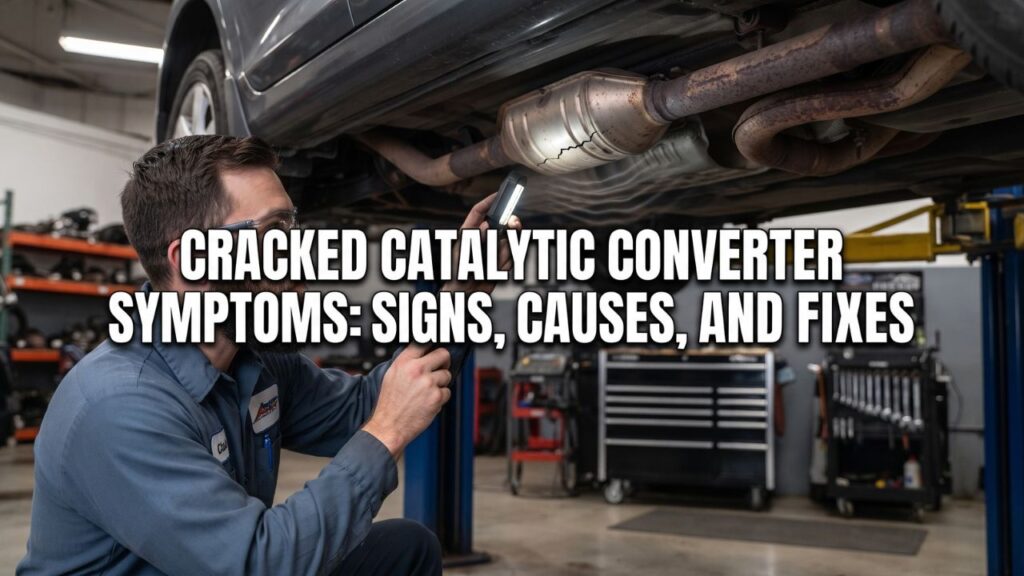
A cracked converter does not always create every symptom. The pattern depends on the location of the damage and whether exhaust flow is still open.
Rattling From Under the Vehicle
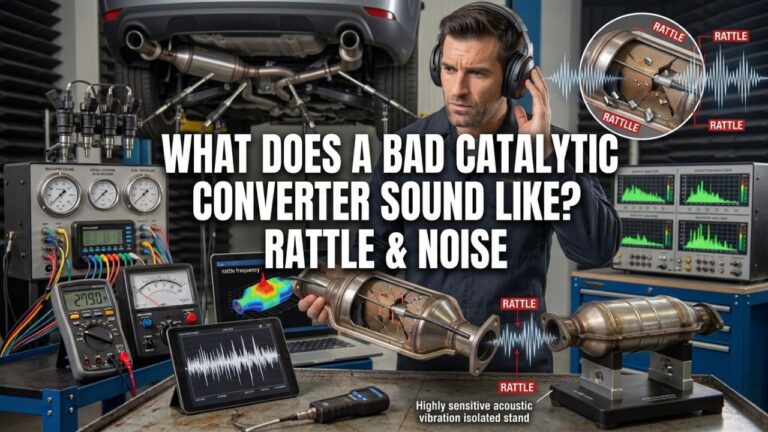
A metallic rattle is one of the stronger signs of an internally damaged catalytic converter.
Inside the metal housing is a ceramic or metallic substrate with many small exhaust passages. Excessive heat, road impact, contamination, or age can cause this material to crack and loosen.
Once pieces become loose, they can vibrate inside the converter housing.
O’Reilly notes that a damaged internal honeycomb can break loose and produce rattling noises. Loose pieces may also move farther through the exhaust or create a restriction.
The noise may be most noticeable:
- During cold startup
- At idle
- When engine RPM changes
- During light acceleration
- When the engine is shut off and the exhaust settles
Do not confuse catalyst rattle with a loose heat shield. Thin converter heat shields can create a very similar metallic buzzing noise.
Ticking, Hissing, or Puffing Exhaust Noise
An external crack in the converter shell, flange, pipe, or weld lets exhaust escape before it reaches the tailpipe.
A small crack may produce a sharp ticking sound that follows engine speed. A larger opening may sound like hissing, puffing, or a deeper exhaust leak.
The noise may be louder when the engine is cold because exhaust components have not expanded yet. As the metal becomes hot, a small crack can change size and the sound may decrease or change pitch.
Walker recommends checking converter weld areas, oxygen-sensor ports, pipe connections, clamps, and nearby flex sections for cracks and leaks during catalyst diagnosis.
Strong Exhaust Smell
A crack that allows exhaust gases to escape under the vehicle may create a stronger exhaust smell around the car.
You may notice it:
- At idle
- After parking
- With the windows open
- Near the front floor area
- Around the engine bay on close-coupled converters
Exhaust smell entering the passenger compartment deserves prompt attention.
Carbon monoxide itself has no odor, so the absence of a strong exhaust smell does not prove that cabin air is safe.
Black Soot Around the Crack
Escaping exhaust can leave black or dark-gray carbon deposits around a leak.
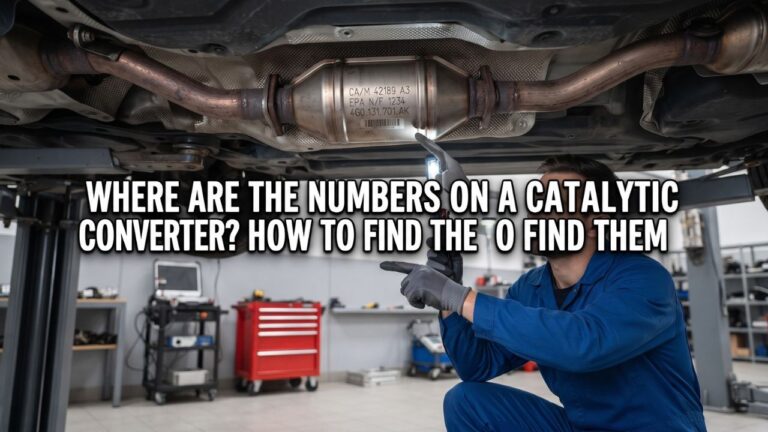
Inspect the converter shell, flange, welds, oxygen-sensor bungs, and pipe connections when the exhaust is completely cool.
A narrow soot trail can make a small crack easier to locate.
Do not touch or inspect a converter immediately after driving. Converter surfaces can remain hot long after the engine is switched off.
Check Engine Light
A cracked converter or nearby exhaust leak can trigger the check engine light.
Common codes may include:
- P0420 — Catalyst System Efficiency Below Threshold, Bank 1
- P0430 — Catalyst System Efficiency Below Threshold, Bank 2
- Lean-mixture codes
- Oxygen-sensor-related codes
A leak can draw outside oxygen into the exhaust stream and interfere with oxygen-sensor readings.
Walker states that even small exhaust leaks can affect converter oxygen storage and sensor readings, which may lead to catalyst-efficiency faults.
A P0420 or P0430 code by itself does not prove the converter is cracked. Sensor faults, engine misfires, fuel-control problems, catalyst aging, and other exhaust leaks can produce similar diagnostic results.
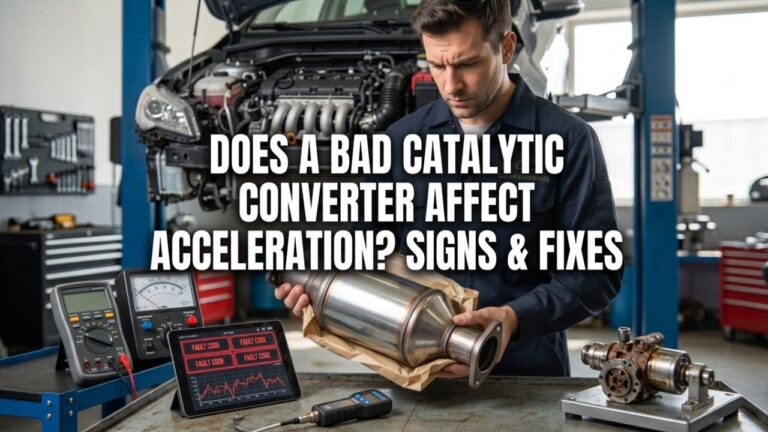
Loss of Power or Slow Acceleration
An external crack that simply leaks exhaust may not create a major power loss.
Internal damage is different.
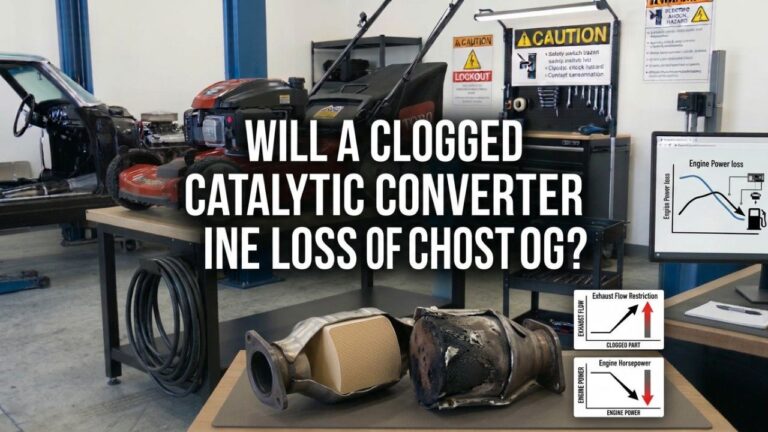
If broken catalyst material shifts and blocks exhaust passages, backpressure rises. The engine then struggles to push exhaust gases out, which may cause:
- Sluggish acceleration
- Poor high-RPM power
- Weak hill climbing
- Engine bogging
- Stalling in severe cases
Underhood Service notes that internal catalyst disintegration can create enough restriction to cause anything from mild acceleration loss to engine stalling.
Reduced Fuel Economy
Fuel economy can drop if an exhaust leak affects oxygen-sensor data or if internal restriction makes the engine work harder.
A fuel-economy change alone is not a strong converter diagnosis.
Tire pressure, cold weather, injectors, ignition faults, airflow sensors, driving conditions, transmission problems, and many other factors can change fuel use.
Look for several converter-related signs together before blaming the catalyst.
Key Takeaway: Rattling points more toward broken internal catalyst material, while ticking, hissing, soot, and exhaust odor point more toward an external shell, weld, flange, or pipe crack.
External Crack vs Internal Catalytic Converter Damage
The phrase “cracked catalytic converter” can describe two separate faults.
Crack in the Outer Converter Shell
The outside casing is exposed to water, road salt, stones, pothole impacts, and thousands of heating and cooling cycles.
A shell or weld crack creates an opening through which exhaust gas escapes.
Typical signs are:
- Hissing or ticking
- Exhaust smell
- Soot marks
- Check engine light
- Louder exhaust
- Possible fuel-trim changes
Walker lists punctures, split seams, cracked exhaust components, and leaking connections as exhaust conditions that can increase noise and release exhaust gases.
A shell crack does not automatically mean the internal catalyst brick is broken.
Cracked Ceramic Substrate Inside
The internal honeycomb is more fragile than the steel shell.
The substrate can crack from:
- Severe overheating
- Thermal shock
- Road impact
- Engine misfires
- Excess fuel entering the exhaust
- Long-term deterioration
A cracked substrate commonly produces rattling.
If fragments remain in position, engine performance may stay normal at first. If those fragments rotate, collapse, or pile together, exhaust restriction can develop.
Both Types Can Occur Together
A hard road impact can dent the shell and crack the internal substrate.
Extreme heat can damage the catalyst brick and stress surrounding metal.
That is why a visual inspection of the shell should be combined with checks for rattle, backpressure, codes, and engine problems.
Key Takeaway: An outer crack mainly creates an exhaust leak; an internal crack can create rattling and may eventually restrict exhaust flow.
What Causes a Catalytic Converter to Crack?
Converter damage is often the result of another problem rather than random failure.
Road Impact
Catalytic converters are mounted beneath the vehicle on many models.
Hitting road debris, a curb, a large rock, or an object in the roadway can dent the shell or crack a weld.
Low-clearance vehicles are more exposed to this type of damage.
A strong enough impact can also fracture the ceramic catalyst inside without creating an obvious hole in the outer shell.
Corrosion
Road salt, moisture, and repeated heat cycles can weaken the converter shell, nearby pipe, flanges, or welds.
Rust damage is more common in regions where winter road salt is heavily used.
Once the metal becomes thin, vibration and thermal expansion can open a crack.
Engine Misfires
An active misfire can send unburned fuel and oxygen into the exhaust.
That mixture may react inside the converter and create extreme heat.
Walker reports that temperatures above roughly 1,600°F can damage catalyst materials, with still higher temperatures capable of damaging the substrate and surrounding matting.
Repeated overheating can weaken and crack the ceramic brick.
Rich Air-Fuel Mixture
An engine running too rich sends excess fuel into the exhaust.
Possible causes include:
- Leaking fuel injector
- Excessive fuel pressure
- Ignition failure
- Faulty airflow measurement
- Sensor errors
- Engine-control faults
The converter then has to process more hydrocarbons than normal, increasing internal temperature.
Oil or Coolant Contamination
Oil burning and internal coolant leaks can contaminate the catalyst surface.
Deposits can damage catalyst operation and may contribute to overheating or structural deterioration over time.
Fix the engine problem before replacing a damaged converter.
Broken Mounts or Exhaust Hangers
The exhaust system needs proper support.
A broken hanger can allow excessive movement that places stress on converter pipes, welds, and flanges.
Engine movement from failed motor mounts can also stress close-coupled exhaust assemblies.
Key Takeaway: Impact, corrosion, extreme heat, misfires, rich operation, contamination, and unsupported exhaust movement are common causes of converter cracking.
How a Cracked Catalytic Converter Sounds
Noise can provide clues about the type of damage.
Rattle Like Stones in a Metal Can
This usually points toward loose material inside the converter.
The sound may change as the vehicle moves because broken catalyst pieces can shift.
If the rattle becomes accompanied by loss of acceleration, restriction becomes a larger concern.
Sharp Tick That Speeds Up With the Engine
A ticking sound near the converter often fits a small exhaust leak.
The frequency rises with engine speed because individual exhaust pulses escape through the crack.
A leak around an exhaust manifold or flange can sound almost identical, so locating the source matters.
Hissing Under Acceleration
A larger crack can make a steady hiss as exhaust flow and pressure increase.
The sound may become more noticeable when climbing a hill or accelerating because more exhaust gas is passing through the system.
Buzzing or Tinny Vibration
This may come from a loose heat shield rather than a cracked converter.
Inspect the shield and mounting points before assuming the catalyst brick has broken.
A loose shield is often much less expensive to repair than a converter.
Can a Cracked Catalytic Converter Cause P0420 or P0430?
Yes, it can, but these codes need diagnosis rather than automatic converter replacement.
P0420 and P0430 tell you that the engine computer sees catalyst behavior below its programmed threshold.
A crack or exhaust leak can affect the sensor data used for that calculation.
Outside air entering near an oxygen sensor changes oxygen concentration in the exhaust stream. The computer may then interpret the rear sensor signal as evidence of poor catalyst operation.
Walker recommends repairing exhaust leaks before making a final converter diagnosis because leaks can distort oxygen-sensor operation and catalyst monitoring.
Check for:
- Cracked welds
- Flange leaks
- Damaged gaskets
- Loose clamps
- Oxygen-sensor-port leaks
- Flex-pipe cracks
Fixing the leak may need to come before judging the converter’s catalyst efficiency.
Can a Cracked Catalytic Converter Cause Exhaust Fumes Inside the Car?
Yes, an external crack can release exhaust beneath the vehicle, and some of those gases may enter the passenger compartment.
This becomes more concerning while:
- Sitting at idle
- Driving with windows open
- Using the HVAC system
- Operating in a garage
- Driving with rear windows or a hatch open
CDC specifically advises having vehicle exhaust systems checked because even a small leak can allow carbon monoxide to build up inside the vehicle.
Safety Tip: If occupants develop headache, dizziness, weakness, nausea, or confusion while inside a vehicle with a suspected exhaust leak, move into fresh air and seek appropriate medical help. Do not continue using the vehicle until the leak is addressed.
How to Check for a Cracked Catalytic Converter
A proper diagnosis should determine if the damage is external, internal, or both.
Inspect the Converter When Completely Cold
Look underneath the vehicle with adequate lighting.
Never work under a vehicle supported only by a hydraulic jack.
Check:
- Converter shell
- Weld seams
- Inlet and outlet pipes
- Flanges
- Oxygen-sensor ports
- Flex pipe
- Brackets and hangers
Look for cracks, dents, rust holes, soot, or damaged mounting points.
Listen During a Cold Start
A small exhaust leak is often easiest to hear when the engine starts cold.
Listen for ticking, hissing, or puffing near the converter and nearby exhaust joints.
Avoid placing your hands near a leak to feel for escaping gas. Exhaust components heat quickly.
Check for Internal Rattle
With the exhaust completely cool, a technician may lightly check the converter housing for loose internal components.
Walker states that a cracked substrate or damaged matting may produce a rattle when the converter housing is lightly tapped with an appropriate tool.
Do not strike the shell hard. Ceramic catalyst material can be fragile.
Scan for Diagnostic Codes
Record stored, pending, and permanent OBD-II codes.
Codes may provide clues about:
- Catalyst efficiency
- Engine misfire
- Rich or lean operation
- Oxygen sensors
- Airflow
- Fuel control
Do not clear the codes before recording them because freeze-frame data may show the conditions present when the fault occurred.
Test Exhaust Backpressure if Power Is Low
If the vehicle also has weak acceleration, test exhaust restriction.
Walker gives general reference values below about 1.5 psi at idle and 3 psi at 2,000 RPM, though vehicle-specific data should take priority.
High pressure ahead of the converter supports a restriction diagnosis.
Key Takeaway: Visual inspection, noise checks, scan data, and backpressure testing separate a simple shell leak from internal catalyst damage that is affecting engine operation.
Can You Drive With a Cracked Catalytic Converter?
A small external crack may not immediately stop the vehicle from running, but continued driving is not something I would ignore.
Minor External Crack
The car may still drive normally if:
- Exhaust flow is open
- The substrate is intact
- There is no major cabin-fume problem
- Engine performance remains normal
The crack can still grow as the exhaust repeatedly heats and cools.
Internal Crack With Rattling
Loose catalyst material may remain harmlessly in place for a while, then move and block the exhaust.
That makes the future behavior difficult to predict.
A converter that rattles deserves inspection even if acceleration still feels normal.
Severe Restriction
Avoid normal driving if you have:
- Major power loss
- Stalling
- Converter glowing red
- Flashing check engine light
- Severe overheating
- Strong burning smell
These signs may indicate a damaged substrate or an engine fault that is rapidly overheating the catalyst.
Exhaust Fumes in the Cabin
Cabin fumes deserve prompt repair.
The safest response is to stop using the vehicle until the exhaust leak has been located and repaired, especially if symptoms suggest possible carbon-monoxide exposure.
Does a Cracked Catalytic Converter Need to Be Replaced?
That depends on where the crack is located and the condition of the converter.
Cracked Internal Substrate
If the catalyst brick has broken apart, the normal repair is converter replacement.
The substrate cannot be glued or rebuilt inside the shell.
Replacement becomes even more likely when there is:
- Persistent rattling
- Exhaust restriction
- Catalyst-efficiency failure
- Melted substrate
- Broken internal pieces
Cracked or Rusted Converter Shell
A crack directly through a thin or corroded converter shell often leads to replacement.
Trying to weld metal that is badly rusted may create another leak nearby.
A repair shop can assess if the crack is limited to a weld or pipe section that can be repaired without damaging the converter.
Nearby Pipe or Flange Crack
Sometimes the catalytic converter itself is fine.
The leak may be in:
- A flange
- A gasket
- The inlet pipe
- The outlet pipe
- A flex section
- An oxygen-sensor bung
Repairing that specific fault may preserve the original converter.
Check Warranty Before Paying
If the original converter is still within the applicable 8-year/80,000-mile federal emissions warranty, contact the vehicle manufacturer or an authorized dealer before approving an expensive replacement.
Warranty eligibility depends on the cause of failure and applicable terms.
Key Takeaway: Broken internal catalyst material usually means replacement, while an external leak may sometimes come from a repairable pipe, flange, gasket, or weld next to the converter.
Conclusion
Cracked catalytic converter symptoms vary depending on which part has failed. An external shell or weld crack commonly creates ticking, hissing, exhaust smell, soot, and sensor-related codes. A cracked internal substrate is more likely to rattle and can eventually reduce power if fragments restrict exhaust flow.
The most useful diagnosis is to separate an exhaust leak from internal catalyst damage. Inspect the shell and connections, scan for codes, listen for a loose substrate, and check backpressure if acceleration has dropped.
I’d address cabin exhaust fumes, severe power loss, stalling, a flashing check engine light, or an overheating converter promptly. If the internal catalyst is broken or melted, replacement is usually required, and the engine fault that caused the damage should be corrected at the same time.
FAQs About Cracked Catalytic Converter Signs
Can a cracked catalytic converter cause a check engine light?
Yes. A crack can create an exhaust leak that changes oxygen-sensor readings, and internal catalyst damage can reduce emissions conversion. Either condition may contribute to P0420, P0430, lean codes, or sensor-related faults. Codes should be diagnosed along with exhaust leaks, engine operation, and sensor data before replacing the converter.
What does a cracked catalytic converter sound like?
An internal crack commonly produces a metallic rattle as loose catalyst material moves inside the shell. An external shell, pipe, or weld crack usually sounds more like ticking, hissing, or puffing. A loose heat shield can imitate an internal converter rattle, so the source should be located before parts are ordered.
Can a cracked catalytic converter cause loss of power?
Yes, if the internal catalyst breaks apart and restricts exhaust flow. A simple outer-shell leak may have little effect on power. If broken pieces block the honeycomb or outlet, backpressure rises and acceleration may become weak, mainly under heavy throttle or at higher engine speed.
Can a cracked catalytic converter leak exhaust?
Yes. A crack through the metal shell, weld, flange, or nearby pipe lets exhaust escape before it reaches the tailpipe. Signs can include ticking, soot deposits, louder exhaust, strong fumes, and possible oxygen-sensor problems. Exhaust entering the cabin creates a carbon-monoxide concern.
Can a cracked catalytic converter be welded?
Some localized cracks in pipes, flanges, or accessible weld areas may be repairable by an exhaust specialist if the metal is sound and the catalyst itself is intact. A rusted-through shell, broken internal substrate, melted catalyst, or badly damaged converter normally calls for replacement rather than a simple weld repair.
Will a cracked catalytic converter cause P0420?
It can. A leak near the converter or oxygen sensors may allow outside oxygen into the exhaust and alter the sensor signals used by the catalyst monitor. Internal catalyst damage can also lower actual conversion activity. P0420 alone does not identify the exact cause, so leaks and engine faults should be checked first.
Is it safe to drive with a cracked catalytic converter?
A vehicle may still run with a small crack, but exhaust leakage, possible cabin fumes, internal substrate movement, and future restriction make continued use a poor long-term choice. Stop driving and seek repair sooner if the vehicle has strong cabin fumes, major power loss, stalling, severe heat, or a flashing check engine light.