What Happens If Your Catalytic Converter Goes Out? Signs & Risks
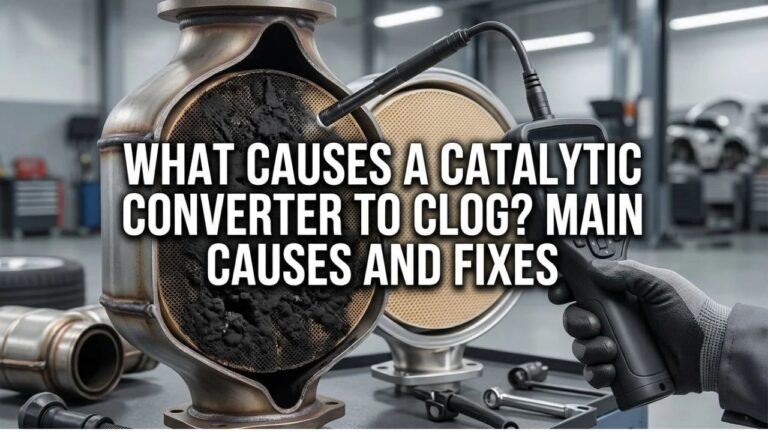
When a catalytic converter fails, the car may turn on the check-engine light, produce more exhaust pollution, lose acceleration, use more fuel, develop a sulfur smell, or make a metallic rattle. If the converter becomes physically clogged, the engine may struggle to breathe, lose substantial power, stall, or become difficult to start.
The severity depends on how the converter failed. A converter that has simply lost catalyst activity may cause little noticeable change in how the car drives. A melted or collapsed internal core is different because it can restrict exhaust flow and create serious drivability problems.
Recognizing that difference can prevent wasted repairs. A P0420 or P0430 code does not automatically mean the converter is blocked, while severe loss of power does not automatically mean the transmission or fuel system has failed.
For U.S. vehicle owners, the EPA classifies the catalytic converter as a specified major emissions-control component. Qualifying light-duty vehicles receive federal emissions warranty coverage for 8 years or 80,000 miles, subject to the warranty conditions.
The short answer to what happens if your catalytic converter goes out is that the car may move from an emissions-only problem to a major performance problem as internal damage gets worse. A worn catalyst may only trigger a warning light, while a melted or broken substrate can choke exhaust flow, rattle, overheat, and eventually make the engine stall.
I’d pay closest attention to the combination of symptoms rather than one warning by itself. Check-engine codes, sluggish acceleration, rattling, unusual exhaust heat, hard starting, and a sulfur odor together provide a much stronger reason to inspect the converter and the engine problem that damaged it.
The sections below explain what changes when the converter fails, which symptoms appear first, what happens when it becomes clogged, how the engine is affected, how long you may be able to drive, and what should be diagnosed before a replacement converter is installed.
What Happens If Your Catalytic Converter Goes Out Completely?
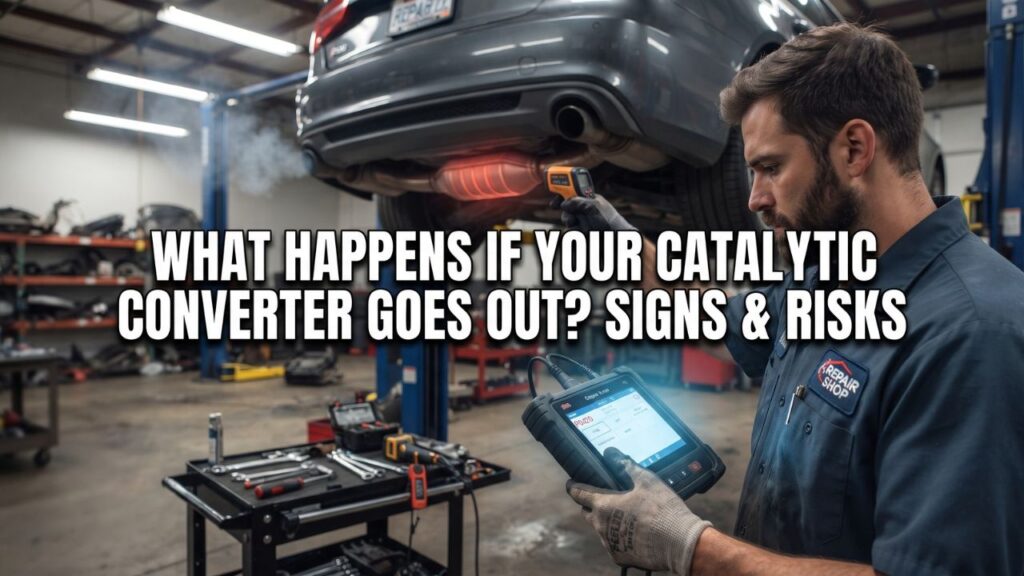
A failed catalytic converter can affect emissions, engine performance, fuel use, exhaust temperature, and drivability. The exact result depends on the internal failure.
The Check-Engine Light May Come On
A converter that is no longer processing exhaust gases as expected may trigger a catalyst-efficiency code.
Two common codes are:
- P0420 — Catalyst System Efficiency Below Threshold, Bank 1
- P0430 — Catalyst System Efficiency Below Threshold, Bank 2
These codes do not directly mean the converter is clogged.
The computer monitors catalyst operation mainly through oxygen-sensor behavior. A converter can fail its emissions test while still allowing exhaust to flow freely.
Walker states that a P0420 code does not automatically prove that the converter itself needs replacement because exhaust-gas balance and other engine faults can affect catalyst operation.
Engine Power May Drop
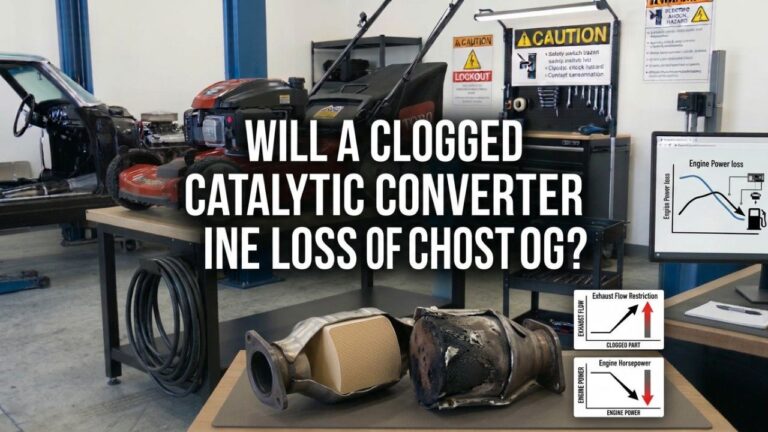
If the converter becomes restricted, exhaust gases cannot leave the engine freely.
That creates backpressure. The engine then has more difficulty clearing burned gases from its cylinders and drawing in a fresh air-fuel charge.
The driver may notice:
- Slow acceleration
- Poor response at higher RPM
- Trouble climbing hills
- Difficulty maintaining highway speed
- More throttle needed for normal acceleration
Walker lists sluggish acceleration, hard starts, loss of power, and stalling among drivability problems associated with a failing or clogged converter.
The Engine May Stall or Become Hard to Start
A severely plugged converter can trap enough exhaust pressure to interfere with normal engine operation.
The car may start but run poorly as pressure builds. In a severe blockage, it may stall or become difficult to restart.
Cars.com also lists reduced acceleration and an engine that may shut off or fail to start when converter problems become severe.
Key Takeaway: Converter failure can start as an emissions warning and progress to major power loss, hard starting, or stalling if the internal core becomes restricted.
Early Signs a Catalytic Converter Is Going Bad
Converter trouble does not always appear suddenly. Several warning signs may develop before the car becomes difficult to drive.
Check-Engine Light
A warning light may be the first symptom, especially when catalyst efficiency has dropped but exhaust flow is still normal.
Scan the vehicle before buying parts.
P0420 or P0430 can point toward the catalyst system, but oxygen sensors, exhaust leaks, misfires, and fuel-control faults should also be checked.
Sluggish Acceleration
Loss of acceleration becomes more suspicious when it gets worse as engine load or RPM rises.
A partially blocked converter may still flow enough exhaust for smooth idle and light driving. Hard acceleration produces much more exhaust volume, exposing the restriction.
CARFAX notes that a clogged converter can restrict exhaust flow enough to cause sluggish acceleration or stalling.
Metallic Rattle
A rattling converter often contains cracked or loose internal substrate.
The ceramic honeycomb can break after overheating, physical impact, or other internal damage.
Loose pieces may move inside the housing. They may also shift into a position that restricts exhaust flow.
A loose heat shield can create a similar noise, so locate the rattle before replacing the converter.
Rotten-Egg or Sulfur Smell
A sulfur-like odor can accompany catalyst or engine problems.
Cars.com notes that a rotten-egg smell may occur when the converter is no longer processing sulfur compounds as expected.
Do not use odor alone for diagnosis. Fuel quality, battery problems, and other faults can produce smells that drivers describe in similar ways.
Poor Fuel Economy
A clogged exhaust can force the driver to use more throttle to obtain the same acceleration.
Fuel-control problems that damage the converter may also increase gasoline use before the converter itself fails.
A sudden mileage drop deserves diagnosis, especially when it appears beside a catalyst code or weak acceleration.
Key Takeaway: The most common early clues are a check-engine light, sluggish acceleration, rattling, sulfur odor, and worsening fuel economy.
What Happens When a Catalytic Converter Gets Clogged?
Clogging is one of the more serious forms of converter failure because it interferes directly with exhaust flow.
Exhaust Backpressure Rises
The converter contains thousands of small passages through its internal substrate.
If those passages melt, collapse, or become blocked by debris, exhaust has fewer paths through the converter.
Pressure builds upstream.
That can make the engine feel normal at low load but weak when greater exhaust flow is required.
High-RPM Power Can Disappear
A partially restricted engine may idle smoothly and even drive reasonably at low speed.
Press the accelerator hard, and the engine may stop building power.
This pattern occurs because the restriction becomes more limiting as exhaust volume increases.
A clogged converter is therefore easy to confuse with:
- Weak fuel delivery
- Ignition trouble
- Turbocharger problems
- Transmission trouble
- Airflow-sensor faults
Backpressure testing can separate physical exhaust restriction from those other causes.
The Converter Can Become Extremely Hot
A converter can overheat when excess unburned fuel reaches the exhaust.
Misfires are a major cause. Fuel that fails to burn inside a cylinder can enter the exhaust and burn inside the converter.
Walker states that converter temperatures above roughly 1,600°F can damage catalyst material even without visible melting.
Repeated overheating may melt the substrate into a solid or partly solid mass, creating the restriction.
Broken Material Can Block Another Converter
Some vehicles have more than one catalyst.
Walker notes that material from a failed upstream converter can break apart and clog a downstream unit.
That means replacing only the visibly damaged front unit may not restore exhaust flow if debris has moved farther downstream.
Key Takeaway: A clogged converter raises exhaust backpressure, cuts power under load, may overheat, and can send broken substrate into another exhaust component.
Different Types of Catalytic Converter Failure
Not every bad converter behaves the same way.
| Failure Type | What Happens | Common Symptoms |
| Low catalyst efficiency | Exhaust treatment falls below the expected level | Check-engine light, P0420/P0430, emissions failure |
| Melted substrate | Internal passages close from excess heat | Major power loss, high backpressure, heat |
| Broken substrate | Ceramic core cracks or separates | Rattling, possible restriction |
| Oil contamination | Catalyst surface becomes coated | Efficiency codes, smoke, oil consumption |
| Coolant contamination | Catalyst surface becomes contaminated | Efficiency loss, white exhaust smoke may be present |
| Physical damage | Core or housing is damaged by impact | Rattle, leak, restriction, visible damage |
Efficiency Failure May Not Affect Driving
A chemically worn converter may still allow exhaust through normally.
The car can feel completely normal while displaying a catalyst code or failing an emissions inspection.
This is why P0420 should not automatically be described as a clogged converter.
Structural Failure Can Affect Performance
A broken or melted core changes exhaust flow.
Once backpressure rises enough, engine performance suffers.
The condition can progress from mild hesitation to severe acceleration loss or stalling.
Contamination Can Destroy Catalyst Activity
Oil or coolant entering the exhaust may coat the catalyst surface.
Walker lists excessive oil consumption and internal coolant leaks among causes of converter contamination.
The converter may still look intact from the outside.
Key Takeaway: Chemical failure mainly affects emissions, while melted or broken internal material is more likely to cause rattling, restriction, and major performance trouble.
Can a Bad Catalytic Converter Damage the Engine?
A failed converter does not automatically ruin an engine, but severe restriction and the fault that caused the converter failure should not be ignored.
Severe Backpressure Can Hurt Engine Operation
A clogged exhaust makes it difficult for the engine to expel combustion gases.
Performance falls, temperatures may rise, and the engine may stall.
Walker states that extended driving with converter problems can reduce drivability and contribute to overheating.
The safer approach is to diagnose a severe restriction rather than repeatedly forcing the engine through full-throttle acceleration.
The Original Engine Fault May Be the Bigger Threat
A converter often fails because another problem came first.
Common causes include:
- Persistent misfires
- Weak or missing spark
- Excessively rich fuel mixture
- Oil burning
- Internal coolant leakage
- Low compression
- Physical exhaust damage
Walker groups converter failures around overheating, contamination, and structural damage and warns that the underlying cause should be repaired before a new converter is installed.
A New Converter Can Fail Again
Installing a new catalytic converter does not repair a leaking injector, worn piston rings, head-gasket leak, or dead ignition coil.
If those faults continue feeding excess fuel, oil, or coolant into the exhaust, the replacement converter may suffer the same failure.
Key Takeaway: Severe restriction can interfere with engine operation, but the misfire, rich mixture, oil burning, or coolant leak that killed the converter may pose an even larger mechanical problem.
Can You Drive When the Catalytic Converter Goes Out?
Sometimes the vehicle remains drivable, but the symptom severity should guide the decision.
Efficiency Code With Normal Performance
A car with only P0420 or P0430 may still start, accelerate, and drive normally.
That does not mean the fault should be ignored. The car may fail an emissions inspection, and the cause still needs diagnosis.
Check warranty status before paying for replacement. EPA federal coverage for specified major emissions components includes the catalytic converter for qualifying vehicles through 8 years or 80,000 miles.
Mild Rattle With Normal Power
A light rattle may come from a loose heat shield rather than the internal catalyst.
Have the source inspected.
If internal ceramic material is broken, the condition can worsen or shift into a position that restricts exhaust.
Severe Power Loss or Stalling
Do not continue normal driving if the car cannot accelerate safely, repeatedly stalls, or struggles to maintain road speed.
A severe restriction can make highway merging or crossing traffic difficult.
Arrange diagnosis instead of trying to force the car to keep running.
Flashing Check-Engine Light
A flashing check-engine light commonly points toward a severe misfire on many vehicles.
That matters because unburned fuel can overheat the converter rapidly.
Follow the owner’s manual for the warning behavior on your vehicle and avoid continued hard driving with an active severe misfire.
Key Takeaway: A catalyst-efficiency code may leave the car drivable, but severe power loss, stalling, overheating, or a flashing warning light calls for much faster attention.
How to Confirm the Catalytic Converter Has Gone Bad
Do not replace an expensive converter from one symptom.
Use several checks.
Scan for Trouble Codes
Read stored and pending codes before clearing anything.
Look for:
- P0420
- P0430
- Misfire codes
- Fuel-trim codes
- Oxygen-sensor faults
- Other engine codes
A misfire or fuel code may reveal what damaged the catalyst.
Test Exhaust Backpressure
Backpressure testing is one of the strongest tests for a physical blockage.
A gauge is commonly fitted ahead of the converter through an oxygen-sensor port.
Walker gives a general reference of less than 1.5 psi at idle and less than 3 psi at 2,000 RPM, though vehicle-specific specifications should be used when available.
High pressure ahead of the converter points toward restriction downstream of the test location.
Inspect the Exhaust
Once the exhaust is cool, inspect for:
- Impact damage
- Crushed pipes
- Broken hangers
- Loose heat shields
- Exhaust leaks
- Heat discoloration
- Internal rattling
Do not work beneath a vehicle supported only by a jack.
Check the Engine Before Replacing the Converter
A replacement should follow diagnosis of the failure cause.
Check ignition, fuel control, oil consumption, coolant loss, compression, and other relevant engine conditions.
Key Takeaway: Use codes, backpressure, exhaust inspection, and engine diagnosis together before deciding that the converter itself needs replacement.
What Should You Do After a Catalytic Converter Fails?
Start by separating converter damage from the fault that caused it.
If the converter has simply lost catalyst activity with no drivability problem, the repair path may begin with codes, oxygen-sensor data, exhaust-leak inspection, and emissions diagnosis.
If it is physically clogged or broken, replacement is usually needed. A melted honeycomb or fractured internal substrate cannot be restored to its original structure with a fuel additive.
Do not replace the converter before correcting a persistent misfire, oil-burning problem, coolant leak, or rich fuel condition.
Also check the vehicle’s emissions warranty before authorizing the repair. A qualifying converter may still fall under federal 8-year/80,000-mile coverage.
Conclusion
What happens if your catalytic converter goes out depends on the type and severity of failure. A converter that loses chemical activity may only turn on the check-engine light and increase emissions, while a physically clogged converter can cause poor acceleration, hard starting, stalling, excess heat, and major loss of engine power.
Rattling often points toward broken internal substrate. P0420 or P0430 points toward catalyst-efficiency trouble. Neither clue alone proves that the exhaust is physically blocked, so backpressure and engine diagnosis matter before replacement.
The next step should also include finding the cause. Misfires, excess fuel, oil consumption, coolant leaks, and physical damage can destroy a converter and may damage the replacement if left unresolved.
I’d treat severe power loss, stalling, a glowing exhaust component, or a flashing check-engine light as reasons to stop stretching the repair. A car that cannot accelerate predictably should be diagnosed before it returns to normal driving.
FAQs About a Catalytic Converter Going Out
Can a car still run with a bad catalytic converter?
Yes. A converter that has only lost emissions efficiency may leave the car driving normally. A badly clogged converter can cause weak acceleration, hard starting, or stalling. How the car runs depends more on exhaust restriction than on the presence of a catalyst-efficiency code alone.
What are the first signs of a catalytic converter going bad?
Common early signs include a check-engine light, P0420 or P0430, sluggish acceleration, a sulfur-like exhaust odor, poor fuel economy, or a rattle underneath the vehicle. Some converters lose efficiency without producing any noticeable driving symptom.
What happens if a catalytic converter gets completely clogged?
Exhaust backpressure can rise enough to reduce cylinder breathing severely. The engine may lose most of its acceleration, struggle at higher RPM, become difficult to start, or stall. A direct exhaust-backpressure test can confirm a physical restriction.
Will a bad catalytic converter make the car shake?
It can contribute indirectly if severe restriction causes rough engine operation or if the converter failed because the engine is misfiring. Shaking has many other possible causes, including ignition faults, engine mounts, fuel problems, and transmission issues, so vibration alone does not identify the converter.
Will a bad catalytic converter always turn on the check-engine light?
No. Catalyst-efficiency failure commonly sets P0420 or P0430, but a physical restriction may develop before the monitor sets a code. The catalyst monitor may also be incomplete after codes are cleared or the battery is disconnected.
Can a bad catalytic converter cause the car to stall?
Yes. A severe blockage can trap exhaust and prevent the engine from moving enough air to keep running. Stalling can also come from fuel, ignition, sensor, or mechanical problems, so exhaust restriction should be confirmed before replacing the converter.
Can a bad catalytic converter ruin gas mileage?
It can. A restricted converter may require greater throttle input for the same acceleration, while the fuel or ignition problem that damaged the converter may also raise fuel consumption. A sudden mileage drop should be diagnosed with the rest of the symptoms.
Does a failed catalytic converter need to be replaced immediately?
A structurally damaged, melted, or badly restricted converter generally needs replacement. A catalyst-efficiency code with normal drivability still needs diagnosis but may not create the same immediate driving risk. Severe power loss, stalling, excess heat, or an active misfire calls for much quicker action.