How Long Can You Drive With Catalytic Converter Light On Safely?
A steady Check Engine Light linked to a catalytic-converter fault may still allow short-term driving if the vehicle runs normally, but there is no safe mileage limit that applies to every car. A flashing light, severe misfire, major power loss, excessive exhaust heat, or stalling calls for immediate attention and minimal driving.
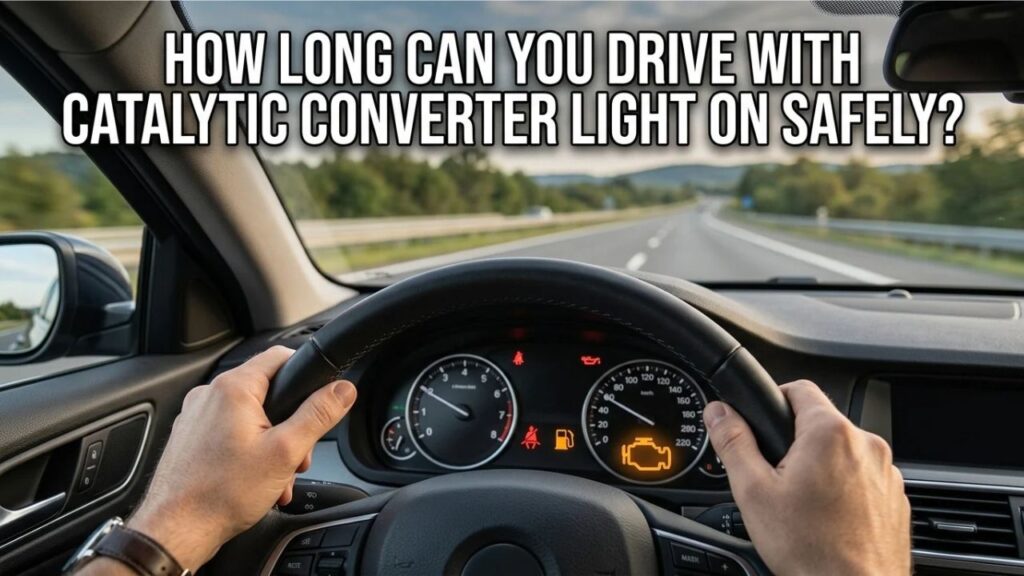
There usually is not a separate dashboard light dedicated only to the catalytic converter. On most modern vehicles, catalyst problems illuminate the Check Engine Light, also called the malfunction indicator lamp or MIL.
How urgent the situation is depends heavily on the fault behind that light. A converter-efficiency code such as P0420 may leave the vehicle driving normally, while a severe misfire can overheat and permanently damage the converter in a short period.
EPA guidance says a steadily illuminated MIL is generally a signal to arrange service soon rather than immediately stop the vehicle. A flashing MIL is much more serious because it can indicate a severe misfire capable of damaging the catalytic converter quickly.
For how long can you drive with catalytic converter light on, I would think in terms of symptoms rather than miles. A car with a steady light, normal temperature, normal acceleration, and no misfire may make a short trip to a repair shop. A car that shakes badly, loses power, smells hot, or flashes the light should not be driven farther than necessary to reach a safe place.
There is also a cost reason to act early. EPA explains that OBD systems are intended to catch emissions faults before they lead to larger emissions increases or more expensive damage.
The sections below explain steady versus flashing warning lights, P0420 and P0430, how far you may be able to drive, symptoms that mean stop immediately, risks of delaying repair, and what to check before replacing the converter.
How Long Can You Drive With Catalytic Converter Light On?
There is no manufacturer-wide rule such as 50 miles, 500 miles, or one week.
The answer depends on:
- Why the light came on
- Whether the light is steady or flashing
- Engine temperature
- Misfire severity
- Exhaust restriction
- Converter temperature
- Engine power
- Stored trouble codes
A steady catalyst-related Check Engine Light may allow short-term driving if the engine behaves normally.
A flashing light deserves much faster action.
If the Light Is Steady
A steady Check Engine Light can indicate an emissions fault that is not immediately catastrophic.
Examples include:
- P0420
- P0430
- Oxygen-sensor fault
- Minor fuel-control problem
- EVAP fault
- Catalyst-efficiency deterioration
EPA guidance says a continuously illuminated MIL generally means the vehicle needs service soon rather than requiring an immediate roadside stop.
That does not mean it is wise to continue driving indefinitely.
Arrange diagnosis as soon as practical.
If the Light Is Flashing
A flashing Check Engine Light is different.
EPA states that blinking or flashing can indicate a severe engine misfire and advises reducing speed and seeking service quickly. Severe misfire can damage emissions components, especially the catalytic converter, over a short period.
Avoid:
- Highway speeds
- Hard acceleration
- Towing
- Heavy loads
- Long climbs
- Extended driving
If the engine is shaking badly or losing substantial power, stop driving and arrange towing.
If the Car Drives Normally
Normal drivability reduces the immediate risk, but it does not prove the converter is healthy.
A chemically weak catalytic converter can trigger P0420 while allowing normal exhaust flow.
The vehicle may:
- Idle smoothly
- Accelerate normally
- Reach highway speed
- Show normal coolant temperature
- Have no unusual exhaust noise
That situation is less urgent than a restricted or overheating converter, but diagnosis is still needed.
Key Takeaway: A steady light with normal drivability may permit short-term driving to arrange repair; a flashing light or severe symptoms calls for minimal driving and rapid diagnosis.
Is There Really a Catalytic Converter Warning Light?
Most vehicles do not have a dedicated catalytic-converter symbol.
Catalyst faults are normally reported through the Check Engine Light.
The Check Engine Light Monitors Emissions Faults
OBD-II monitors numerous engine and emissions systems.
EPA documentation identifies monitored functions that include:
- Catalyst efficiency
- Engine misfire
- Oxygen sensors
- Fuel system
- EVAP system
- EGR-related systems on equipped vehicles
When a monitored fault meets the programmed threshold, the computer stores a diagnostic trouble code and may command the MIL on.
Common Catalyst Codes
Two codes are strongly associated with catalytic-converter operation:
P0420 — Catalyst System Efficiency Below Threshold, Bank 1
P0430 — Catalyst System Efficiency Below Threshold, Bank 2
These codes do not always mean the converter is clogged.
They primarily indicate that catalyst operation appears below the PCM’s expected threshold.
A Flashing Light Usually Points to Misfire
If the light flashes rather than remaining steadily illuminated, severe misfire is often the bigger concern.
The converter may still be healthy at the start of the event.
Continued misfiring can then damage it.
Key Takeaway: The “catalytic converter light” is generally the Check Engine Light, with P0420 or P0430 among the common catalyst-related codes.
Can You Drive With P0420 or P0430?
In many cases, a vehicle with P0420 or P0430 can still physically drive.
The question is how the vehicle behaves and what caused the code.
P0420 With No Driving Symptoms
Suppose the car has:
- Steady Check Engine Light
- Normal acceleration
- Smooth idle
- No overheating
- No rattling
- No sulfur smell
- No flashing MIL
That pattern often points more toward catalyst-efficiency deterioration than severe physical restriction.
Driving a short distance to diagnosis is generally less concerning in this situation.
P0420 With Major Power Loss
If P0420 comes with major acceleration loss, limited RPM, or stalling, the converter may be physically restricted.
A melted or collapsed catalyst core can block exhaust flow.
Continuing to drive against that restriction can increase heat and make the vehicle unsafe in traffic.
P0420 With Misfire Codes
Pay close attention to codes such as:
- P0300
- P0301
- P0302
- P0303
- P0304
A severe misfire can send unburned fuel into the converter.
That fuel can burn inside the catalyst and produce damaging heat.
In that situation, the misfire may be more urgent than P0420 itself.
Key Takeaway: P0420 or P0430 with normal drivability is less urgent than the same code paired with misfires, severe power loss, stalling, or high exhaust heat.
Symptoms That Mean You Should Stop Driving
Some warning signs suggest that continuing the trip could damage the converter further or leave you stranded.
Flashing Check Engine Light
This is one of the strongest warning signs.
EPA guidance associates a flashing MIL with severe misfire and potential catalyst damage.
Reduce load and speed immediately.
If the engine continues shaking badly, tow the vehicle.
Severe Loss of Acceleration
A car that suddenly struggles to accelerate may have a badly restricted converter.
The engine can be unable to push exhaust through the blocked honeycomb.
This can make merging or crossing traffic unsafe.
Glowing Catalytic Converter
A converter that visibly glows red or orange is excessively hot.
Possible causes include:
- Severe misfire
- Rich fuel mixture
- Raw fuel entering the exhaust
- Internal converter damage
Turn the engine off in a safe location and keep the vehicle away from dry grass or combustible material.
Strong Burning Smell
A sharp burning odor paired with excessive underbody heat deserves immediate attention.
The smell can come from an overheated catalyst, exhaust component, wiring, or another hot part.
Severe Engine Shaking
Strong shaking may indicate multiple-cylinder misfire.
Continued combustion failure can send large amounts of unburned fuel into the exhaust.
Repeated Stalling
A badly restricted exhaust can cause the engine to stall.
If it repeatedly stalls in traffic, continued driving creates both mechanical and safety concerns.
Smoke From Under the Vehicle
Smoke beneath the floor should never be ignored.
Pull over safely and switch the engine off.
If there is any sign of fire, move away from the vehicle and contact emergency services.
Key Takeaway: A flashing MIL, major power loss, glowing converter, severe shaking, stalling, smoke, or extreme heat means stop driving as soon as safely possible.
What Happens if You Keep Driving With the Light On?
The outcome ranges from no immediate change to expensive converter or engine damage.
The Converter May Overheat
Misfires and rich fuel mixtures can send excess fuel into the exhaust.
That fuel can burn inside the converter.
Converter temperature can rise far beyond normal operating conditions.
Catalyst Material Can Melt
Extreme heat can damage the ceramic substrate.
Once portions of the honeycomb melt together, exhaust passages shrink or close.
That turns an emissions-efficiency problem into an exhaust restriction.
The Car May Lose More Power
A progressively clogged converter can cause:
- Slow acceleration
- Limited RPM
- Hard starting
- Rough idle
- Stalling
The vehicle may eventually become difficult to drive.
Fuel Economy Can Drop
An engine with a misfire, mixture problem, or restricted exhaust may use more fuel.
Poor fuel economy may continue getting worse until the original fault is repaired.
Repair Cost Can Increase
A worn spark plug or ignition coil is generally much cheaper to repair than a catalytic converter.
If an inexpensive misfire fault is allowed to destroy the catalyst, the repair bill can rise sharply.
EPA specifically notes that timely diagnosis of OBD faults may prevent more costly repairs later.
Key Takeaway: Delaying repair can turn a manageable ignition, fuel, or emissions fault into converter overheating, physical blockage, drivability trouble, and a larger repair bill.
Can a Bad Catalytic Converter Damage the Engine?
A catalyst-efficiency fault by itself does not usually damage internal engine parts.
A physically clogged converter is different.
Excessive Exhaust Backpressure
A blocked catalyst makes it difficult for exhaust gases to leave the cylinders.
The engine may lose power because it cannot breathe normally.
Higher Exhaust Temperature
Restriction can trap heat upstream of the blockage.
Exhaust manifolds, valves, turbochargers on equipped vehicles, and nearby components may operate under harsher conditions.
Poor Cylinder Filling
If exhaust cannot leave completely, more residual gas can remain in the cylinder.
That leaves less space for a fresh air-fuel charge.
The result can include:
- Weak combustion
- Rough running
- Misfires
- Reduced power
A clogged converter should therefore be diagnosed promptly rather than treated only as an emissions issue.
Why Did the Catalytic Converter Light Come On?
The converter itself is not always the original cause.
Worn Catalytic Converter
Catalyst material can lose emissions-cleaning capacity after long service.
P0420 or P0430 may appear while the vehicle still drives normally.
Engine Misfire
Worn plugs, bad coils, damaged wires, injector trouble, or low compression can produce misfires.
Those misfires may eventually damage the converter.
Rich Fuel Mixture
Too much fuel can overload and overheat the converter.
Possible causes include:
- Leaking injector
- Incorrect fuel pressure
- Faulty airflow sensor
- Sensor problem
- Fuel-control fault
Exhaust Leak
An exhaust leak near the oxygen sensors can affect the readings used to judge catalyst operation.
This may contribute to catalyst-related codes.
Oxygen-Sensor Fault
A faulty sensor or wiring problem can interfere with catalyst monitoring.
That is why P0420 should be diagnosed before automatically replacing the converter.
Burning Oil or Coolant
Oil consumption and internal coolant leaks can contaminate catalyst surfaces.
Those engine problems need repair before another converter is installed.
Key Takeaway: A catalyst light may trace to the converter, misfire, rich mixture, exhaust leak, oxygen-sensor fault, or engine contamination problem.
How Soon Should You Get the Car Checked?
A steady light should be diagnosed soon, even if the car drives normally.
I would avoid waiting weeks or months simply because the vehicle still feels fine.
Same Day or Immediate Diagnosis
Arrange very fast service if you have:
- Flashing MIL
- Severe shaking
- Major power loss
- Stalling
- Glowing exhaust
- Strong burning smell
- Overheating
Towing may be the better choice.
Soon, but Not Usually an Emergency
A short scheduling delay may be reasonable when:
- Light is steady
- Car drives normally
- No misfire
- No strange noise
- No excess heat
- No stalling
Scan the codes first rather than assuming that the converter itself has failed.
Do Not Judge by Mileage Alone
Two cars with the same catalyst code can have very different risks.
One may have a worn but unrestricted converter.
The other may have an active misfire pouring unburned fuel into the catalyst.
A mileage estimate cannot capture that difference.
Should You Clear the Light and Keep Driving?
Clearing the code does not repair the problem.
It also resets OBD readiness information on many vehicles.
The Code Can Return
If the converter or engine problem remains, the PCM can detect it again after the monitor runs.
Readiness Monitors May Reset
OBD inspections check system readiness in many emissions-testing programs.
EPA inspection guidance allows states to reject vehicles when too many required monitors remain unset.
Clearing the code shortly before an emissions test may therefore create a new inspection problem.
Stored Data Helps Diagnosis
Freeze-frame and trouble-code information can show:
- Engine speed
- Engine load
- Temperature
- Fuel conditions
Clearing codes before diagnosis can erase useful clues.
I would read and record the codes before resetting anything.
How to Diagnose the Catalytic Converter Light
Start with an OBD-II scanner.
Read Stored and Pending Codes
Look beyond P0420 and P0430.
Codes for misfire, mixture control, oxygen sensors, airflow, or fuel delivery may point toward the reason the catalyst monitor failed.
Check for Misfires
If the scan tool reports cylinder misfires, diagnose those first.
Do not install a new converter while a serious misfire remains active.
Inspect the Exhaust
Look for:
- Leaks
- Cracked pipes
- Damaged flanges
- Loose converter material
- Rattling
- Physical impact
Let the exhaust cool before inspection.
Check Exhaust Backpressure
If the vehicle has poor acceleration or limited RPM, backpressure testing can confirm physical restriction.
A technician may test pressure at an oxygen-sensor port or another approved location.
Check Sensor Data
Compare upstream and downstream oxygen-sensor readings using the diagnostic procedure for the vehicle.
Do not replace sensors just because a catalyst code appears.
Key Takeaway: Read all codes, diagnose active misfires and mixture problems, inspect the exhaust, and test for restriction before deciding that the converter needs replacement.
Is It Safe to Drive to a Repair Shop?
Often yes if the light is steady and the car behaves normally.
Keep the trip short and avoid heavy engine load.
Do not drive it if you have severe symptoms such as:
- Flashing MIL
- Major shaking
- Glowing converter
- Smoke
- Severe power loss
- Repeated stalling
EPA guidance for a flashing MIL recommends minimizing road time, reducing speed, and avoiding heavy load.
If you are unsure and the vehicle runs very poorly, towing costs much less than a converter, engine repair, or collision caused by sudden power loss.
Conclusion
For how long can you drive with catalytic converter light on, there is no reliable mileage or time limit. A steady Check Engine Light with normal drivability may allow short-term driving while you arrange diagnosis, but it should not be ignored indefinitely.
A flashing light changes the situation. It can indicate severe misfire capable of damaging the catalytic converter quickly, so reduce engine load and get the vehicle checked as soon as possible.
Do not rely on the warning light alone to decide that the converter needs replacement. P0420, P0430, misfires, oxygen-sensor faults, exhaust leaks, fuel problems, and physical blockage can create very different levels of risk.
I would scan the vehicle promptly and base the driving decision on both the codes and symptoms. If the car loses substantial power, shakes heavily, stalls, smokes, or develops extreme exhaust heat, stop driving and arrange professional diagnosis.
FAQs About Driving With the Catalytic Converter Light On
Can I Drive 100 Miles With a Catalytic Converter Light On?
Possibly, but no one can safely guarantee 100 miles without diagnosing the fault.
A steady light with normal performance may pose less immediate risk. A flashing light, misfire, high heat, stalling, or poor acceleration can damage the converter or leave you stranded much sooner.
Can I Drive for a Week With P0420?
The vehicle may continue running for a week if P0420 is caused only by catalyst-efficiency deterioration, but delaying diagnosis is still a gamble.
If a misfire, rich mixture, or other engine fault is causing the code, continued driving may damage the converter further.
Is a Steady Catalytic Converter Light an Emergency?
A steady Check Engine Light is usually less urgent than a flashing one.
EPA guidance indicates that a steady MIL generally calls for service soon. If the vehicle also loses power, overheats, stalls, or develops a strong burning smell, treat it with much greater urgency.
Is It Safe to Drive With P0420 if the Car Runs Fine?
A short trip is generally less concerning when the vehicle runs normally and the light is steady.
Still, scan for other codes and arrange diagnosis. P0420 does not reveal whether the problem is catalyst aging, an exhaust leak, engine fault, or sensor-related issue.
What Does a Flashing Catalytic Converter Light Mean?
There normally is not a dedicated converter light. A flashing Check Engine Light often means severe engine misfire.
That condition can overheat and damage the catalytic converter quickly, so reduce speed, avoid heavy loads, and seek repair promptly.
Can a Bad Catalytic Converter Suddenly Stop the Car?
A chemically weak converter usually will not stop the engine.
A severely clogged or internally collapsed converter can create enough exhaust restriction to cause major power loss, rough running, hard starting, or stalling.
Will the Catalytic Converter Light Turn Off by Itself?
The Check Engine Light may eventually switch off if the fault no longer occurs for the required number of driving cycles, but the stored diagnostic information may remain for a period.
If the converter is genuinely failing, the light can return once the catalyst monitor detects the problem again.
Should I Tow My Car if the Catalytic Converter Light Is On?
Tow it if the light is flashing and the engine runs very poorly, or if you have severe power loss, repeated stalling, smoke, a glowing converter, or extreme exhaust heat.
A steady light with normal drivability may allow a short drive to a repair facility, but getting the codes checked first is the safer decision.