How to Fix Overheating Catalytic Converter: Causes and Repairs
An overheating catalytic converter is fixed by correcting the engine or exhaust fault sending excess fuel, oxygen, or heat into the catalyst. Misfires and rich fuel mixtures are common causes. If the converter has already melted, collapsed, or broken internally, correcting the engine problem will not repair the damaged substrate, and the converter will need replacement.
A converter naturally operates at high temperature. Heat alone does not mean something is wrong. Trouble begins when temperature rises far beyond its normal range because excessive hydrocarbons and oxygen are reacting inside the catalyst.
Walker lists misfires, poor spark, low compression, air-fuel imbalance, fuel-system faults, slow oxygen sensors, and excessive exhaust backpressure among conditions that can push converter temperature too high. Temperatures above roughly 1,600°F can damage catalyst material, while still higher heat can damage the internal mat and substrate.
For how to fix overheating catalytic converter problems correctly, start with the engine rather than the converter. Scan for trouble codes, fix any active misfire, check fuel control, repair exhaust leaks, inspect oxygen-sensor data, and confirm that oil or coolant is not entering the combustion chambers.
There is also a warranty reason not to replace parts too quickly. EPA states that catalytic converters are specified major emissions components covered for 8 years or 80,000 miles under federal emissions warranty rules, subject to eligibility and the cause of the failure. Damage caused by misuse or poor maintenance may not qualify.
A glowing converter, flashing check engine light, major power loss, smoke, or a strong burning smell calls for prompt action. Shut the engine off when it is safe, keep the vehicle away from dry grass and other combustible material, and do not spray a hot converter with water.
The sections below cover the main causes of converter overheating, the repair sequence, temperature limits, signs of melted catalyst material, diagnostic tests, and the point where replacement becomes unavoidable.
How to Fix Overheating Catalytic Converter Step by Step
The converter itself is rarely the first component to repair. Excess temperature is usually the result of a combustion, fuel-control, mechanical, or exhaust-system problem.
1. Stop Driving if the Converter Is Glowing Red
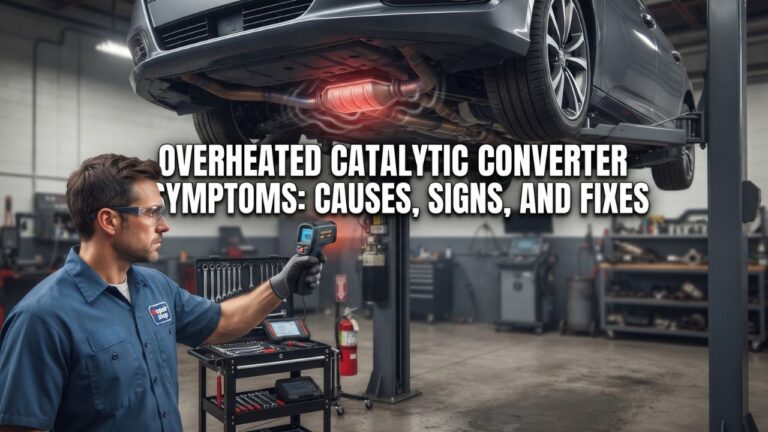
A red or orange glow from the converter means the exhaust system is reaching extreme temperature.
Walker notes that high hydrocarbon readings combined with oxygen can create enough heat to make the converter shell glow and damage the substrate.
If you see a glowing converter:
- Park safely away from combustible material.
- Shut the engine off.
- Do not touch the exhaust.
- Do not pour or spray cold water onto it.
- Do not continue revving the engine in an attempt to clear the fault.
Rapid cooling can thermally shock the hot catalyst, while continued operation may worsen internal melting.
2. Scan for Engine Trouble Codes
Connect an OBD-II scanner before clearing any codes.
Pay close attention to:
- P0300 — random or multiple-cylinder misfire
- P0301-P0308 — cylinder-specific misfires
- P0172/P0175 — rich mixture
- P0171/P0174 — lean mixture
- Oxygen-sensor codes
- Mass-airflow sensor codes
- Fuel-pressure-related codes
- P0420/P0430 catalyst-efficiency codes
Walker recommends resolving other engine trouble codes before treating a catalyst-efficiency code, with P0300-series misfire codes receiving special attention.
Do not clear the codes before saving them. Freeze-frame information may show engine speed, load, coolant temperature, and fuel-trim conditions present when the problem occurred.
3. Repair Any Engine Misfire First
An active misfire is one of the most serious causes of converter overheating.
A misfiring cylinder may send both unburned fuel and oxygen into the exhaust. When they reach the hot catalyst, combustion can occur inside the converter instead of inside the cylinder.
Walker identifies misfire as a primary cause of converter meltdown.
Check the cause of the misfire rather than replacing spark plugs automatically.
Possible faults include:
- Worn or fouled spark plug
- Failed ignition coil
- Damaged plug wire
- Faulty injector
- Low compression
- Burned valve
- Vacuum or intake leak
- Contaminated fuel
- Mechanical engine damage
A flashing check engine light often accompanies a misfire serious enough to threaten the catalyst. Avoid continued driving until the cause is found.
4. Correct a Rich Air-Fuel Mixture
A rich-running engine sends too much fuel into the cylinders.
Some of that fuel can leave the engine unburned and react inside the converter, raising temperature sharply.
Potential causes include:
- Leaking fuel injector
- Excessive fuel pressure
- Faulty fuel-pressure regulator
- Incorrect mass-airflow reading
- Faulty oxygen or air-fuel-ratio sensor
- Incorrect coolant-temperature input
- Ignition failure
- Restricted air intake
- Fuel-control software issue
Walker recommends checking fuel pressure and performing a leak-down test when diagnosing converter trouble. A rapid pressure drop after shutdown can point toward leaking injectors, a regulator problem, or another fuel-system fault.
Use scan-tool fuel trims along with vehicle-specific test data rather than replacing sensors from codes alone.
5. Check Oxygen and Air-Fuel-Ratio Sensors
The engine computer depends on oxygen-related sensors to adjust fuel delivery.
A slow, biased, or faulty sensor can contribute to incorrect mixture control.
Walker includes worn oxygen sensors among conditions associated with converter overheating and recommends verifying both front and rear sensor operation during diagnosis.
A sensor should not be replaced simply because the converter is hot. Check its response against manufacturer specifications and look for wiring, exhaust leaks, and fuel-control faults first.
6. Repair Exhaust Leaks
An exhaust leak can introduce outside oxygen into the exhaust stream.
If the engine is already running rich, that added oxygen can combine with unburned fuel and create intense heat inside the converter. Walker specifically identifies the combination of a rich mixture and an exhaust leak as one path to converter meltdown.
Inspect:
- Exhaust manifold
- Manifold gasket
- Flex pipe
- Converter welds
- Oxygen-sensor bungs
- Pipe joints
- Flanges
- Clamp connections
Walker recommends checking welds, pipe connections, burnt gaskets, clamps, and flex sections for leaks during converter diagnosis.
7. Check for Oil or Coolant Entering the Exhaust
Oil and coolant can contaminate catalyst material.
Excessive oil consumption may result from worn piston rings, valve seals, PCV-system faults, or turbocharger problems.
Coolant may enter through:
- Head-gasket failure
- Cracked cylinder head
- Intake-gasket leak on applicable engines
- Other internal cooling-system faults
Walker states that oil can foul the converter washcoat and that an internal coolant leak can damage the catalyst in a similar way.
Look for unexplained fluid loss, abnormal exhaust smoke, contaminated spark plugs, compression problems, and cooling-system pressure loss.
8. Check for Excessive Exhaust Backpressure
A restricted converter or muffler can trap heat and interfere with engine operation.
Walker gives general backpressure references of less than about 1.5 psi at idle and less than about 3 psi at 2,000 RPM, though the vehicle manufacturer’s specification should control the diagnosis.
Testing ahead of and behind the converter also helps identify the location:
- High pressure ahead of converter: converter restriction is possible.
- High pressure behind converter: muffler or resonator restriction is possible.
- High pressure at the manifold: restriction may be farther upstream.
A converter that has already melted internally may create both excessive heat and poor acceleration.
9. Retest the Converter After Repairing the Cause
Once the misfire, rich mixture, exhaust leak, sensor fault, or mechanical problem has been corrected, bring the engine to normal operating temperature and recheck the converter.
Evaluate:
- Trouble codes
- Fuel trims
- Misfire counters
- Converter temperature
- Exhaust backpressure
- Upstream and downstream O2 behavior
- Acceleration
- Rattling or physical damage
If temperature returns to a normal pattern and the substrate remains intact, converter replacement may not be needed.
If the converter remains restricted, rattles internally, or no longer performs its emissions function, the heat may already have caused permanent damage.
Key Takeaway: Stop severe overheating first, then repair misfires, rich operation, leaks, sensor faults, contamination, or restriction before deciding if the converter itself needs replacement.
What Causes a Catalytic Converter to Overheat?
A healthy converter creates heat as part of its normal chemical reactions. Excessive heat means it is receiving exhaust gases outside the conditions it was built to process.
Engine Misfire
Misfire is one of the biggest concerns.
The unburned air-fuel charge passes into the exhaust, then reacts inside the hot converter. Walker states that converter meltdown is primarily associated with engine misfire in many failure cases.
An ignition fault should therefore be diagnosed quickly.
Rich Fuel Mixture
Too much fuel increases hydrocarbon and carbon-monoxide levels entering the catalyst.
Walker explains that unusually high HC or CO combined with oxygen can raise converter temperature dramatically.
A rich condition may come from injection problems, sensor errors, pressure faults, or poor combustion.
Low Compression
A cylinder with low compression may not burn its charge properly.
The result can resemble an ignition misfire: unburned material enters the exhaust and places extra thermal load on the converter.
Walker includes low compression among causes of overheated catalyst damage.
A compression or leak-down test may be needed if ignition and fuel components check out.
Exhaust Leak Combined With Rich Running
An exhaust leak by itself does not always overheat a converter.
The dangerous combination is excess fuel plus oxygen entering through a leak. That provides the ingredients for combustion inside the catalyst.
Walker identifies this combination as one cause of melted converter bricks.
Excessive Engine Load
Heavy load raises normal exhaust temperature.
Towing, steep grades, high engine load, and sustained high speed create more heat than light cruising. A properly running system is built to tolerate expected operating loads, but an existing fuel or ignition problem can push temperatures much farther.
Walker lists excessive engine or vehicle load among conditions that may contribute to high hydrocarbon levels and converter overheating.
Converter Restriction
A converter that has begun melting may restrict exhaust flow.
Restriction raises backpressure, reduces power, and may trap additional heat. This creates a cycle where previous thermal damage contributes to further drivability trouble.
Walker states that prolonged high converter temperature can melt the substrate into a solid mass and cause noticeable loss of power.
Key Takeaway: Misfires and rich operation are major causes, but low compression, oxygen entering through leaks, heavy load, sensor faults, and existing exhaust restriction can also raise converter temperature.
Signs of an Overheating Catalytic Converter
Heat problems can range from mild abnormal readings to a visibly glowing exhaust component.
Converter Glows Red
A glowing converter is a strong overheating sign.
Do not treat this as normal operating heat. Stop the engine when safe and diagnose the combustion fault before continuing normal use.
Burning Smell
Severe exhaust heat may produce a hot-metal or burning smell.
Nearby underbody insulation, shields, wiring, coatings, or debris may become overheated.
A sulfur-like smell may also occur with some fuel or catalyst faults, but odor alone does not identify the cause.
Blue, Bronze, or Rainbow Discoloration
Heat can discolor a stainless converter shell.
Walker notes that bronze or blue rainbow discoloration can indicate elevated converter temperature.
Discoloration shows that excessive heat occurred, but it does not reveal why.
Loss of Power
If the ceramic substrate melts, exhaust passages may collapse.
The car may then develop:
- Slow acceleration
- Poor high-RPM power
- Difficulty climbing hills
- Bogging
- Stalling in severe cases
Walker states that melted substrate can turn into a solid mass inside the converter and make the vehicle feel sluggish.
Rattling
Severe thermal damage can crack or loosen the internal substrate.
A rattling converter may contain broken catalyst material.
If fragments shift into the exhaust path, restriction can become worse.
Check Engine Light
An overheating converter may accompany:
- P0300-series misfire codes
- Rich-mixture codes
- O2 sensor codes
- P0420
- P0430
Do not focus only on P0420 or P0430. The code that explains why the converter became hot may be more useful than the catalyst-efficiency code itself.
Key Takeaway: A glowing shell, discoloration, burning smell, power loss, rattling, and misfire or catalyst codes all deserve investigation for excess converter heat.
How Hot Is Too Hot for a Catalytic Converter?
Catalytic converters are designed to run hot, so a surface temperature that would be dangerous to touch can still be normal for the component.
Walker gives useful reference ranges:
| Converter condition | Approximate temperature |
| Light-off begins | Around 350°F |
| Fully lit | Around 500°F |
| Common operating range cited by Walker | About 500-800°F |
| Heavy-load operation | Can approach 1,200°F |
| Catalyst coating damage becomes a concern | Above roughly 1,600°F |
| Matting/substrate damage may occur | Around 1,700°F and above |
| Severe substrate melting | Can occur at still higher temperatures |
Walker states that a properly running engine typically keeps converter temperatures below about 1,200°F, while periodic operation above roughly 1,600°F can damage the precious-metal coating and higher temperatures can destroy the matting or substrate.
Another Walker technical reference notes that melting the ceramic substrate may require internal temperatures above about 2,000°F, depending on the circumstances.
Temperature readings should therefore be interpreted alongside engine operation rather than using one exact temperature as a universal failure point.
Can You Cool Down an Overheating Catalytic Converter?
The repair is not to cool the converter artificially.
Turning the engine off when severe overheating is present stops the continued supply of hot exhaust and unburned fuel.
After that, allow the exhaust system to cool naturally.
Do not spray a hot converter with water. Walker identifies thermal quenching from deep water or snow as one possible source of converter damage.
Cold liquid on extremely hot ceramic and steel creates rapid contraction that can crack the substrate or other exhaust parts.
Cooling also does not remove the underlying fault. The converter will overheat again after restart if the engine continues misfiring or running excessively rich.
Will Catalytic Converter Cleaner Fix Overheating?
No cleaner should be considered the primary repair for an overheated converter.
A fuel additive cannot repair:
- Bad ignition coil
- Worn spark plug
- Leaking injector
- Low compression
- Faulty fuel pressure
- Melted ceramic substrate
- Broken catalyst brick
- Internal coolant leak
- Oil-burning engine
If the converter is overheating because excessive fuel is reaching the exhaust, adding another product to the fuel tank does not address the main fault.
Find and repair the engine condition first.
Can an Overheated Catalytic Converter Recover?
Sometimes, if the excessive temperature is caught before permanent catalyst damage occurs.
For example, an ignition coil failure may create a misfire and excessive converter temperature. If the engine is shut down early, the coil is repaired, and the converter substrate remains intact, the original converter may continue to work.
Recovery becomes less likely when there is:
- Internal rattling
- Melted honeycomb
- Persistent high backpressure
- P0420/P0430 after other faults are repaired
- Severe shell discoloration
- Collapsed catalyst passages
- Catalyst contamination
Walker notes that temperatures above 1,600°F may damage catalyst coating without obvious external signs of melting.
That means a converter can look normal outside and still have suffered internal heat damage.
When Does an Overheating Converter Need Replacement?
Repair the engine fault first, then judge the converter.
Melted Substrate
Once the ceramic honeycomb melts and passages fuse together, it cannot be restored with cleaner or normal driving.
Replacement is required.
Collapsed or Broken Honeycomb
Broken catalyst material may rattle and can move into a position that restricts exhaust flow.
The internal brick cannot be rebuilt inside the housing.
Excessive Backpressure Remains
If backpressure stays high after the engine is running correctly, the converter may have become permanently restricted.
Testing ahead of and behind the converter helps locate the blockage.
Catalyst Efficiency Remains Low
After misfires, mixture faults, leaks, and sensor problems are repaired, a converter that still fails its efficiency tests may have suffered irreversible catalyst damage.
Walker advises resolving the original cause before installing a replacement because an unresolved engine problem can damage the new converter too.
Federal Warranty May Still Apply
Before buying a replacement, check the vehicle’s age, mileage, and warranty booklet.
EPA identifies catalytic converters as specified major emissions components with federal coverage for up to 8 years or 80,000 miles, subject to the warranty’s terms and cause of failure.
Key Takeaway: Replace the converter when heat has melted, broken, restricted, or permanently damaged the catalyst, but correct the engine fault before installing the new part.
How to Prevent Catalytic Converter Overheating
Repair Misfires Quickly
Do not continue driving for days with a flashing check engine light or strong engine shake.
Misfires can send raw fuel into the catalyst.
Maintain the Ignition System
Use the correct spark plugs and replace ignition parts according to vehicle service requirements.
A weak ignition system can create incomplete combustion long before the car stops running.
Watch Fuel Trims and Engine Codes
Repeated rich-mixture codes should not be ignored.
Fuel-control problems place extra thermal load on the converter and may shorten its service life.
Fix Oil and Coolant Consumption
A converter exposed continuously to burned oil or coolant can become contaminated and damaged.
Monitor fluid levels and diagnose unexplained consumption.
Repair Exhaust Leaks
Leaks can interfere with O2 sensor readings and, under certain rich-running conditions, introduce oxygen that feeds combustion inside the converter.
Do Not Ignore Power Loss
A converter that has already begun melting may create increasing backpressure.
Power loss that gets worse with RPM deserves exhaust-restriction testing before the substrate becomes more damaged.
Key Takeaway: Fast repairs to misfires, fuel-control faults, fluid consumption, exhaust leaks, and restriction are the best protection against repeated converter overheating.
Conclusion
The correct approach to how to fix overheating catalytic converter problems is to repair the condition creating excessive exhaust heat rather than trying to cool or clean the converter itself. Misfires and rich operation deserve attention first, followed by fuel pressure, injectors, O2 and airflow sensors, exhaust leaks, compression, oil consumption, coolant leaks, and backpressure.
A converter that became hot for a short period may survive once the engine fault is corrected. A converter with melted passages, broken substrate, persistent restriction, or permanent catalyst damage cannot be restored by additives or highway driving.
If the shell is glowing, the check engine light is flashing, power has dropped sharply, or there is a strong burning smell, shut the vehicle down when safe and arrange diagnosis before driving again. Correcting the root problem early gives the original converter its best chance of surviving and protects any replacement from the same failure.
FAQs About an Overheating Catalytic Converter
What is the most common cause of a catalytic converter overheating?
Engine misfire is one of the main causes. A misfiring cylinder can send unburned fuel and oxygen into the exhaust, where they react inside the converter and create extreme heat. Rich fuel mixtures, low compression, fuel-system faults, sensor problems, and exhaust leaks can contribute too.
Why is my catalytic converter glowing red?
A red glow usually means the converter is far hotter than normal. A severe misfire or rich condition may be sending fuel into the exhaust and causing it to burn inside the converter. Stop the engine when safe and diagnose the cause instead of continuing to drive.
Can a bad oxygen sensor make the catalytic converter overheat?
It can contribute if incorrect sensor information causes poor fuel control. A rich mixture can send excess hydrocarbons into the converter and increase heat. Test the sensor and related fuel-control data before replacing it, since wiring, leaks, injectors, or other faults can produce similar symptoms.
Will driving at highway speed cool an overheating catalytic converter?
No. If an active misfire or rich mixture is creating the heat, higher engine load may send even more fuel and exhaust through the converter. Do not use high-speed driving as a cooling method for a converter that is glowing or showing signs of severe overheating.
Can I spray water on an overheating catalytic converter?
No. Let it cool naturally. Rapid cooling can create thermal shock in the hot ceramic substrate and metal housing. Walker lists thermal quenching from cold water or snow as a possible source of converter damage.
Does an overheated catalytic converter always need replacement?
No. If the excessive heat is caught early and the substrate remains intact, repairing the engine problem may allow the original converter to remain in service. Replacement becomes more likely when the substrate has melted, broken, become restricted, or lost catalyst activity.
Can a clogged catalytic converter cause overheating?
Yes. A damaged converter may melt internally and restrict exhaust flow, producing excessive backpressure and poor power. High pressure ahead of the converter supports a restriction diagnosis. A backpressure test is stronger evidence than temperature alone.