Why Is My Catalytic Converter Glowing Red? Main Causes and Risks
A catalytic converter that visibly glows red is overheating. The most common reason is unburned fuel entering the exhaust and burning inside the converter, often because of an engine misfire, ignition failure, rich fuel mixture, or leaking injector. Stop hard driving because extreme converter heat can melt the internal substrate and create a fire hazard.
A converter normally runs hot, but visible red or orange glow is not normal operating behavior. Walker states that a properly running engine generally keeps converter temperature below about 1,200°F, while temperatures above roughly 1,600°F can damage catalyst material.
The converter is usually reacting to a problem created elsewhere in the engine. Replacing the glowing unit without fixing the engine fault may cause the new converter to overheat in the same way.
If you are asking why is my catalytic converter glowing red, start by checking for an active misfire and excess fuel entering the exhaust. Walker identifies misfires, poor spark, fuel-system faults, cylinder imbalance, and abnormal air-fuel conditions as common paths to converter overheating.
A flashing check-engine light is another serious clue. EPA material states that a flashing malfunction indicator can signal a severe engine misfire capable of damaging the catalytic converter in a short period.
The sections below explain why the converter becomes red hot, the most likely engine faults, the connection with a clogged converter, what to test first, and when the converter itself may already be damaged.
Why Is My Catalytic Converter Glowing Red?
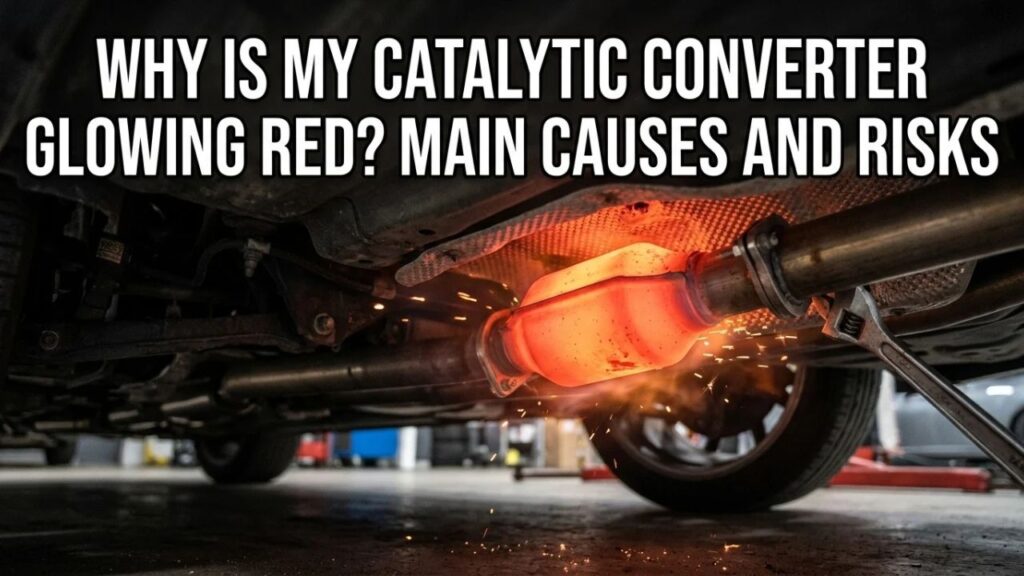
A red-hot converter usually means fuel is burning inside the exhaust system instead of being completely burned inside the engine cylinders.
The catalytic converter normally processes small amounts of hydrocarbons and carbon monoxide. If large amounts of fuel and oxygen reach it together, oxidation inside the catalyst creates intense heat.
An Engine Misfire Sends Raw Fuel Into the Exhaust
Misfire is one of the first problems to check.
A cylinder needs the correct combination of:
- Fuel
- Air
- Compression
- Spark at the correct time
If combustion does not occur, part of the air-fuel charge can leave the cylinder through the exhaust valve.
The catalytic converter receives that unburned fuel. Once it encounters enough oxygen and a hot catalyst surface, the fuel can burn inside the converter.
Walker specifically identifies engine misfire as a common cause of converter thermal meltdown.
Too Much Fuel Can Overheat the Converter
An excessively rich mixture means the engine receives more fuel than it can burn correctly.
Possible causes include:
- Leaking fuel injector
- Excessive fuel pressure
- Faulty fuel-pressure regulator
- Bad airflow information
- Sensor faults
- Poor ignition
- Incorrect fuel control
- Engine mechanical problems
Walker notes that fuel-system faults and air-fuel imbalance can raise hydrocarbon and carbon-monoxide levels entering the converter, driving converter temperature upward.
The Converter Is Burning What the Engine Did Not
A glowing converter is often blamed first because that is the part visibly overheating.
The converter may actually be responding to fuel the engine failed to burn.
EPA technical material describes the same process: an engine misfire leaves raw fuel in the exhaust, and oxidation inside the catalyst raises converter temperature sharply.
Key Takeaway: A catalytic converter commonly glows red because excess fuel and oxygen are burning inside it, with engine misfire and rich operation among the first faults to investigate.
Common Causes of a Red-Hot Catalytic Converter
Several engine problems can create the fuel or exhaust conditions that overheat the catalyst.
Bad Spark Plug
A badly fouled, cracked, worn, or incorrectly gapped spark plug may fail to ignite the mixture reliably.
That creates a misfire and sends hydrocarbons into the exhaust.
Check for misfire codes such as:
- P0300 — Random or multiple-cylinder misfire
- P0301 — Cylinder 1 misfire
- P0302 — Cylinder 2 misfire
- Similar P0300-series codes for other cylinders
A flashing check-engine light during rough running increases the concern for catalyst-damaging misfire.
Failed Ignition Coil
A weak or failed coil can prevent one cylinder from firing.
Coil-on-plug engines may develop one dead cylinder while the remaining cylinders keep the engine running. The failed cylinder still receives fuel on many systems, so that fuel can reach the converter.
Ford owner guidance warns that misfiring or uneven running can send unburned fuel into the exhaust and damage the catalytic converter through overheating.
Leaking Fuel Injector
An injector that leaks or stays open can put too much fuel into one cylinder.
The mixture may become too rich to burn completely.
A fuel-pressure leak-down test and injector testing may be needed. Walker recommends checking fuel pressure and watching for rapid pressure loss that may point toward injector or regulator problems.
Excessively Rich Air-Fuel Mixture
The whole engine can run rich rather than one cylinder being affected.
Possible causes include:
- Incorrect MAF sensor readings
- MAP sensor faults
- Fuel-pressure problems
- Injector problems
- Oxygen or air-fuel sensor faults
- Air-intake problems
- Engine-control faults
A scan tool can show short-term and long-term fuel trims that provide clues about mixture control.
Low Compression
Misfire is not always electrical.
A burned valve, damaged piston, worn rings, valve-train fault, or other mechanical problem can reduce compression enough to stop a cylinder from burning its mixture correctly.
Walker lists low compression among conditions that can create excessive hydrocarbons and converter overheating.
If spark and fuel delivery test correctly but one cylinder continues to misfire, a compression or cylinder leak-down test may be needed.
Exhaust Leak Combined With Rich Operation
An exhaust leak can pull extra oxygen into the exhaust stream.
If excess fuel is already present, that added oxygen can contribute to combustion inside the converter.
Walker describes rich operation combined with an exhaust leak as one path to a converter becoming red hot.
Incorrect Ignition or Valve Timing
Timing faults can create incomplete combustion and poor engine performance.
A jumped timing chain or belt, cam timing fault, or ignition timing problem on applicable engines can contribute to misfires and abnormal exhaust temperatures.
The engine may also show poor power, rough idle, hard starting, or timing-related diagnostic codes.
Key Takeaway: Spark plugs, ignition coils, injectors, rich fuel control, low compression, exhaust leaks, and timing faults can all create the conditions that make a catalytic converter overheat.
Is a Glowing Catalytic Converter Dangerous?
Yes. A visibly red converter should be treated as an overheating exhaust component.
The Internal Core Can Melt
Inside the converter is a ceramic or metallic substrate containing many small exhaust passages.
Extreme heat can damage or melt that structure.
Walker states that operation above roughly 1,600°F can damage catalyst material, with damaged matting and melted substrate associated with still higher temperatures.
Once the substrate melts, passages can collapse and block exhaust flow.
The original overheating problem can then turn into a clogged-converter problem.
Nearby Materials Can Overheat
The converter sits close to:
- Vehicle floor
- Heat shields
- Wiring
- Fuel-system components on some layouts
- Underbody coatings
- Road debris
EPA material notes that abnormally hot catalyst surfaces can scorch underbody material and create ignition concerns around dry vegetation.
Do not park a vehicle with a glowing converter over dry grass, leaves, paper, or other combustible material.
Do Not Touch or Cool It With Water
The housing can cause severe burns long after the visible glow disappears.
Do not crawl underneath and touch it.
Do not pour cold water over a red-hot converter. Sudden temperature change can damage the converter substrate or exhaust components.
Let the exhaust cool naturally before inspection.
Key Takeaway: A glowing converter can melt internally, damage nearby parts, cause burns, and create a fire risk around combustible material.
What Should You Do if the Catalytic Converter Is Glowing Red?
Reduce the chance of further heat damage before starting diagnosis.
Stop Hard Driving
If you notice the glow after driving, avoid further heavy acceleration.
Move the vehicle to a safe location away from dry grass or other combustible surfaces.
If the engine is running very rough, the check-engine light is flashing, or the converter remains visibly red, continuing to drive can add more unburned fuel and heat.
Shut the Engine Off
Once safely parked, shutting the engine off stops the continuous supply of exhaust and fuel to the converter.
Give the exhaust plenty of time to cool.
Do not begin handling oxygen sensors, exhaust clamps, or the converter while the system remains hot.
Scan for Trouble Codes
After the system is safe to inspect, scan all stored and pending trouble codes.
Pay close attention to:
- P0300-series misfire codes
- Rich-mixture codes
- Fuel-trim codes
- Injector circuit codes
- Ignition-coil codes
- MAF or MAP sensor codes
- Oxygen-sensor codes
- P0420 or P0430 catalyst codes
Do not clear codes before recording freeze-frame data.
Freeze-frame information can show engine speed, load, coolant temperature, and fuel-control conditions present when the computer recorded the fault.
Fix the Engine Fault Before Replacing the Converter
A replacement catalytic converter will not repair a dead ignition coil or leaking injector.
Walker repeatedly recommends correcting the source of converter damage before installing a new catalyst.
If the engine fault remains, the replacement converter can overheat again.
Key Takeaway: Stop adding heat, let the exhaust cool, scan the vehicle, diagnose the engine fault, and repair that fault before deciding the converter needs replacement.
How to Diagnose Why the Converter Is Glowing
The fastest diagnosis starts with the engine rather than the converter.
Check Misfire Data
Use a scan tool that can display cylinder misfire counters if the vehicle supports them.
A rapidly increasing count on one cylinder gives you a place to start.
Inspect that cylinder’s:
- Spark plug
- Ignition coil or wire
- Injector
- Compression
- Wiring and connectors
Do not assume the ignition coil is bad just because a misfire code names one cylinder.
Inspect the Spark Plugs
Spark plug appearance can reveal useful clues.
Look for:
- Fuel-wet plug
- Heavy black carbon
- Oil fouling
- Cracked insulator
- Excessive gap
- Physical damage
Compare the suspect cylinder with the others.
A fuel-soaked plug may point toward no spark, injector trouble, or a cylinder that is not firing for another reason.
Check Fuel Trim
Fuel trims show how much correction the engine computer is applying to maintain its commanded mixture.
Large abnormal corrections can point toward problems with:
- Fuel delivery
- Air measurement
- Vacuum leaks
- Exhaust leaks
- Sensors
- Injector operation
Fuel-trim interpretation differs by operating condition, so evaluate idle and raised-RPM data rather than one isolated reading.
Test Fuel Pressure and Injector Leakage
Compare fuel pressure with the manufacturer specification.
After the fuel pump stops, rapid pressure loss may indicate leakage.
Walker includes pressure and leak-down testing as part of converter diagnosis because leaking injectors or regulator faults can contribute to excessive fuel entering the exhaust.
Check Engine Compression
If ignition and fuel delivery appear normal, test mechanical condition.
Low compression can create a persistent misfire that continually feeds hydrocarbons into the exhaust.
Compression testing followed by a leak-down test can narrow the fault to valves, rings, piston damage, or another mechanical issue.
Inspect for Exhaust Restriction
If the converter has already overheated badly, its substrate may have melted.
Test exhaust backpressure when low power remains after the original misfire or fuel fault is corrected.
Walker gives a general reference of less than 1.5 psi at idle and less than 3 psi at 2,000 RPM, though vehicle-specific service limits should take priority.
High pressure ahead of the converter points toward restriction.
Key Takeaway: Misfire data, spark-plug inspection, fuel trims, fuel pressure, compression, and backpressure testing can identify both the overheating cause and damage left behind.
Can a Clogged Catalytic Converter Glow Red?
Yes, but a clog is not the only explanation.
A restricted converter can retain heat and create very high exhaust temperatures. The bigger question is why it became restricted.
Overheating Can Create the Clog
The sequence often runs like this:
- Engine develops a misfire or rich condition.
- Unburned fuel reaches the converter.
- Fuel burns inside the converter.
- Converter temperature rises sharply.
- Ceramic substrate begins to melt.
- Exhaust passages collapse.
- Backpressure increases.
- Engine loses power.
Walker describes prolonged high converter temperatures as a cause of substrate meltdown and eventual loss of power from restriction.
A Blocked Converter Can Cause Severe Power Loss
Once the passages are restricted, common symptoms include:
- Poor acceleration
- Engine struggling above a certain RPM
- Hard starting
- Stalling
- Excess exhaust heat
- High backpressure
A pressure test is a better way to confirm blockage than temperature alone.
Do Not Replace the Converter Before Testing the Engine
If a melted converter is removed but the misfire remains, the new unit can suffer the same overheating.
Repair the cause first, then determine if the converter still flows correctly and passes catalyst-monitor testing.
Key Takeaway: A glowing converter can become clogged after overheating melts its substrate, so diagnose both the original engine fault and any resulting exhaust restriction.
Does a Red Catalytic Converter Mean the Converter Is Bad?
Not always at the beginning.
The converter can glow because it is processing an abnormal amount of fuel created by an engine problem.
If overheating is caught early and the engine fault is repaired, the converter may still function.
Repeated or extreme heat can permanently damage it.
Signs the Converter May Already Be Damaged
Look for:
- Rattling from loose internal material
- P0420 or P0430 after engine repairs
- High exhaust backpressure
- Major loss of power
- Melted substrate
- Heavy shell discoloration
- Poor catalyst-monitor performance
Walker notes that bronze or blue shell discoloration can indicate excessive temperature and that melted sections can exist inside the substrate even when the ends appear normal.
A Temperature Test Alone Cannot Prove Converter Failure
A converter temperature measurement can reveal excessive heat, but it does not tell you everything about catalyst health.
A scan tool, backpressure test, emissions testing, and inspection may be needed after the engine fault is corrected.
Can You Drive With a Glowing Catalytic Converter?
Continued normal driving is a bad idea.
A visibly glowing converter indicates a level of heat that can damage the catalyst and surrounding parts.
If the engine is misfiring, driving also keeps supplying fuel to the converter.
Ford guidance for a flashing engine warning light tells drivers that misfire can increase exhaust temperatures and damage the converter, and calls for immediate service while avoiding heavy acceleration.
If you are already safely stopped and the converter is visibly glowing, shutting the engine off and arranging diagnosis is safer than deliberately driving farther to see if the glow disappears.
Do not park over dry vegetation.
Will Replacing the Catalytic Converter Fix the Red Glow?
Not if the engine problem remains.
A new converter exposed to the same unburned fuel can overheat too.
Before installation, check:
- Misfire codes
- Spark plugs
- Ignition coils or wires
- Injectors
- Fuel pressure
- Fuel trims
- Oxygen or air-fuel sensors
- MAF or MAP data
- Compression
- Exhaust leaks
Walker states that converter meltdown is commonly linked to engine misfire and warns that a replacement can melt as well if the original cause is left unresolved.
Once the engine runs correctly, test the old converter for physical restriction and catalyst performance. Replace it if the substrate has melted, broken apart, become restricted, or no longer meets the required catalyst function.
Conclusion
The answer to why is my catalytic converter glowing red is usually excessive heat created when unburned fuel reaches the exhaust and burns inside the converter. An ignition misfire, leaking injector, rich mixture, low compression, or another combustion fault is often the real starting point.
Visible red glow is not a normal sign that the converter is simply “working hard.” Excess temperature can melt the ceramic substrate, create exhaust restriction, damage the catalyst coating, and expose nearby material to extreme heat.
Start with misfire codes and engine diagnosis. Once the cause is repaired, check the converter for rattling, restriction, heat damage, and catalyst-efficiency faults.
I would not replace the converter first and hope the problem disappears. Fix the condition feeding excess fuel into the exhaust, then determine if overheating has already damaged the converter enough to require replacement.
FAQs About a Catalytic Converter Glowing Red
Is it normal for a catalytic converter to glow red?
No. Catalytic converters normally operate at high temperatures, but a visible red or orange glow points toward excessive heat. Misfires and rich fuel conditions are common causes because they send unburned fuel into the converter, where it can burn and raise temperature sharply.
Can a bad spark plug make the catalytic converter glow red?
Yes. A spark plug that fails to ignite the mixture can create a misfire. Unburned fuel and oxygen then enter the exhaust and may burn inside the catalytic converter. Check the plug, ignition coil, injector, and compression on any cylinder showing repeated misfire counts.
Can a bad ignition coil cause a red-hot catalytic converter?
Yes. A failed ignition coil can stop one cylinder from firing while fuel continues to enter that cylinder. The unburned mixture reaches the exhaust and can create extreme converter heat. A flashing check-engine light may appear during a severe misfire.
Can a rich fuel mixture make a catalytic converter glow?
Yes. Excess fuel that does not burn completely in the cylinders can reach the converter. If enough oxygen is present, oxidation inside the catalyst creates intense heat. Fuel pressure, injectors, airflow sensors, oxygen sensors, and engine-control data should be checked.
Can a clogged catalytic converter turn red hot?
Yes. A restricted converter can retain heat and run abnormally hot. In many cases, overheating occurs first and melts the substrate, which then creates the blockage. Backpressure testing can show if the converter has become physically restricted.
What temperature damages a catalytic converter?
The exact limit varies by converter design. Walker states that properly running converters typically remain below about 1,200°F, temperatures above roughly 1,600°F can damage catalyst material, and still higher heat can damage or melt internal substrate and matting.
Should I shut my car off if the catalytic converter is glowing red?
If you can stop safely, shutting the engine off prevents it from continually feeding hot exhaust and possible unburned fuel into the converter. Park away from dry grass or other combustible material, let the exhaust cool naturally, and diagnose the engine fault before normal driving resumes.
Will a catalytic converter recover after glowing red?
It may survive a short overheating event if the substrate and catalyst coating were not damaged, but there is no guarantee. After the underlying engine problem is repaired, check for rattling, high backpressure, persistent P0420 or P0430, and poor performance. A melted or broken substrate requires replacement.