How to Test PCV Valve Without Removing It: Simple Checks
A faulty PCV valve can cause rough idle, vacuum leaks, abnormal crankcase pressure, oil consumption, and sometimes lean-condition or misfire trouble codes. Fortunately, you do not always need to remove the valve immediately to get useful information about whether the PCV system is working correctly.
You can test a PCV valve without removing it by checking for crankcase vacuum, briefly pinching or blocking the PCV hose, listening for vacuum leaks, observing idle changes, and checking fuel-trim data with a scan tool.
Learning how to test PCV valve without removing it is especially useful on modern engines where the PCV valve may be hidden under the intake manifold or built directly into the valve cover. These tests cannot confirm every internal PCV failure, but they can tell you whether the system is flowing, leaking excessively, or creating abnormal crankcase pressure.
The key is to evaluate the entire PCV system rather than relying on one old-fashioned test. A good PCV valve, its hoses, diaphragm, and intake connections all have to work together for crankcase ventilation to operate correctly.
How to Test PCV Valve Without Removing It
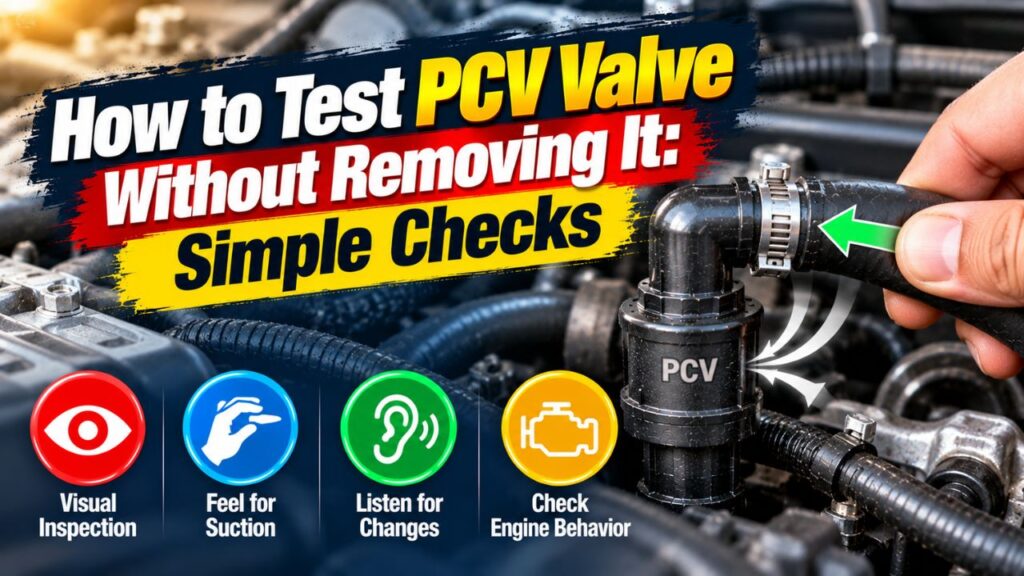
The easiest way to test PCV valve without removing it is to start the engine, let it idle, and check whether the PCV system creates a small amount of vacuum in the crankcase.
You can then compare engine behavior while briefly restricting the PCV hose. If the engine idle changes dramatically or becomes smoother when the PCV airflow is blocked, the valve or related hose may be allowing too much air into the intake.
For a more accurate diagnosis, combine several tests instead of depending on only one.
Useful checks include:
- Oil-cap vacuum test
- PCV hose pinch test
- Hissing or whistling inspection
- Crankcase pressure check
- Scan-tool fuel-trim comparison
The exact result depends on the engine design, so manufacturer-specific specifications always take priority.
Understand What the PCV Valve Is Supposed to Do
The positive crankcase ventilation system, or PCV system, removes blow-by gases from the engine crankcase.
Some combustion gases naturally escape past the piston rings during normal operation. Without ventilation, these gases would build pressure inside the crankcase and contribute to moisture, sludge, and oil leaks.
The PCV system routes those gases back into the intake so they can be burned.
A traditional PCV valve regulates that airflow according to intake manifold vacuum.
Many newer vehicles use a diaphragm or integrated crankcase ventilation assembly instead of a simple removable valve.
That difference matters because a modern PCV failure may involve more than the valve itself.
Test 1: Check Vacuum at the Oil Filler Cap
One of the simplest tests can be performed at the oil filler cap.
Start the engine and allow it to idle normally. Carefully loosen the oil filler cap.
A properly functioning PCV system often creates a slight vacuum inside the crankcase.
You may notice the cap is lightly pulled toward the valve cover.
That usually suggests that the PCV system is drawing crankcase vapors into the intake.
What Does Excessive Suction Mean?
If the oil cap is extremely difficult to remove because of strong suction, the PCV system may be flowing too much air.
Possible causes include:
- PCV valve stuck open
- Torn PCV diaphragm
- Incorrect replacement valve
- Internal PCV assembly failure
Excessive crankcase vacuum may also cause a whistling noise or abnormal idle.
What Does No Vacuum Mean?
If there is no noticeable vacuum, several possibilities exist.
The PCV valve may be stuck closed, a hose may be blocked, or the crankcase ventilation passage may be restricted.
However, some engines naturally operate with very little detectable vacuum at the oil cap.
This test should therefore be used as a clue rather than a final diagnosis.
Test 2: Place a Thin Paper Over the Oil Fill Opening
Another variation uses a lightweight piece of paper.
With the engine idling, remove the oil filler cap and place a small piece of paper loosely over the opening.
Do not push anything into the engine.
On many properly functioning PCV systems, slight crankcase vacuum should gently pull the paper toward the opening.
If the paper is strongly sucked downward, crankcase vacuum may be excessive.
If pressure repeatedly pushes the paper upward, the PCV system may not be ventilating the crankcase correctly.
Keep in mind that normal piston movement can create some pulsing at the oil fill opening, so focus on the overall tendency rather than every small movement.
Test 3: Pinch the PCV Hose and Watch the Idle
If the PCV hose is accessible, you can perform a useful test without removing the valve.
Let the engine idle.
Briefly pinch the flexible PCV hose closed using your fingers or a suitable hose-pinching tool that will not damage the hose.
Listen to the engine and watch the RPM.
What a Normal Reaction Looks Like
On many engines, restricting PCV flow will cause a small change in idle speed or sound because you have changed the amount of air entering the intake.
A slight change is normal.
What a Large Improvement Can Mean
If the engine has a rough idle and suddenly becomes much smoother when you pinch the PCV hose, the PCV system may be creating an excessive vacuum leak.
This can happen if the:
- Valve is stuck open
- Diaphragm is torn
- PCV hose is cracked
- Internal PCV passage is leaking excessively
The engine may have been receiving too much unmetered air.
Blocking that air temporarily improves the mixture and smooths the idle.
Do not leave the PCV hose blocked permanently. The crankcase requires ventilation during normal operation.
Test 4: Listen for Hissing or Whistling
A failing PCV valve or diaphragm often makes noise.
With the engine idling, listen around the:
- Valve cover
- PCV hose
- Intake connection
- PCV diaphragm housing
A strong hissing sound may indicate a vacuum leak.
A high-pitched whistling sound is especially common on some engines with torn PCV diaphragms.
You may notice the sound changes when you loosen the oil cap.
That is a useful clue that the noise is related to crankcase vacuum.
A mechanic’s stethoscope or short length of hose can help locate the sound, but keep hands and clothing away from belts, fans, and other moving parts.
Test 5: Feel for Vacuum in the PCV Hose
If the PCV hose has an accessible section or service connection, you may be able to confirm that vacuum is present without actually removing the valve.
With the engine idling, carefully feel whether the hose is drawing vacuum.
A functioning manifold-connected PCV circuit normally has some vacuum while the engine is idling.
No vacuum may indicate:
- Blocked hose
- Blocked intake fitting
- Stuck-closed PCV valve
- Damaged routing
- Another system problem
Very strong airflow may suggest excessive PCV flow.
The amount of normal vacuum varies significantly by engine, so comparing against service specifications is more accurate than relying on feel alone.
Test 6: Check Fuel Trims With a Scan Tool
A scan tool can provide one of the most useful non-invasive PCV tests.
Look at:
- Short-term fuel trim (STFT)
- Long-term fuel trim (LTFT)
A PCV valve stuck open can behave like a vacuum leak.
The extra unmetered air makes the mixture lean, so the engine computer responds by adding fuel.
This appears as positive fuel trim.
Compare Idle With Higher RPM
Check fuel trims at idle.
Then increase engine speed to approximately 2,000–2,500 RPM and observe them again.
If fuel trims are strongly positive at idle but improve significantly at higher RPM, a vacuum leak becomes more likely.
A leaking PCV system is one possible source.
This pattern does not prove the PCV valve is faulty because an intake manifold gasket, vacuum hose, brake booster, or another leak can cause similar results.
Test 7: Watch for PCV-Related Trouble Codes
A faulty PCV valve does not always generate a dedicated PCV code.
Instead, you may see codes caused by the resulting air-fuel problem.
Common examples can include:
P0171 – System too lean, Bank 1
P0174 – System too lean, Bank 2
P0300 – Random or multiple-cylinder misfire
You may also see cylinder-specific misfire codes.
These codes do not automatically mean the PCV system is bad.
They simply support further investigation when combined with PCV symptoms such as hissing, abnormal crankcase vacuum, and idle problems.
How to Tell If the PCV Valve Is Stuck Open Without Removing It
A PCV valve stuck open usually allows too much airflow through the crankcase ventilation system.
Typical clues include rough idle, lean fuel trims, hissing, and excessive crankcase vacuum.
A practical test is to briefly restrict the PCV hose.
If the engine immediately idles better and fuel trims move toward normal, excessive PCV flow becomes much more likely.
A stuck-open condition is often most noticeable at idle because intake vacuum is highest there.
How to Tell If the PCV Valve Is Stuck Closed Without Removing It
A stuck-closed PCV valve prevents normal crankcase ventilation.
Instead of excessive vacuum, you may develop positive crankcase pressure.
Possible signs include:
- Oil being pushed from seals
- New oil leaks
- Oil around gaskets
- Sludge buildup
- Pressure at the oil fill opening
If pressure consistently pushes outward from the oil fill opening rather than producing slight vacuum, the PCV path may be restricted.
However, excessive engine blow-by from worn piston rings can also create crankcase pressure.
That is why crankcase pressure alone does not prove the PCV valve is stuck closed.
Can You Test a PCV Valve With the Oil Dipstick?
Sometimes the dipstick tube provides useful clues about crankcase pressure.
With the engine idling, abnormal pressure may push vapor or oil mist from the dipstick tube.
That can indicate poor crankcase ventilation.
However, some normal vapor movement may be present depending on engine design.
The dipstick test is best used together with the oil-cap and PCV hose tests rather than as a standalone diagnosis.
Can a Bad PCV Valve Cause Rough Idle?
Yes.
A PCV valve stuck open can create a vacuum leak that makes the engine run lean.
Because vacuum leaks have a relatively large effect at idle, the engine may:
- Shake
- Surge
- Stumble
- Idle too high
- Nearly stall
If restricting the PCV hose immediately improves idle quality, inspect the PCV system carefully.
Can a Bad PCV Valve Cause a Misfire?
Yes.
A large PCV vacuum leak can create a lean mixture severe enough to cause unstable combustion and misfires.
The misfire may affect multiple cylinders or, depending on intake manifold design, appear more strongly on one cylinder.
PCV-related misfires are often accompanied by other vacuum-leak symptoms rather than appearing completely alone.
Can You Test a PCV Valve by Shaking It Without Removing It?
No.
The traditional shake test requires removing a conventional PCV valve and listening for the internal plunger to move.
Even then, the shake test is limited.
A valve can rattle and still have an incorrect flow rate or fail to seal properly.
Modern diaphragm-style PCV systems may not rattle at all.
For an installed valve, vacuum, idle, fuel-trim, and pressure tests are more useful.
Smoke Testing the PCV System
If basic checks suggest a leak but you cannot locate it, a smoke test is one of the most effective diagnostic methods.
Low-pressure diagnostic smoke is introduced into the intake or crankcase ventilation system.
If the PCV system leaks, smoke may escape from:
- PCV diaphragm
- Valve cover
- Hose connection
- Cracked hose
- Intake fitting
This test usually requires specialized equipment, but it can find leaks that are nearly impossible to see visually.
Symptoms That Support a Bad PCV Diagnosis
No single symptom confirms a failed PCV valve.
The diagnosis becomes stronger when several symptoms appear together, such as rough idle combined with hissing and abnormal crankcase vacuum.
Other possible clues include increased oil consumption, oil in the intake, lean codes, misfires, or new oil leaks.
For example, strong suction at the oil cap plus a whistle from the valve cover and positive fuel trims at idle strongly suggests an excessive PCV vacuum problem.
By contrast, crankcase pressure plus oil leaks and little or no PCV vacuum may point toward a restricted ventilation path.
When the PCV Valve May Not Be the Problem
Many engine problems can imitate PCV failure.
A rough idle or lean code could also come from:
- Intake manifold gasket leak
- Cracked vacuum hose
- Brake booster leak
- Dirty or faulty mass airflow sensor
- Fuel delivery problem
- Ignition misfire
Excess crankcase pressure can also result from excessive piston-ring blow-by rather than a blocked PCV valve.
This is why testing several parts of the system is more reliable than replacing the PCV valve based on one symptom.
Be Careful With Modern Integrated PCV Systems
On many newer engines, the PCV system is integrated into the valve cover.
You may not see a small replaceable valve at all.
Instead, the system can contain an internal diaphragm and molded passages.
When that diaphragm fails, the repair may require replacing:
- PCV module
- Oil separator assembly
- Valve cover assembly
Always confirm how your particular engine’s PCV system is designed before buying parts.
Is It Safe to Drive With a Suspected Bad PCV Valve?
A minor PCV problem may not immediately prevent driving, but it should not be ignored.
A severe PCV vacuum leak can cause persistent lean operation and misfires.
A blocked system can increase crankcase pressure and contribute to oil leaks.
If the vehicle has a flashing check engine light, severe misfire, major oil leak, or heavy smoke, driving should be minimized until the problem is diagnosed.
FAQs About How to Test PCV Valve Without Removing
Can You Test a PCV Valve While the Engine Is Running?
Yes.
Several useful PCV tests are performed with the engine idling, including checking oil-cap vacuum, listening for hissing, observing fuel trims, and briefly restricting the PCV hose.
Keep hands, clothing, and tools away from moving engine components.
Should There Be Vacuum at the Oil Cap?
Many engines normally have a slight crankcase vacuum.
Extremely strong suction may indicate excessive PCV flow, while obvious pressure may indicate restricted ventilation or excessive engine blow-by.
Does Pinching the PCV Hose Test the Valve?
It can provide useful diagnostic information.
If pinching the hose makes a rough engine idle much smoother, excessive airflow through the PCV system may be contributing to the problem.
It does not identify the exact failed component by itself.
How Do I Know If My PCV Valve Is Stuck Open?
Common clues include excessive crankcase vacuum, rough idle, hissing, lean fuel trims, and an idle that improves when PCV flow is briefly restricted.
How Do I Know If My PCV Valve Is Stuck Closed?
Possible signs include crankcase pressure, oil leaks, poor ventilation, sludge, and little or no expected vacuum through the PCV circuit.
Other engine problems can cause similar symptoms.
Can a Scan Tool Detect a Bad PCV Valve?
A scan tool usually cannot directly declare that the PCV valve is bad, but fuel-trim and misfire data can help identify the effects of a PCV vacuum leak.
Can a Bad PCV Valve Cause High Fuel Trims?
Yes.
If the PCV valve allows excessive unmetered air into the intake, the engine computer may add fuel to compensate, resulting in positive fuel trims.
Do I Have to Remove the PCV Valve to Know for Sure?
Not always.
Vacuum, hose-isolation, smoke, and scan-data testing may provide enough evidence to identify a PCV fault. In some cases, removal or replacement is still necessary for final confirmation.
Conclusion
The practical verdict on how to test PCV valve without removing it is to look at the PCV system’s effect on crankcase pressure, engine idle, and air-fuel control rather than relying on a single test. A healthy system usually produces a small amount of crankcase vacuum without creating excessive suction or pressure.
Start with the oil-cap vacuum check, listen for hissing or whistling, and briefly restrict the accessible PCV hose while watching for changes in idle quality. If you have a scan tool, compare fuel trims at idle and higher RPM. Strongly positive idle fuel trims that improve when PCV airflow is restricted can point toward a leaking or stuck-open PCV system.
No one test confirms every failure, especially on modern engines with integrated PCV diaphragms. Combining several results—and using a smoke test when necessary—gives a much more reliable answer while allowing you to diagnose many PCV problems before removing the valve.