Upstream vs Downstream Oxygen Sensor: Location, Function & Differences
Modern gasoline vehicles usually use more than one oxygen sensor. Some are installed before the catalytic converter, while others are installed after it. Although these sensors may look similar and may even use the same thread size, they often perform different jobs in the engine-management and emissions systems.
The short answer: an upstream oxygen sensor is located before the catalytic converter and is mainly used to help control the air-fuel mixture, while a downstream oxygen sensor is located after the catalytic converter and is mainly used to monitor catalytic converter performance. They are not automatically interchangeable.
Understanding the difference between these sensors is important when diagnosing a check engine light, poor fuel economy, rough running, catalytic converter codes, or when ordering a replacement sensor. Installing the wrong sensor in the wrong location can lead to incorrect readings, heater-circuit faults, fuel-control problems, or repeated diagnostic trouble codes.
This pillar guide explains what is an upstream oxygen sensor, what is a downstream oxygen sensor, where each sensor is located, how they work, the difference between upstream and downstream oxygen sensors, whether they are the same, and whether a downstream oxygen sensor can be used in the upstream position.
What Is an Upstream Oxygen Sensor?
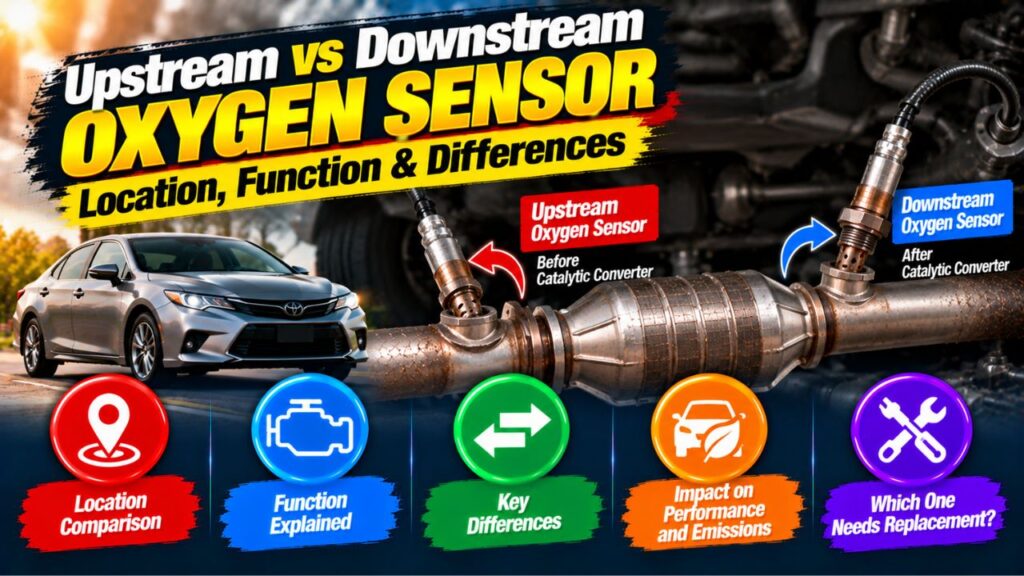
An upstream oxygen sensor is an exhaust sensor installed before the catalytic converter. It measures the oxygen content in the exhaust gases leaving the engine and sends that information to the engine control module, or ECM.
The ECM uses the sensor signal to help adjust the amount of fuel being delivered to the engine.
For this reason, the upstream sensor is often considered the primary oxygen sensor for fuel control.
It may also be called:
- Sensor 1
- Pre-cat oxygen sensor
- Front oxygen sensor
- Air-fuel ratio sensor on some vehicles
The upstream sensor has a direct influence on how the engine maintains the correct air-fuel mixture during closed-loop operation.
What Does an Upstream Oxygen Sensor Do?
The upstream sensor helps the ECM determine whether the engine is running relatively rich or lean.
A rich mixture contains more fuel relative to available oxygen.
A lean mixture contains less fuel relative to available oxygen.
When the ECM receives information from the upstream sensor, it can make small corrections to fuel injector operation.
This helps the engine maintain efficient combustion, lower emissions, and proper catalytic converter operation.
Upstream Sensor and Fuel Trim
The ECM continuously adjusts fuel delivery using information from several sensors.
The upstream oxygen sensor is one of the most important feedback devices during closed-loop operation.
Its readings influence:
- Short-term fuel trim
- Long-term fuel trim
- Air-fuel mixture correction
- Emissions control
If the upstream sensor provides inaccurate information, the ECM may add or remove the wrong amount of fuel.
That can affect drivability.
Where Is the Upstream Oxygen Sensor Located?
The answer to where is the upstream oxygen sensor located is usually straightforward: it is installed in the exhaust system before the catalytic converter.
Common mounting points include the exhaust manifold, exhaust header, or front exhaust pipe.
On many four-cylinder engines, the sensor may be visible near the exhaust manifold.
On V6 or V8 engines, there may be two upstream oxygen sensors—one for each cylinder bank.
These may be identified as:
- Bank 1 Sensor 1
- Bank 2 Sensor 1
The number 1 indicates that the sensor is upstream of the catalytic converter for that bank.
What Is a Downstream Oxygen Sensor?
A downstream oxygen sensor is located after the catalytic converter.
Its main job is usually to help the ECM monitor whether the catalytic converter is storing and processing exhaust oxygen as expected.
It may also be called:
- Sensor 2
- Post-cat oxygen sensor
- Rear oxygen sensor
The downstream sensor generally has less direct influence on the primary fuel mixture than the upstream sensor.
Its role is more closely connected with emissions-system monitoring.
What Does a Downstream Oxygen Sensor Do?
The downstream sensor looks at the exhaust after it has passed through the catalytic converter.
The ECM compares the downstream signal with the upstream signal to evaluate catalyst performance.
A properly functioning catalytic converter changes the composition of exhaust gases and smooths out rapid oxygen fluctuations.
If the downstream sensor signal begins to closely resemble the upstream sensor signal, the ECM may determine that the catalytic converter is not working efficiently enough.
That can lead to catalyst-efficiency codes such as P0420 or P0430 on many vehicles.
Where Is the Downstream Oxygen Sensor Located?
If you are wondering where is the downstream oxygen sensor located, it is typically threaded into the exhaust pipe after the catalytic converter.
Depending on the exhaust layout, it may be located:
- Immediately behind the catalytic converter
- Farther downstream in the exhaust pipe
- Under the vehicle
- Near a second catalytic converter
On vehicles with two exhaust banks, there may be more than one downstream sensor.
For example:
Bank 1 Sensor 2 is downstream on Bank 1.
Bank 2 Sensor 2 is downstream on Bank 2.
What Is the Difference Between Upstream and Downstream Oxygen Sensors?
The main difference between upstream and downstream oxygen sensors is their location and primary function.
The upstream sensor is mainly involved in fuel control.
The downstream sensor is mainly involved in catalyst monitoring.
| Feature | Upstream Oxygen Sensor | Downstream Oxygen Sensor |
| Location | Before catalytic converter | After catalytic converter |
| Common designation | Sensor 1 | Sensor 2 |
| Main purpose | Fuel mixture feedback | Catalyst monitoring |
| Effect on fuel trim | High | Usually limited |
| Common location | Exhaust manifold/front pipe | After catalytic converter |
| Failure may affect drivability | More likely | Less likely |
| Used to monitor catalyst | Indirectly | Directly |
This difference is important when diagnosing engine performance issues.
Are Upstream and Downstream Oxygen Sensors the Same?
Sometimes they can be physically similar, but are upstream and downstream oxygen sensors the same? Not necessarily.
They may differ in:
- Connector
- Wire length
- Heater resistance
- Sensor technology
- Calibration
- Response characteristics
On some vehicles, the exact same part number may be used in both upstream and downstream positions.
On other vehicles, the two sensors are completely different.
You should always check the correct part number for the specific position.
Can the Upstream Sensor Be a Wideband Sensor?
Yes.
Many modern vehicles use a wideband air-fuel ratio sensor in the upstream position.
A wideband sensor provides more precise mixture information than a traditional narrowband oxygen sensor.
It may also be called:
- A/F sensor
- AFR sensor
- Wideband O2 sensor
These sensors use a different electrical design from ordinary narrowband oxygen sensors.
A wideband upstream sensor usually cannot be replaced with a narrowband downstream sensor even if the threads are identical.
Is the Downstream Sensor Usually Narrowband?
On many vehicles, yes.
The downstream sensor is often a conventional heated narrowband oxygen sensor because the ECM mainly uses it to monitor catalytic converter performance.
However, not every vehicle uses the same arrangement.
Some modern emissions systems use more advanced downstream sensors.
Always verify the specific vehicle application.
How an Upstream Oxygen Sensor Works
The upstream sensor samples oxygen in the exhaust stream.
A traditional narrowband oxygen sensor produces a voltage that changes depending on whether the exhaust is relatively rich or lean.
The ECM watches these changes and continually adjusts fuel delivery.
A healthy narrowband upstream sensor often switches rapidly between rich and lean indications once the engine reaches operating temperature.
A wideband sensor behaves differently and should be interpreted using vehicle-specific scan data.
How a Downstream Oxygen Sensor Works
The downstream sensor also measures exhaust oxygen, but it sees exhaust gases after the catalytic converter.
The catalytic converter stores and releases oxygen as it processes pollutants.
Because of this, the downstream signal should generally be more stable than the upstream signal when the catalytic converter is working properly.
The ECM compares the two signals.
If their patterns become too similar, the converter may be losing efficiency.
Why Does a Vehicle Need Both Sensors?
The two sensors perform complementary jobs.
The upstream sensor helps the engine control combustion.
The downstream sensor helps verify that the catalytic converter is cleaning the exhaust effectively.
Without the upstream sensor, fuel control becomes less accurate.
Without the downstream sensor, the ECM loses an important method of monitoring emissions-system performance.
Both sensors contribute to modern emissions control, but they do not perform the same primary job.
Can I Use a Downstream Oxygen Sensor for Upstream?
Sometimes, but only if the manufacturer lists the exact same sensor part number for both positions.
In most cases, you should not assume a downstream oxygen sensor can be used upstream simply because it physically fits.
The upstream sensor may require different:
- Electrical characteristics
- Response speed
- Heater design
- Connector
- Calibration
- Sensor technology
If the upstream location uses a wideband air-fuel ratio sensor and the downstream location uses a narrowband sensor, they are definitely not interchangeable.
What Happens If You Put the Wrong O2 Sensor Upstream?
The ECM relies heavily on the upstream sensor for fuel control.
If an incompatible sensor is installed, possible problems include:
- Check engine light
- Incorrect fuel trim
- Rough idle
- Poor fuel economy
- Hesitation
- Rich or lean running
- Heater-circuit codes
- O2 sensor performance codes
The sensor may screw into the exhaust normally and still be electrically wrong for the vehicle.
What Happens If You Put an Upstream Sensor Downstream?
If the sensors are not designed to be interchangeable, the ECM may receive a signal it does not expect from the post-catalyst location.
Possible results include:
- O2 sensor codes
- Catalyst monitoring errors
- Heater circuit faults
- Incorrect emissions-system diagnosis
Again, use the correct position-specific sensor unless the parts catalog confirms they are identical.
Upstream vs. Downstream Sensor Numbering
Understanding sensor numbering makes replacement easier.
Sensor 1
Sensor 1 is located before the catalytic converter.
It is the upstream sensor.
Sensor 2
Sensor 2 is located after the catalytic converter.
It is the downstream sensor.
This numbering applies separately to each engine bank.
What Is Bank 1 Sensor 1?
Bank 1 Sensor 1 is the upstream oxygen sensor on the side of the engine containing cylinder number 1.
It is located before the catalytic converter.
What Is Bank 1 Sensor 2?
Bank 1 Sensor 2 is the downstream oxygen sensor on Bank 1.
It is located after the catalytic converter.
What Is Bank 2 Sensor 1?
Bank 2 Sensor 1 is the upstream sensor on the second cylinder bank.
It is installed before the catalytic converter for Bank 2.
What Is Bank 2 Sensor 2?
Bank 2 Sensor 2 is the downstream sensor on Bank 2.
It is located after the catalytic converter.
Does a Four-Cylinder Engine Have Bank 2?
Most inline four-cylinder engines have only one cylinder bank.
That means you may see:
- Bank 1 Sensor 1
- Bank 1 Sensor 2
There is usually no Bank 2.
However, always follow vehicle-specific service information because exhaust configurations can vary.
Does a V6 or V8 Have More Oxygen Sensors?
Often, yes.
A V6 or V8 commonly has two cylinder banks and may use at least four oxygen sensors.
A typical arrangement is:
Bank 1 Sensor 1
Bank 1 Sensor 2
Bank 2 Sensor 1
Bank 2 Sensor 2
Some vehicles use even more sensors when multiple catalytic converters or more complex emissions systems are present.
Upstream Sensor Failure Symptoms
Because the upstream sensor affects fuel control, its failure may produce noticeable drivability symptoms.
Possible symptoms include rough idle, hesitation, reduced fuel economy, poor acceleration, rich or lean operation, and a check engine light.
However, these symptoms can also come from vacuum leaks, ignition problems, fuel issues, and other sensors.
The O2 sensor should be tested before replacement.
Downstream Sensor Failure Symptoms
A bad downstream oxygen sensor is more likely to cause an emissions-related check engine light than a major drivability problem.
You may notice little or no change in how the vehicle runs.
Possible symptoms include:
- Check engine light
- O2 heater codes
- Catalyst-monitoring codes
- Failed emissions inspection
Poor engine performance is less commonly caused by the downstream sensor alone.
Can an Upstream O2 Sensor Cause Poor Fuel Economy?
Yes.
Because the upstream sensor influences fuel trim, inaccurate readings can cause the ECM to add or remove the wrong amount of fuel.
A sensor that falsely indicates a lean condition may cause the ECM to add excess fuel.
Fuel economy can then decrease.
However, fuel economy problems have many possible causes.
Can a Downstream O2 Sensor Affect Fuel Economy?
Usually much less.
The downstream sensor’s primary job is catalyst monitoring.
Some modern systems may use downstream data for minor fuel corrections or diagnostics, but it generally has much less influence than the upstream sensor.
A severe fuel-economy problem should not automatically be blamed on the downstream O2 sensor.
Can an Upstream Oxygen Sensor Cause a Misfire?
It can contribute indirectly.
If incorrect upstream sensor data causes the engine to run excessively rich or lean, combustion can become unstable and misfires may occur.
However, spark plugs, coils, injectors, vacuum leaks, and compression problems are generally more direct causes of misfires.
Can a Downstream O2 Sensor Cause a Misfire?
Usually not.
A downstream sensor generally does not control the primary air-fuel mixture strongly enough to create a significant misfire by itself.
If you have a misfire code and a downstream O2 code together, investigate the misfire independently rather than assuming the rear sensor caused it.
Can a Bad Upstream O2 Sensor Damage the Catalytic Converter?
It can contribute to conditions that damage the converter.
If incorrect fuel control causes prolonged rich operation, unburned fuel can enter the exhaust.
That can overheat the catalytic converter.
A malfunctioning upstream sensor should therefore not be ignored when it significantly affects fuel mixture.
Can a Bad Downstream Sensor Make the Catalytic Converter Look Bad?
Yes.
Because the ECM relies on downstream sensor data to judge catalyst efficiency, an inaccurate sensor can sometimes contribute to misleading catalyst-monitoring results.
However, a P0420 or P0430 code does not automatically mean the downstream sensor is bad.
The catalytic converter, upstream sensor, exhaust leaks, fuel mixture, and engine condition all need to be considered.
Can an Exhaust Leak Affect Upstream and Downstream Sensors?
Yes.
An exhaust leak can allow outside oxygen into the exhaust stream.
If that oxygen reaches a sensor, the reading can appear leaner than the actual combustion mixture.
Leaks near an upstream sensor can affect fuel-control diagnosis.
Leaks near or around the catalytic converter can also interfere with downstream catalyst monitoring.
Exhaust leaks should be repaired before interpreting some oxygen sensor data.
How Long Do Upstream Oxygen Sensors Last?
There is no universal lifespan.
Sensor life depends on:
- Vehicle design
- Engine condition
- Sensor technology
- Oil consumption
- Coolant contamination
- Fuel mixture
- Operating temperatures
A sensor may last a long time under normal conditions but fail early if contaminated.
Follow manufacturer maintenance recommendations rather than relying on one universal mileage interval.
Do Downstream Oxygen Sensors Last Longer?
Sometimes they may experience different operating conditions, but you should not assume the downstream sensor always lasts longer.
Both are exposed to:
- High exhaust temperatures
- Moisture
- Contaminants
- Road conditions
Actual service life depends on the vehicle and operating environment.
What Can Damage Oxygen Sensors?
Oxygen sensors can be contaminated or damaged by engine problems.
Common causes include oil burning, coolant entering the combustion chamber, excessively rich fuel mixtures, physical damage, damaged wiring, and some chemical contaminants.
Replacing the sensor without correcting the underlying problem can cause the new sensor to fail again.
Can You Clean Upstream or Downstream Oxygen Sensors?
Cleaning is generally not considered a reliable repair.
The sensing element is delicate, and solvents or aggressive brushing may damage it.
If testing confirms the sensor is faulty, replacement is usually the correct solution.
How to Identify Which O2 Sensor Is Bad
Start with the diagnostic trouble code.
For example, a code description may identify:
- Bank 1 Sensor 1
- Bank 1 Sensor 2
- Bank 2 Sensor 1
- Bank 2 Sensor 2
Do not replace the sensor solely because the code mentions it.
Inspect wiring, connectors, exhaust leaks, heater circuits, and scan-tool sensor data.
A sensor code can sometimes be caused by a wiring or engine problem rather than the sensor itself.
How to Choose the Correct Replacement O2 Sensor
Use the exact vehicle information:
Year, make, model, engine, bank, and sensor position.
Then confirm whether the sensor is:
- Upstream or downstream
- Narrowband or wideband
- Direct-fit or universal
A direct-fit sensor usually reduces installation mistakes because the connector and wiring are already correct.
Direct-Fit vs. Universal Oxygen Sensor
A direct-fit sensor includes the correct connector and wiring for a specific application.
A universal sensor may require splicing or transferring the original connector.
Universal does not mean it fits every upstream or downstream position.
It still must match the correct electrical sensor type.
For most DIY repairs, a direct-fit sensor is usually easier.
Common Mistakes When Replacing Upstream and Downstream Sensors
A frequent mistake is confusing Sensor 1 with Sensor 2.
Remember:
Sensor 1 = upstream
Sensor 2 = downstream
Another common mistake is assuming Bank 1 always means the driver’s side. Bank 1 is actually the side containing cylinder number 1, and cylinder numbering varies by manufacturer.
It is also easy to assume two sensors are interchangeable because they have the same connector or thread. Always verify the part number.
FAQs About Upstream and Downstream Oxygen Sensors
What is an upstream oxygen sensor?
An upstream oxygen sensor is located before the catalytic converter and provides exhaust-oxygen feedback that the engine computer uses primarily for fuel control.
What is a downstream oxygen sensor?
A downstream oxygen sensor is located after the catalytic converter and is primarily used to monitor catalytic converter efficiency.
What is the difference between upstream and downstream oxygen sensors?
The main difference is their role. The upstream sensor helps control the air-fuel mixture, while the downstream sensor mainly monitors catalyst performance.
Are upstream and downstream oxygen sensors the same?
Not always.
Some vehicles use identical sensors in both positions, but many use different sensor technologies, connectors, wire lengths, or heater characteristics.
Where is the upstream oxygen sensor located?
It is located before the catalytic converter, usually in the exhaust manifold or front exhaust pipe.
Where is the downstream oxygen sensor located?
It is located after the catalytic converter, normally in the exhaust pipe downstream of the converter.
Can I use a downstream oxygen sensor for upstream?
Only if the exact part is listed by the manufacturer for both positions.
Do not assume interchangeability based on thread size, wire count, or appearance.
Which oxygen sensor affects fuel mixture the most?
The upstream oxygen sensor generally has the greatest influence on fuel mixture because the ECM uses its feedback for closed-loop fuel control.
Conclusion
The overall difference between an upstream oxygen sensor and a downstream oxygen sensor comes down to both location and purpose. The upstream sensor sits before the catalytic converter and plays a major role in controlling the engine’s air-fuel mixture, while the downstream sensor sits after the converter and is mainly used to evaluate catalytic converter performance.
So, are upstream and downstream oxygen sensors the same? Sometimes they may share the same physical design or even the same part number, but they should never be assumed interchangeable. Modern vehicles may use a wideband air-fuel ratio sensor upstream and a conventional narrowband sensor downstream, making the two completely different electrically even when they look similar.
The easiest way to remember their locations is that Sensor 1 is upstream and Sensor 2 is downstream. If you are trying to determine where is the upstream oxygen sensor located, look before the catalytic converter. If you need where is the downstream oxygen sensor located, look after the converter.
As for can I use a downstream oxygen sensor for upstream, only do so when the vehicle manufacturer or parts catalog confirms that the same exact sensor is specified for both positions. Choosing the correct sensor for the correct bank and location is the best way to avoid repeated check engine lights, incorrect fuel control, and unnecessary parts replacement.