How to Reset Oxygen Sensor After Replacement: Step-by-Step Guide
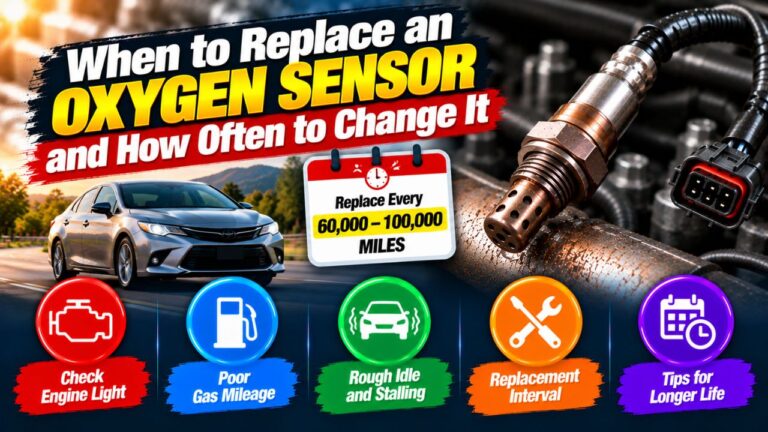
Replacing a faulty oxygen sensor is only part of the repair. The engine control module may still have the old diagnostic trouble code (DTC) stored in memory, the check engine light may remain on, and some emissions monitors may show as “not ready” until the vehicle completes additional driving.
In most vehicles, you reset the oxygen sensor after replacement by clearing the stored trouble code with an OBD-II scan tool, then driving the vehicle normally so the engine computer can relearn fuel corrections and run its oxygen-sensor and emissions monitors. The oxygen sensor itself does not usually require a separate manual reset.
Understanding how to reset oxygen sensor after replacement is important because simply disconnecting the battery is not always the best solution. A scan tool lets you clear the relevant fault while preserving other vehicle settings, and it also lets you verify whether the new sensor is operating correctly.
If the check engine light returns after clearing the code, do not keep resetting it. A returning fault usually means the original problem was not completely fixed, the wrong sensor was replaced, there is a wiring or exhaust problem, or another engine condition is causing abnormal oxygen-sensor readings.
This guide explains the proper reset process, whether disconnecting the battery works, how long relearning takes, what happens to emissions readiness monitors, and what to check if the oxygen-sensor code comes back.
How to Reset Oxygen Sensor After Replacement
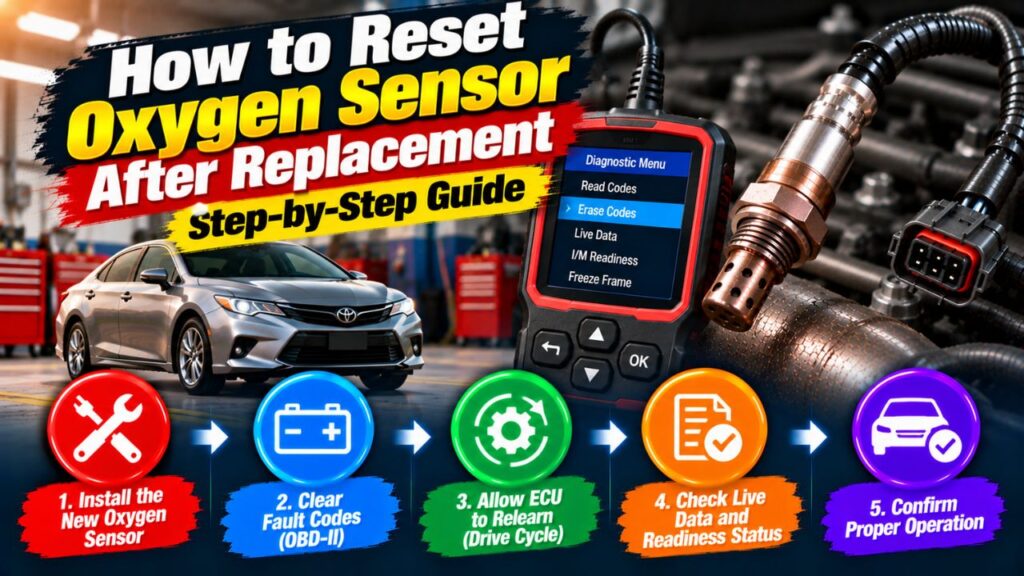
The preferred method is to use an OBD-II scan tool to clear the stored oxygen-sensor trouble code after confirming the new sensor is installed correctly.
The general process is:
- Make sure the replacement oxygen sensor and electrical connector are installed correctly.
- Turn the ignition on without starting the engine if your scan tool requires it.
- Connect the OBD-II scanner to the diagnostic port.
- Read and record any stored trouble codes.
- Clear the codes.
- Start the engine and check that the warning light stays off.
- Allow the engine to reach normal operating temperature.
- Drive the vehicle through normal operating conditions.
- Rescan for pending or returning codes.
- Check emissions readiness monitors if an inspection is approaching.
The exact drive-cycle requirements vary by manufacturer, so there is no single driving pattern that applies to every vehicle.
Does an Oxygen Sensor Actually Need to Be Reset?
Usually, no.
The new oxygen sensor itself generally does not contain a resettable memory that needs to be manually programmed.
What needs attention is the vehicle’s engine control module, also called the ECM or PCM.
Before replacement, the computer may have stored:
- O2 sensor trouble codes
- Fuel-trim corrections
- Freeze-frame data
- Emissions monitor results
Once the faulty component is repaired, the computer must see normal sensor behavior before it considers the problem resolved.
Clearing the code speeds up that process, but the computer will still need to monitor the new sensor during normal operation.
Use an OBD-II Scanner to Clear the Code
For most vehicles made for the U.S. market since 1996, an OBD-II scanner is the easiest way to reset the check engine light after oxygen-sensor replacement.
The diagnostic connector is commonly located underneath the dashboard near the driver’s side.
Connect the scan tool and follow its instructions.
Most basic scanners provide options such as:
- Read codes
- Clear codes
- Check pending codes
- View readiness monitors
Before clearing anything, record the stored code.
That gives you a reference if the problem returns.
For example, oxygen-sensor-related codes may identify a particular bank, sensor position, heater circuit, or sensor-response problem.
Should You Start the Engine Before Clearing the Code?
Usually, the ignition should be switched to the ON position while the engine remains off, but scan-tool procedures vary.
Follow the instructions for your scanner and vehicle.
Once the code has been cleared, turn the ignition off if instructed, restart the engine, and verify that the check engine light does not immediately return.
If the light comes back almost instantly, the problem may still be electrically present.
Can You Reset the O2 Sensor by Disconnecting the Battery?
Sometimes disconnecting the battery can clear stored engine information, but it is generally not the preferred method.
Depending on the vehicle, battery disconnection may also erase:
- Radio presets
- Clock settings
- Idle adaptations
- Transmission adaptations
- Window or sunroof initialization
- Other learned values
Some vehicles may also require security or relearn procedures afterward.
Modern vehicles may retain some diagnostic information even after a short battery disconnection.
Using a scan tool is cleaner because it lets you clear diagnostic codes intentionally and then confirm the repair.
How Long Should You Disconnect the Battery?
There is no universal battery-disconnection time that guarantees a code reset on every vehicle.
You may see recommendations ranging from several minutes to much longer, but modern control modules do not all behave the same way.
If your goal is simply to clear an oxygen-sensor trouble code, using an OBD-II scanner is more reliable than guessing how long the battery should remain disconnected.
If the vehicle manufacturer specifically provides a battery-reset procedure, follow that procedure.
What Happens After You Clear the O2 Sensor Code?
Clearing the code does more than switch off the check engine light.
It may also reset the vehicle’s OBD readiness monitors.
These monitors are self-tests used to evaluate emissions-related systems such as:
- Oxygen sensors
- Oxygen-sensor heaters
- Catalytic converter
- EVAP system
- EGR system where equipped
After codes are cleared, some monitors may change to Not Ready.
The vehicle must then be driven through appropriate operating conditions before those tests become complete again.
What Is an OBD-II Drive Cycle?
A drive cycle is a series of driving conditions that allows the engine computer to run emissions-system tests.
A typical drive cycle may include a combination of:
- Cold start
- Idling
- Steady-speed cruising
- Moderate acceleration
- Deceleration
- Highway-speed operation
- Engine cooldown
The exact sequence varies by manufacturer and model.
This means there is no universal instruction such as “drive exactly 50 miles” that guarantees every readiness monitor will complete.
Normal mixed driving over several trips may be enough for many vehicles.
How Long Does It Take for an O2 Sensor to Relearn?
The new sensor begins operating as soon as it reaches its normal operating temperature and the engine control system starts using its signal.
Fuel-control adjustments can begin very quickly.
However, completing all readiness monitors can take longer.
Depending on the vehicle and driving conditions, monitors may complete after:
- One trip
- Several trips
- Several dozen miles
- A few days of normal driving
Certain monitors require very specific conditions, so mileage alone does not determine completion.
Do You Need to Reset Fuel Trims?
Usually, manually resetting fuel trims is not necessary after replacing an oxygen sensor.
The engine computer continuously adjusts short-term fuel trim (STFT) and long-term fuel trim (LTFT) based on sensor feedback.
After the replacement sensor begins providing accurate data, the computer can gradually correct its learned fuel adjustments.
Some professional scan tools allow fuel adaptations to be reset, but this should be done only when appropriate for the vehicle and repair.
Clearing diagnostic codes may reset some adaptive information automatically on certain vehicles.
Can You Just Drive and Let the Check Engine Light Clear Itself?
Sometimes.
If the repair corrected the fault, the engine computer may eventually turn off the check engine light after enough successful monitoring cycles.
However, the stored fault may remain in memory for some time.
Using a scan tool is usually better because you can confirm the original code, clear it intentionally, and monitor whether it returns.
If you are preparing for an emissions inspection, simply waiting for the light to go out is also not enough. You need to make sure the readiness monitors have completed.
Why Is the Check Engine Light Still On After Replacing the Oxygen Sensor?
A check engine light that remains on does not automatically mean the new sensor is defective.
Several possibilities exist.
The stored code may simply not have been cleared yet.
But if the light stays on or quickly returns after clearing, possible causes include a damaged sensor connector, wiring fault, blown heater-circuit fuse, exhaust leak, incorrect replacement sensor, or an engine condition that is still causing abnormal readings.
Another common issue is replacing the wrong sensor.
Modern vehicles may have multiple oxygen sensors identified by bank and sensor number.
Bank 1 Sensor 1 vs. Bank 1 Sensor 2
Understanding sensor location matters when diagnosing a returning code.
Sensor 1 generally means the upstream sensor located before the catalytic converter.
Sensor 2 generally means the downstream sensor located after the catalytic converter.
On engines with two cylinder banks, you may also see:
- Bank 1 Sensor 1
- Bank 1 Sensor 2
- Bank 2 Sensor 1
- Bank 2 Sensor 2
Bank 1 is the side of the engine containing cylinder number 1.
Do not assume Bank 1 always means the driver’s side or passenger’s side. That varies by engine.
Replacing the wrong sensor will not correct the original fault.
Why an Oxygen Sensor Code Can Come Back
An oxygen-sensor code does not always mean the sensor itself caused the problem.
For example, a lean-reading sensor may actually be reporting a real lean condition caused by:
- Vacuum leak
- Intake leak
- Low fuel pressure
- Exhaust leak upstream of the sensor
- Fuel injector problem
A rich reading can also be caused by excessive fuel delivery rather than a faulty sensor.
If the same code returns after installing a new sensor, the next step should be diagnosis rather than another reset.
Check the Oxygen Sensor Connector
If the code returns quickly, inspect the electrical connection.
Make sure the connector is fully seated and locked.
Look for:
- Bent terminals
- Broken wires
- Melted insulation
- Corrosion
- Wiring touching the exhaust
- Connector not fully engaged
Oxygen-sensor wiring operates close to extremely hot exhaust components.
If the harness is routed incorrectly after replacement, heat can damage it rapidly.
Check for Exhaust Leaks
An exhaust leak near an upstream oxygen sensor can draw outside air into the exhaust stream.
That extra oxygen can make the sensor indicate a lean condition even when fuel delivery is normal.
Possible leak locations include:
- Exhaust manifold
- Manifold gasket
- Flex pipe
- Cracked exhaust pipe
- Sensor bung
If an oxygen-sensor code returns despite a new sensor, checking for exhaust leaks can prevent unnecessary parts replacement.
Do You Need to Reset the ECU After Replacing a Downstream O2 Sensor?
The process is generally the same.
Clear the stored diagnostic code with a scanner, then allow the vehicle to complete its monitors.
A downstream oxygen sensor primarily monitors catalytic-converter behavior on many vehicles.
If a downstream sensor-related code returns after replacement, investigate wiring, exhaust leaks, and catalytic-converter operation rather than repeatedly clearing the code.
Do You Need to Reset the ECU After Replacing an Upstream O2 Sensor?
Clearing the stored code is recommended.
The upstream sensor plays a major role in closed-loop fuel control, so accurate feedback from the new sensor is important.
The engine computer normally begins using the new sensor automatically once operating conditions allow closed-loop operation.
No special programming is required for most conventional replacement oxygen sensors.
What Is Closed-Loop Operation?
When the engine is cold, it may initially operate in open loop.
During open loop, the computer relies more heavily on preprogrammed fuel maps and inputs from other sensors.
Once operating conditions are suitable and the oxygen sensor has warmed sufficiently, the system can enter closed loop.
In closed loop, oxygen-sensor feedback becomes an important part of fine fuel control.
This is why you may need to allow the engine to warm up before judging whether the replacement sensor is working normally.
How to Check Whether the New O2 Sensor Is Working
A scan tool with live-data capability can provide more information than simply clearing the code.
Depending on sensor type, you may monitor:
- O2 sensor voltage
- Air-fuel ratio sensor data
- Heater status
- Short-term fuel trim
- Long-term fuel trim
Traditional narrowband oxygen sensors generally switch between richer and leaner exhaust conditions once they are hot and operating normally.
Wideband or air-fuel ratio sensors behave differently and should be interpreted using manufacturer-specific specifications.
Do not apply narrowband voltage rules to every modern oxygen sensor.
What if the O2 Sensor Heater Code Returns?
Modern oxygen sensors commonly contain electric heaters that help them reach operating temperature quickly.
If a heater-circuit code returns after sensor replacement, the problem may not be the sensing element.
Check the heater circuit for issues such as:
- Fuse failure
- Damaged wiring
- Poor connector contact
- Missing power
- Poor ground
The heater circuit should be diagnosed electrically rather than repeatedly replacing sensors.
How to Know the Reset Was Successful
The repair is more convincing when several things happen together.
The check engine light stays off, the original oxygen-sensor code does not return, the vehicle operates normally, and related OBD readiness monitors eventually show complete.
If your scan tool supports live data, normal sensor response provides additional confirmation.
A code that remains gone only for a few minutes is not enough to prove the repair.
Drive the vehicle through normal operating conditions and scan it again.
Can You Pass Emissions Immediately After Resetting the O2 Sensor?
Often, no.
Clearing trouble codes can reset readiness monitors to Not Ready.
Many U.S. emissions-inspection programs check these monitor statuses.
Even with the check engine light off, a vehicle may fail or be rejected from testing if too many required monitors are incomplete.
Complete the appropriate drive cycle and verify readiness with a scan tool before going for inspection.
Do not repeatedly clear codes immediately before an emissions test. That generally resets the monitors again.
Should You Clear Codes Before or After Replacing the Sensor?
Diagnostically, it is useful to read and record the codes before replacing anything.
After the repair, clear the code.
This gives you a clean starting point.
If the same code returns afterward, you know the control module detected the problem again after the replacement.
Clearing codes before diagnosing them can erase useful information such as freeze-frame data, which shows operating conditions present when the fault was detected.
What if You Replaced the O2 Sensor but Did Not Clear the Code?
The vehicle can still use the new sensor.
The sensor does not need the code to be manually cleared before it begins functioning.
If the repair is successful, the engine computer may eventually recognize normal operation and turn the check engine light off.
However, clearing the code with a scanner makes it easier to monitor the repair and determine whether the fault returns.
Common Mistakes After Oxygen Sensor Replacement
One common mistake is assuming that disconnecting the battery is mandatory. In most cases, a scan tool provides a better reset method.
Another is immediately taking the vehicle for emissions inspection after clearing the codes. The monitors may not be ready yet.
Also avoid repeatedly clearing a code that keeps returning. A returning code is diagnostic information. It means the system is still detecting a fault and needs further investigation.
Finally, make sure the oxygen-sensor harness is routed away from the exhaust. A perfectly good new sensor can quickly develop wiring problems if its cable rests against a hot manifold or pipe.
FAQs About How to Reset Oxygen Sensor After Replacement
Do I have to reset the computer after replacing an oxygen sensor?
You usually do not need a special ECU programming procedure, but clearing the stored diagnostic code with an OBD-II scanner is recommended.
The computer will then monitor the new sensor and relearn any necessary fuel corrections automatically.
How long should I drive after replacing an O2 sensor?
There is no universal mileage.
Several normal trips with a mixture of city and highway driving may be enough for the computer to complete its tests, but some readiness monitors require specific conditions.
Will an oxygen sensor reset itself?
The sensor itself does not require a reset.
The engine computer can eventually recognize that the fault is no longer present, although manually clearing the stored code with a scan tool is usually faster and more convenient.
Can I reset an O2 sensor by disconnecting the battery?
Battery disconnection may clear some stored information on some vehicles, but it is not the preferred method.
It may also erase other learned settings and reset emissions monitors.
An OBD-II scanner is generally better.
Why is my check engine light still on after replacing the O2 sensor?
The code may not have been cleared, or the original problem may still exist.
Possible causes include wiring damage, exhaust leaks, a heater-circuit problem, incorrect sensor replacement, or another engine condition affecting the sensor reading.
How many miles does it take for an O2 sensor monitor to become ready?
There is no fixed mileage for every vehicle.
The monitor completes when the vehicle experiences the required temperatures, speeds, loads, and operating conditions.
Checking readiness with an OBD-II scanner is more reliable than counting miles.
Do I need to clear fuel trims after replacing an oxygen sensor?
Usually not.
The engine computer can adjust fuel trims as it receives accurate data from the new sensor.
Vehicle-specific service procedures may call for an adaptive reset in certain cases.
What should I do if the same oxygen sensor code comes back?
Do not simply clear it again.
Confirm that the correct sensor was replaced, inspect the connector and wiring, check for exhaust leaks, and diagnose any fuel-mixture or catalytic-converter problems related to the code.
Conclusion
The overall process for how to reset oxygen sensor after replacement is straightforward: verify that the new sensor is installed correctly, use an OBD-II scan tool to clear the stored trouble code, then drive the vehicle normally so the engine computer can evaluate the new sensor, relearn fuel corrections, and complete its emissions readiness monitors.
In most vehicles, there is no separate manual reset procedure for the oxygen sensor itself. Disconnecting the battery may clear some information, but a scan tool is usually the better method because it lets you preserve useful vehicle settings, check pending codes, and confirm whether the original fault returns.
The most important part comes after the reset. If the check engine light stays off, the sensor data looks normal, and the readiness monitors eventually complete, the repair was likely successful. If the same code returns, do not keep resetting it. Check the sensor wiring, connector, exhaust system, heater circuit, fuel mixture, and whether the correct upstream or downstream sensor was replaced. A successful reset should confirm a completed repair—not hide an unresolved problem.