Bad Catalytic Converter Symptoms: Signs, Tests, and Diagnosis
A failing catalytic converter can cause a Check Engine Light, sluggish acceleration, reduced high-RPM power, rattling underneath the vehicle, sulfur-like exhaust odor, poor fuel economy, hard starting, rough running, or stalling. Some converters fail chemically with few drivability changes, while clogged or broken converters can create much stronger symptoms.
The converter sits in the exhaust system and uses a catalyst-coated honeycomb to treat harmful gases after combustion. A fault can involve the catalyst coating, the internal ceramic structure, exhaust flow, or several of these at once.
The most useful bad catalytic converter symptoms are not a single warning light or smell. A combination of catalyst codes, power loss under load, abnormal converter heat, rattling, and measured exhaust restriction provides much stronger evidence.
A converter also often fails because of another engine problem. Misfires, rich fuel mixtures, oil burning, coolant leaks, weak ignition, and fuel-system faults can overheat or contaminate the catalyst. Walker advises finding and repairing the underlying engine fault before installing another converter.
For U.S. owners, EPA states that catalytic converters are among the specified major emissions components covered under applicable federal warranty provisions for 8 years or 80,000 miles, whichever comes first. Checking the vehicle’s warranty information can be worthwhile before paying for replacement.
A P0420 or P0430 code does not automatically prove that the converter is physically clogged. A converter can lose catalyst efficiency while exhaust flow remains normal, so diagnosis should match the code with engine performance, sensor data, exhaust condition, and restriction tests.
The sections below cover the most common signs, what a failing converter does to the vehicle, how to diagnose it, and how to identify which converter is bad on vehicles with more than one.
Bad Catalytic Converter Symptoms to Watch For
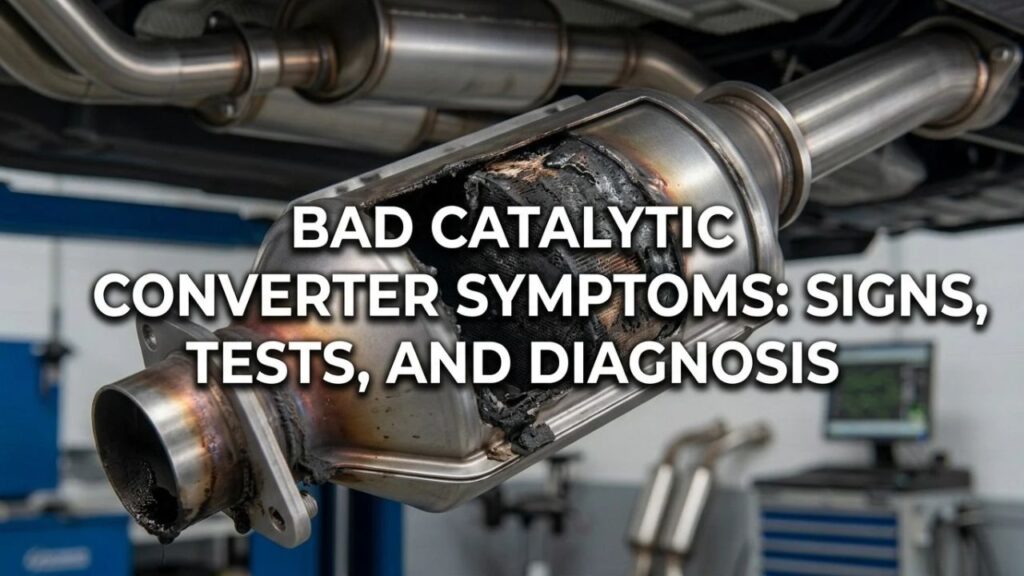
Converter symptoms change according to the type of failure.
A chemically weak catalyst may trigger little more than a warning light, while a melted or collapsed core can severely restrict the engine.
1. Check Engine Light
A Check Engine Light is one of the most common early clues.
Typical catalyst-related codes include:
- P0420 — Catalyst System Efficiency Below Threshold, Bank 1
- P0430 — Catalyst System Efficiency Below Threshold, Bank 2
The light may appear before you notice any major change in acceleration or idle quality. AutoZone also lists the Check Engine Light among common converter-failure signs.
A catalyst code should still be diagnosed rather than treated as an automatic replacement order.
Exhaust leaks, sensor faults, misfires, and fuel-control problems can affect catalyst-monitor results.
2. Sluggish Acceleration
A converter that becomes physically restricted can make the vehicle feel weak when you press the accelerator.
The engine produces more exhaust as load and RPM increase. If the converter passages are partly blocked, exhaust pressure rises upstream of the restriction.
The vehicle may:
- Accelerate slowly
- Struggle on hills
- Feel weak during passing
- Need more throttle than before
Both Cars.com and AutoZone identify sluggish performance as a common converter symptom.
3. Loss of High-RPM Power
A partly blocked converter may still allow enough exhaust flow for a normal idle.
The restriction becomes much more noticeable as engine speed rises.
You may find that the engine:
- Revs normally at first
- Becomes weak above a certain RPM
- Cannot reach its previous power range
- Feels as if something is holding it back
This pattern points more strongly toward exhaust restriction than a catalyst-efficiency code by itself.
4. Rattling Under the Vehicle
The converter contains a ceramic or metallic substrate.
If the ceramic core cracks, pieces can loosen and move inside the shell.
You may hear a metallic rattle during:
- Startup
- Idle
- Light acceleration
- Deceleration
- Driving over bumps
AutoZone lists rattling underneath the vehicle as a possible sign of a broken converter substrate.
A loose heat shield can produce a similar noise, so confirm the source before replacing the converter.
5. Rotten-Egg or Sulfur-Like Smell
A sulfur-like exhaust odor can appear when the engine or catalyst system is not processing exhaust normally.
Cars.com lists a rotten-egg smell among common warning signs associated with converter trouble.
Smell alone does not prove the converter is bad.
Rich fuel operation, fuel composition, or another combustion fault can create a similar odor and may actually be the condition damaging the converter.
6. Poor Fuel Economy
A restricted converter can make the engine work harder to move exhaust gases.
Drivers may compensate by pressing the accelerator farther, increasing fuel use.
The engine problem that damaged the converter can also lower fuel economy.
Rich operation, misfires, leaking injectors, and faulty airflow information are examples.
7. Hard Starting
A severely clogged converter can trap exhaust pressure and make starting more difficult.
The engine may:
- Crank longer than normal
- Start and stumble
- Start and die
- Run better cold than hot
AutoZone lists hard starting among symptoms associated with severe converter restriction.
8. Rough Idle or Misfires
A heavily restricted converter can interfere with cylinder breathing.
Exhaust gas may not leave the cylinders as freely as intended, reducing the amount of fresh air available for the next combustion cycle.
The engine can shake, stumble, or develop random misfires.
Keep in mind that the direction can run the other way: a misfire can damage the converter first by sending unburned fuel into the exhaust. Walker lists misfires among major causes of converter overheating and substrate damage.
9. Stalling
A nearly blocked converter can restrict exhaust enough to make the engine stall.
Some vehicles may run for a short period after startup, then lose power and stall as exhaust pressure and heat build.
Repeated stalling paired with poor acceleration deserves prompt diagnosis.
10. Excessive Heat or Converter Discoloration
Converters normally operate at high temperature, but extreme heat is a warning sign.
Walker states that sustained temperatures above roughly 1,600°F can damage catalyst material, while still higher temperature can destroy internal matting or substrate.
A bronze or blue discoloration of the converter shell can suggest prior overheating.
A converter that glows red or orange requires immediate attention.
11. Failed Emissions Test
A converter can fail chemically even when the engine still feels normal.
If catalyst activity drops below the required level, the vehicle may fail an emissions inspection or set P0420/P0430.
This type of failure may occur without a major exhaust restriction.
12. Dark or Abnormal Exhaust
Cars.com lists dark exhaust smoke among possible signs associated with converter trouble.
Dark smoke often points toward a rich-running engine, so do not assume the converter itself created the smoke.
A rich engine may instead be what damaged the catalyst.
Key Takeaway: The strongest signs are catalyst codes combined with power loss, limited RPM, rattling, abnormal heat, hard starting, or measured exhaust restriction.
What Does a Bad Catalytic Converter Do?
A bad converter can affect emissions, exhaust flow, or both.
The result depends on how the unit failed.
It Can Stop Cleaning Exhaust Properly
A converter may lose chemical activity while remaining physically open.
The engine can still run normally, but the catalyst no longer reduces pollutants at the expected rate.
The PCM may detect this and store P0420 or P0430.
It Can Restrict Exhaust Flow
If the internal honeycomb melts, collapses, or becomes heavily contaminated, exhaust gases cannot pass through normally.
Backpressure rises upstream of the blockage.
The engine can then lose power because it cannot expel exhaust efficiently.
It Can Break Apart Internally
A cracked substrate may rattle inside the converter housing.
Loose material can shift and block the outlet intermittently.
One drive may feel nearly normal, while the next produces major acceleration loss.
It Can Overheat
A converter exposed to unburned fuel can reach damaging temperature.
Misfires and rich operation are common causes.
Severe overheating can melt the honeycomb, turning an emissions fault into a physical exhaust restriction.
Key Takeaway: A bad converter can lose emissions efficiency, restrict exhaust flow, break apart internally, or overheat; these failure modes create different symptom patterns.
What Happens When a Catalytic Converter Goes Bad?
A failing converter often progresses through stages rather than failing instantly.
Early failure may produce little more than a catalyst code.
As damage increases, other symptoms can appear.
A possible sequence is:
- An engine fault sends excess fuel, oil, or coolant into the exhaust.
- Catalyst activity starts to deteriorate.
- P0420 or P0430 appears.
- Heat or contamination damages the internal core.
- The substrate begins to melt, crack, or clog.
- Exhaust backpressure rises.
- Acceleration and high-RPM performance decline.
- Severe restriction leads to hard starting, rough running, or stalling.
A converter does not always follow this exact sequence.
Physical impact can crack a healthy converter suddenly, while an old converter may lose chemical efficiency without ever becoming clogged.
How Do You Tell If a Catalytic Converter Is Bad?
Start with symptoms and scan data, then confirm the type of failure.
Do not rely on a single smell, temperature reading, or trouble code.
Check All Diagnostic Trouble Codes
Use an OBD-II scanner and record stored and pending codes.
Look for:
- P0420
- P0430
- P0300-series misfire codes
- Rich or lean codes
- Oxygen-sensor codes
- MAF or MAP codes
- Fuel-system faults
Walker recommends correcting other PCM trouble codes before condemning the converter.
Inspect the Exhaust
Check for:
- Dents
- Crushed pipes
- Corrosion
- Exhaust leaks
- Loose heat shields
- Discoloration
- Physical impact damage
An exhaust leak near an oxygen sensor can interfere with catalyst monitoring.
Listen for Internal Rattling
A loose substrate may rattle when engine speed changes.
A technician can distinguish converter noise from heat shields, hangers, and exhaust pipes.
Check Engine Performance Under Load
Notice if power becomes worse as RPM rises.
A clogged converter often becomes more restrictive under higher exhaust flow.
A vehicle that runs normally at all speeds but has P0420 may have a catalyst-efficiency issue rather than a blocked converter.
Key Takeaway: A bad converter should be identified from codes, exhaust inspection, noise, and performance patterns rather than from one symptom alone.
How to Diagnose a Bad Catalytic Converter
Proper diagnosis should separate catalyst-efficiency failure from actual exhaust blockage.
Test Exhaust Backpressure
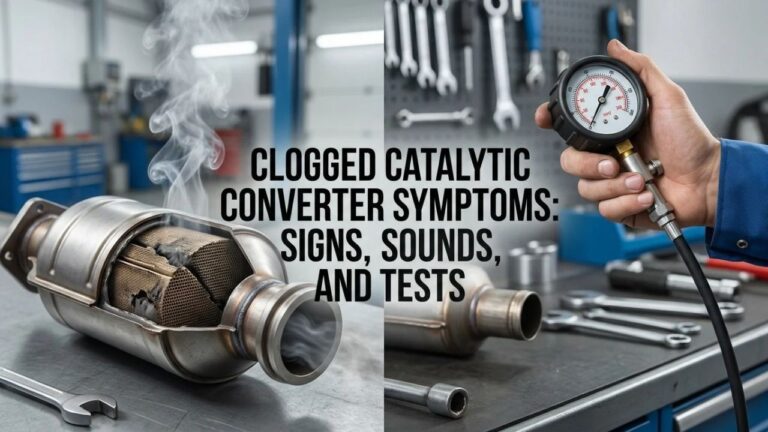
Backpressure testing is one of the better ways to confirm a restricted converter.
Walker gives general reference figures of less than about 1 to 1.5 psi at idle and less than 3 psi around 2,000–2,500 RPM on many vehicles, while vehicle-specific specifications should take priority.
Pressure is commonly measured through oxygen-sensor ports with the correct adapter.
High pressure ahead of the converter points toward restriction downstream of the test point.
If pressure is normal after the converter but high before it, the converter becomes a strong suspect.
Perform an Engine Vacuum Test
A vacuum gauge can provide another clue.
Walker notes that vacuum should generally recover after RPM is raised and held. A large continuing drop can point toward exhaust restriction.
Vacuum is also affected by valve timing and other engine faults, so it should not be used alone.
Check Converter Temperature Carefully
An infrared thermometer can show abnormal temperature patterns.
A hot converter does not automatically mean it is clogged.
Misfires and rich fuel mixtures can make the converter extremely hot even before physical blockage develops.
Walker notes that abnormal front-to-rear temperature behavior can provide diagnostic information, but engine mixture and operating conditions must also be considered.
Check Oxygen-Sensor Data
The upstream and downstream sensors can provide information about catalyst operation.
A healthy downstream sensor pattern is generally less active than the upstream signal once the converter is operating correctly.
Sensor interpretation varies by vehicle, so use manufacturer data when possible.
Do not replace an oxygen sensor simply because P0420 appears.
Check for Oil or Coolant Contamination
Walker recommends checking for oil consumption and internal coolant leaks because both can contaminate catalyst surfaces.
Look for:
- Falling oil level
- Blue exhaust smoke
- Coolant loss
- Persistent white exhaust smoke
- Oil- or coolant-fouled spark plugs
Diagnose Misfires and Fuel Problems
A new converter can fail again quickly if the original engine problem remains.
Check:
- Spark plugs
- Ignition coils
- Injectors
- Fuel pressure
- Fuel trims
- Compression
- MAF data
- Intake leaks
Key Takeaway: Backpressure testing, vacuum behavior, temperature patterns, oxygen-sensor data, and checks for engine faults provide a stronger converter diagnosis than P0420 alone.
How to Tell Which Catalytic Converter Is Bad
Many vehicles have more than one converter.
V6 and V8 engines may have a separate catalyst system for each cylinder bank, and some vehicles use primary and secondary converters.
Use P0420 and P0430 as Starting Clues
P0420 points toward the catalyst system on Bank 1.
P0430 points toward the catalyst system on Bank 2.
Bank 1 is the cylinder bank containing cylinder number 1.
Do not assume Bank 1 is always the driver or passenger side. Its location varies by engine.
Compare Bank-Specific Sensor Data
On vehicles with separate left and right converters, compare:
- Bank 1 upstream oxygen sensor
- Bank 1 downstream oxygen sensor
- Bank 2 upstream oxygen sensor
- Bank 2 downstream oxygen sensor
A scan tool may reveal one bank behaving differently from the other.
Check Backpressure by Bank
If the exhaust system allows separate test points, pressure can be checked upstream of each converter.
A bank with significantly higher pressure may contain the restriction.
Compare Temperature Between Banks
Temperature comparison can provide another clue on dual-bank systems.
A large difference can justify closer testing, but temperature by itself should not determine which converter gets replaced.
Verify the Converter Layout
Use the exact year, make, model, engine, and emissions configuration.
Some vehicles have:
- Two converter assemblies
- Four catalyst sections
- Manifold-mounted converters
- Underbody converters
- Primary and secondary catalyst stages
Know which part the code and test results actually refer to before buying a replacement.
Key Takeaway: Use bank-specific codes, sensor data, backpressure readings, and the vehicle’s exhaust layout to identify which converter is actually failing.
Bad Converter vs Bad Oxygen Sensor
A bad oxygen sensor can create symptoms or data that resemble converter trouble.
That is why replacing a converter from P0420 alone is risky.
Signs That Point More Toward the Converter
Converter failure becomes more likely with:
- Rattling substrate
- Severe power loss at higher RPM
- High exhaust backpressure
- Melted or collapsed honeycomb
- Repeated catalyst-efficiency failure after other faults are repaired
Signs That Point Toward a Sensor or Circuit
Sensor trouble becomes more likely with:
- O2 sensor heater code
- Sensor circuit high or low code
- No sensor activity
- Damaged wiring
- Corroded connector
- Implausible live-data signal
An exhaust leak can also distort sensor information.
Walker recommends checking oxygen-sensor operation and exhaust-system integrity before converter replacement.
Key Takeaway: Physical restriction and internal converter damage point toward the catalyst, while circuit-specific codes and abnormal sensor signals require oxygen-sensor and wiring diagnosis first.
What Causes Catalytic Converter Failure Symptoms?
Converters commonly fail because of another engine fault rather than spontaneous internal failure.
Misfires
Unburned fuel can enter the converter and burn inside it.
The resulting heat may melt the substrate.
Rich Fuel Mixture
Too much fuel raises hydrocarbon load and converter temperature.
Leaking injectors, excess fuel pressure, airflow-sensor faults, and other fuel-control problems can contribute.
Oil Burning
Oil ash can coat catalyst surfaces and passages.
Worn rings, valve seals, or other oil-consumption problems should be repaired before converter replacement.
Coolant Leaks
Coolant entering the cylinders can reach the exhaust and poison the catalyst.
Walker specifically identifies internal coolant leaks as a converter-damaging condition.
Physical Impact
Road debris or a hard impact can crack the ceramic substrate.
A broken core may rattle or shift into the exhaust path.
Key Takeaway: Misfires, rich mixtures, oil consumption, coolant contamination, and physical impact are common causes behind converter failure symptoms.
Can You Drive With a Bad Catalytic Converter?
Some vehicles remain drivable with a chemically weak converter.
A severely clogged or overheating converter is different.
Avoid continued driving if you have:
- Flashing Check Engine Light
- Severe loss of acceleration
- Repeated stalling
- Glowing converter
- Smoke beneath the vehicle
- Strong burning smell
- Severe shaking
- Engine unable to reach normal road speed
A flashing Check Engine Light often indicates a severe misfire, which can quickly overheat the converter.
A restricted converter can also make acceleration unpredictable, creating a traffic safety problem.
If the engine can barely run or the exhaust is glowing, towing is the safer option.
Does a Bad Catalytic Converter Always Need Replacement?
Not every catalyst code means replacement.
Fix other engine and exhaust faults first.
Walker recommends correcting PCM codes, exhaust leaks, ignition problems, contamination, fuel-system faults, and other causes before replacing the converter.
Replacement becomes more likely when:
- Catalyst efficiency remains below threshold after other faults are repaired
- The substrate is melted
- Internal material is broken or loose
- Backpressure confirms severe restriction
- The converter is physically damaged
- Catalyst material is permanently contaminated
A cleaner cannot rebuild melted or fractured ceramic.
Conclusion
The main bad catalytic converter symptoms include a Check Engine Light, sluggish acceleration, reduced high-RPM power, rattling, sulfur-like odor, poor fuel economy, hard starting, rough running, excessive heat, stalling, and emissions-test failure.
Not every bad converter behaves the same way. A chemically weak catalyst may trigger P0420 or P0430 with almost no change in driving, while a melted or collapsed substrate can create enough backpressure to severely reduce engine power.
For diagnosis, start with all stored codes and engine faults, inspect the exhaust, check oxygen-sensor data, and measure backpressure when restriction is suspected. Do not replace the converter until misfires, fuel problems, oil consumption, coolant leaks, and exhaust leaks have been checked.
On vehicles with several converters, use bank-specific codes and testing to identify the failing side. This reduces the chance of replacing a good converter while leaving the actual fault untouched.
FAQs About Bad Catalytic Converter Symptoms
What Are the First Signs of a Bad Catalytic Converter?
The first sign may simply be a Check Engine Light with P0420 or P0430.
As damage progresses, you may notice poor acceleration, unusual exhaust odor, rattling, lower fuel economy, excessive heat, or reduced high-RPM power.
How Do You Know if Your Catalytic Converter Is Bad?
Combine scan codes with physical and performance tests.
Look for P0420/P0430, rattling, power loss, abnormal heat, and exhaust restriction. Backpressure testing is especially useful when the engine struggles more as RPM rises.
What Are Signs of Bad Catalytic Converter Restriction?
Typical restriction signs include weak acceleration, limited RPM, hard starting, stalling, rough running, and high measured exhaust backpressure.
A P0420 code alone does not prove restriction.
Can a Bad Catalytic Converter Cause Rough Idle?
Yes, if the converter is severely restricted.
Backpressure can interfere with cylinder breathing and contribute to unstable combustion. Rough idle is also commonly caused by ignition, fuel, vacuum, and compression faults.
Can a Bad Catalytic Converter Cause a Misfire?
A severely restricted converter can contribute to misfires, but misfires more commonly damage the converter first.
Worn plugs, failed coils, injectors, or low compression can send unburned fuel into the catalyst and overheat it.
What Does a Failing Catalytic Converter Sound Like?
A physically broken converter can produce a metallic rattle as loose substrate pieces move inside the housing.
A clogged converter may produce little unusual sound and show up mainly as power loss.
Can a Catalytic Converter Be Bad Without P0420?
Yes.
A converter can become physically damaged or partially restricted before the PCM determines that catalyst efficiency has crossed the threshold needed to store P0420 or P0430.
How Do You Tell Which Catalytic Converter Is Bad?
Start with P0420 for Bank 1 or P0430 for Bank 2, then compare bank-specific oxygen-sensor data and exhaust backpressure.
Verify the vehicle’s exact converter layout before ordering parts, since some vehicles have multiple catalyst stages on each bank.