Can a Bad Catalytic Converter Cause Overheating? Causes and Signs
Yes, a severely clogged catalytic converter can contribute to engine overheating by restricting exhaust flow and increasing backpressure and heat around the engine. Still, a bad converter is not among the first causes to suspect when the coolant-temperature gauge rises. Cooling-system faults are usually more direct causes of engine overheating.
That distinction matters because the converter itself can become extremely hot without the engine coolant overheating. A rich fuel mixture or misfire may send unburned fuel into the exhaust, where it burns inside the converter and can make the converter glow red.
A restricted converter creates a different problem. Exhaust gases cannot leave the engine freely, power drops, exhaust heat rises, and the engine has to push against greater backpressure. A severe restriction can add enough thermal load to make an existing cooling problem worse or contribute to overheating.
Current Walker technical guidance states that a catalytic converter normally operates around 500–800°F and can reach about 1,200°F under heavy load. Walker also states that temperatures exceeding roughly 2,000°F can melt the converter substrate, with engine misfires and rich operation among the main causes of that damage.
So, can a bad catalytic converter cause overheating? Yes, mainly when the converter is badly restricted or internally melted. A converter that is simply below its emissions-efficiency threshold may set a check-engine light without causing the engine-temperature gauge to rise.
A useful diagnostic clue is the combination of overheating with poor acceleration, loss of high-RPM power, hard starting, stalling, or excessive exhaust heat. If the engine overheats but still accelerates normally, check the cooling system before assuming the catalytic converter is responsible.
The sections below explain how a converter can raise engine temperature, why converters themselves overheat, symptoms of a clogged unit, tests that separate exhaust restriction from cooling-system trouble, and when the vehicle should no longer be driven.
Can a Bad Catalytic Converter Cause Overheating Directly?
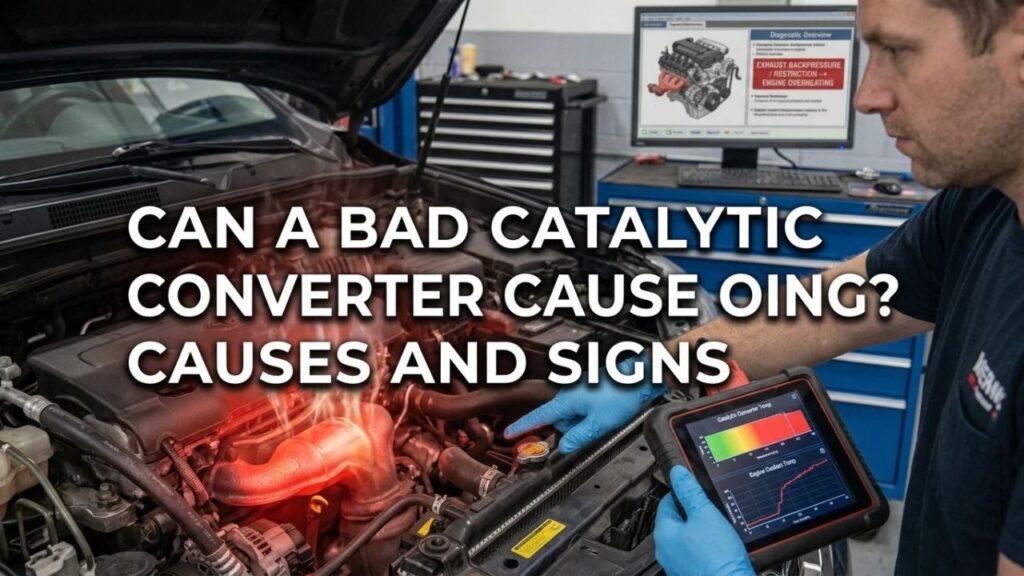
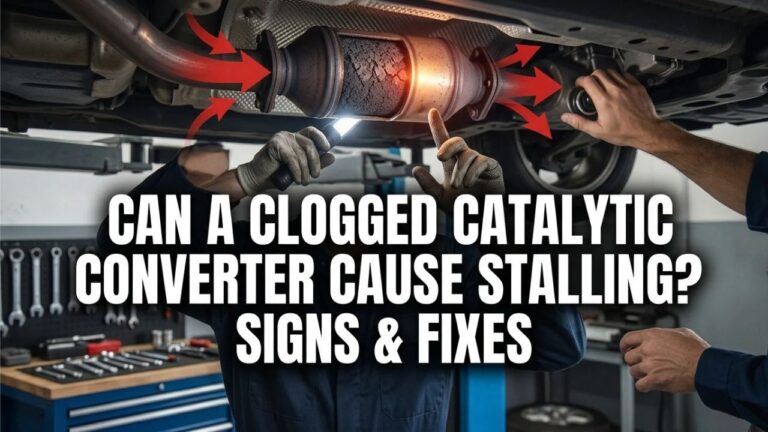
A badly restricted catalytic converter can contribute to engine overheating because the engine cannot expel exhaust gases normally.
During the exhaust stroke, the piston pushes burned gases out of the cylinder and into the exhaust system. A melted or blocked converter creates resistance farther downstream.
That resistance is called exhaust backpressure.
A Clogged Converter Restricts Exhaust Flow
Inside most converters is a honeycomb-like substrate containing many small exhaust passages.
If that substrate melts, collapses, shifts, or becomes heavily contaminated, the passages can become restricted.
Walker lists melted substrate and shifted internal material among causes of converter blockage and notes that a plugged converter commonly produces sluggish performance and loss of power.
When exhaust cannot leave freely, the engine has to work against that restriction. Exhaust-manifold and cylinder-head temperatures can rise, especially under load.
Severe Backpressure Can Increase Heat
A restricted exhaust changes the engine’s breathing.
The cylinders cannot clear spent gases as freely, which can reduce fresh air entering during the next cycle. Engine output falls, and the driver may press the accelerator farther to maintain speed.
That combination can create more heat while producing less useful power.
Walker states that continued driving with a faulty converter can increase the risk of engine overheating and reduce engine performance.
A Weak Converter Is Not Always a Clogged Converter
This point prevents many wrong diagnoses.
A converter can fail its emissions function without physically blocking exhaust flow.
For example, a vehicle may store:
- P0420
- P0430
These codes indicate catalyst-system efficiency below the expected threshold. They do not automatically prove that the converter is clogged.
Walker also warns that P0420 or P0430 does not automatically mean the converter itself needs replacement because fuel-control, oxygen-sensor, misfire, or other engine faults can affect catalyst readings.
A converter with reduced chemical activity may have almost no effect on coolant temperature.
Key Takeaway: A bad converter is most likely to contribute to engine overheating when its internal substrate creates a serious exhaust restriction, not merely because a catalyst-efficiency code is stored.
Why Does a Catalytic Converter Itself Overheat?
Sometimes the direction of cause and effect is reversed: the engine fault damages the catalytic converter rather than the converter overheating the engine.
This is common with active misfires and rich fuel mixtures.
Engine Misfires Send Fuel Into the Converter
A cylinder misfire means some or all of its air-fuel charge fails to burn inside the cylinder.
That unburned fuel can enter the hot exhaust system.
When enough oxygen is present, the fuel can burn inside the catalytic converter and create intense heat.
Walker identifies misfires as a major cause of converter meltdown and explains that unused fuel and air can burn inside the converter.
Possible causes of a misfire include:
- Worn spark plugs
- Weak ignition coils
- Damaged plug wires on older vehicles
- Fuel-injector faults
- Compression problems
- Air-fuel mixture faults
A flashing check-engine light often accompanies a severe active misfire and should not be ignored.
A Rich Fuel Mixture Can Overheat the Converter
A rich mixture contains more fuel than the engine can burn properly.
Excess fuel enters the exhaust and raises catalyst temperature.
Possible causes include a leaking injector, fuel-pressure problem, incorrect sensor input, ignition fault, or another fuel-control issue.
Walker also lists rich operation as a cause of converter overheating and internal melting.
An Overheated Converter Can Melt and Become Clogged
Excessive heat can damage the internal honeycomb.
The substrate may melt, deform, break apart, or collapse.
At that point, a problem that started as a misfire can become two problems:
- The engine fault overheats the converter.
- The damaged converter restricts the exhaust.
Now the vehicle may have poor acceleration and excessive exhaust heat even after the original misfire appears less severe.
This is why replacing a melted converter without repairing the engine fault can result in another failed converter.
Key Takeaway: Misfires and rich mixtures often overheat the converter first. Extreme heat can then melt the internal substrate and create the restriction that later causes power loss and extra engine heat.
Signs a Bad Catalytic Converter Is Causing Too Much Heat
A rising temperature gauge by itself does not strongly identify a converter problem.
Look for exhaust-restriction symptoms occurring at the same time.
Loss of Power Under Acceleration
Restricted exhaust flow commonly causes the engine to feel weak.
The vehicle may accelerate normally at light throttle but struggle when:
- Climbing a hill
- Entering a highway
- Carrying a heavy load
- Reaching higher RPM
The restriction can act like a blockage in the engine’s exhaust path.
AutoZone and Walker both list reduced acceleration and loss of engine performance among common symptoms of a clogged converter.
Engine Runs Worse as It Gets Hot
Some restrictions become more noticeable after the exhaust system warms.
A damaged substrate may expand with heat or shift inside the housing, further reducing exhaust flow.
A vehicle that starts normally but gradually loses power after several minutes deserves an exhaust-restriction check alongside normal fuel and ignition tests.
Excessive Heat Under the Vehicle
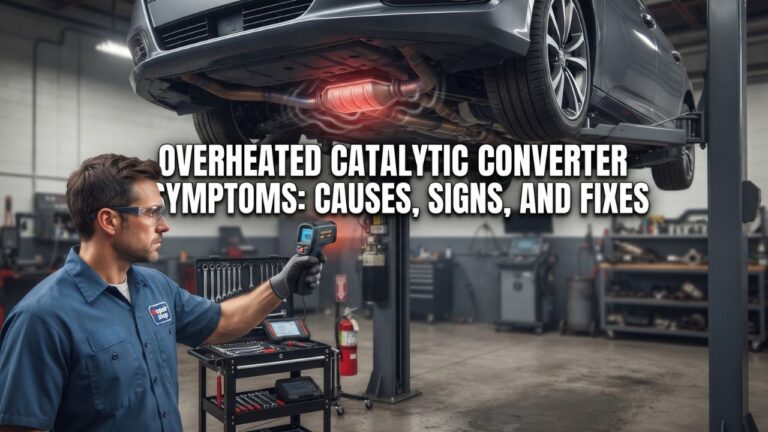
A converter normally becomes hot, but unusual radiant heat, scorching, or a glowing converter points to a serious problem.
Older EPA technical material describes converter shell temperatures around 600–800°F and internal temperatures around 1,200–1,600°F in catalyst systems operating under the conditions covered by that material. It also notes that rich operation can push catalyst temperature much higher.
A glowing converter should be treated as an abnormal condition rather than proof that the converter itself caused the fault.
Rotten-Egg or Sulfur Smell
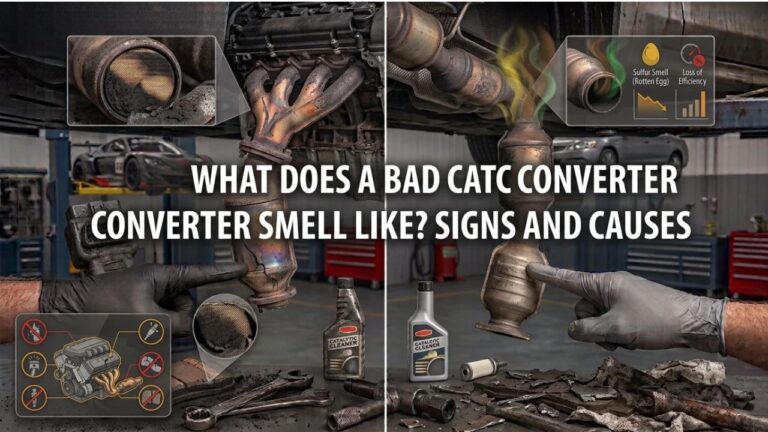
A sulfur-like smell can accompany catalyst or fuel-control problems.
It is not a reliable stand-alone diagnosis because fuel quality and engine mixture can influence the odor.
Combine the smell with other clues such as loss of power, catalyst codes, misfires, and unusual exhaust temperature.
Hard Starting or Stalling
A severe restriction can make it difficult for the engine to move enough air through the intake and exhaust.
The engine may:
- Crank longer before starting
- Start and then stall
- Idle poorly
- Refuse to rev freely
In extreme cases, the restriction may become severe enough for the engine to stop running.
Check-Engine Light
A catalyst problem may turn on the malfunction indicator lamp.
Common catalyst codes include P0420 and P0430, but these codes do not reveal the physical condition of the converter by themselves.
Misfire, fuel-trim, oxygen-sensor, or air-metering codes may provide stronger clues about what damaged the converter.
Key Takeaway: Overheating plus poor acceleration, restricted RPM, hard starting, extreme converter heat, or catalyst-related codes makes exhaust restriction more plausible than overheating by itself.
Bad Catalytic Converter vs Cooling-System Overheating
If the coolant-temperature gauge rises, start by distinguishing an exhaust problem from a cooling-system problem.
A catalytic converter is only one possible cause.
| Symptom | Converter Restriction More Likely | Cooling-System Fault More Likely |
| Strong loss of acceleration | Yes | Less typical |
| Engine will not rev freely | Yes | Less typical |
| Extreme heat near converter | Yes | Possible but less specific |
| Low coolant level | No | Yes |
| Coolant leak | No | Yes |
| Radiator fan not running | No | Yes |
| Heater suddenly blows cold while gauge rises | Less typical | Yes |
| Overheating mainly at idle | Less typical | Fan/airflow fault possible |
| Overheating during heavy acceleration with power loss | Possible | Also possible |
| P0420/P0430 only | Possible catalyst fault | Does not identify cooling fault |
Low Coolant or a Coolant Leak
Low coolant is a much more direct path to engine overheating.
Check the coolant level only when the engine is cool and according to the vehicle manufacturer’s procedure.
Never remove a pressurized cooling-system cap from a hot engine.
Thermostat Problems
A thermostat that does not open correctly can restrict coolant flow from the engine to the radiator.
This may cause the engine temperature to rise even though the exhaust system is flowing normally.
Radiator Fan Failure
Electric radiator fans are especially important during low-speed driving and idling because natural airflow through the radiator is limited.
If the engine overheats in traffic but cools at highway speed, fan operation deserves attention.
Water-Pump or Radiator Problems
Poor coolant circulation from a failing water pump or restricted radiator can also create overheating.
These conditions may produce no loss of engine power from exhaust backpressure.
Head-Gasket or Internal Engine Trouble
Combustion gases entering the cooling system can cause rapid pressure buildup and overheating.
Coolant loss, white exhaust smoke, repeated coolant-system pressure, or coolant contamination can point toward a separate engine problem rather than a converter.
Key Takeaway: If overheating occurs without major power loss or exhaust-restriction symptoms, investigate the coolant level, thermostat, fans, radiator, water pump, and engine before blaming the converter.
How to Check If the Catalytic Converter Is Clogged
Do not replace a converter solely because the vehicle is running hot.
Confirm restriction first.
Scan for Diagnostic Trouble Codes
An OBD-II scan is a good starting point.
Look beyond catalyst codes.
Misfire codes such as P0300-series faults, rich-mixture codes, fuel-trim problems, oxygen-sensor faults, and air-metering codes can reveal what damaged the converter.
A converter may be the victim rather than the original fault.
Check Exhaust Backpressure
An exhaust backpressure test is a direct way to investigate a restriction.
A technician can install a pressure gauge at an upstream oxygen-sensor port or another specified test location and measure pressure at idle and higher engine speed.
High pressure can point to:
- Clogged converter
- Restricted muffler
- Collapsed exhaust pipe
- Another exhaust blockage
Use the vehicle manufacturer’s pressure specification rather than applying one generic limit to every engine.
U.S. military automotive training material also describes exhaust backpressure testing as a method for finding a clogged converter or restricted exhaust component.
Compare Engine Vacuum Behavior
A vacuum gauge can also provide clues.
With some exhaust restrictions, intake-manifold vacuum drops as engine speed is held above idle because exhaust cannot leave freely.
This method needs proper interpretation since valve timing, engine wear, leaks, and other faults can change the reading.
Inspect the Converter
A damaged converter may show:
- Severe discoloration
- Dents
- Heat damage
- Rattling internal material
- Scorching nearby
EPA technical material specifically identifies discoloration and underbody scorching as visual signs associated with converter overheating.
Rattling can indicate broken substrate, but not every internal failure produces noise.
Do Not Rely on Temperature Alone
An infrared thermometer can provide useful clues, but converter temperature is affected by engine load, mixture, catalyst activity, ambient conditions, and how long the engine has been running.
A hot converter does not automatically mean it is clogged.
A cooler-than-expected converter does not automatically mean it has no restriction.
Backpressure testing and engine-performance diagnosis give stronger evidence when blockage is suspected.
Key Takeaway: Scan the vehicle, check for misfires and fuel-control faults, and confirm exhaust restriction with proper testing before replacing the catalytic converter.
Can You Drive With an Overheating Catalytic Converter?
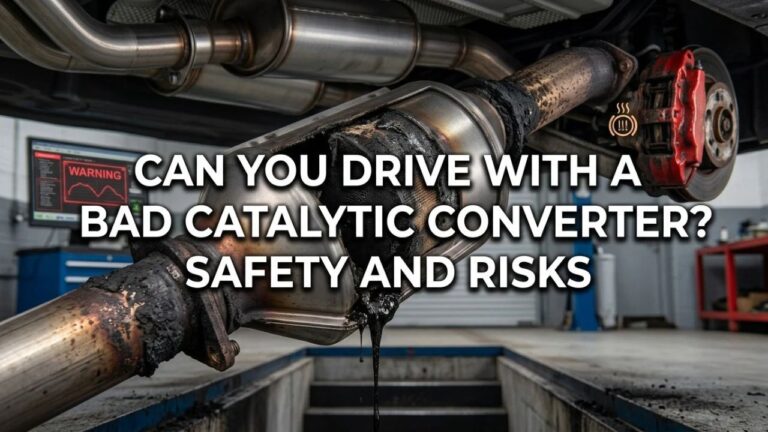
Driving should stop if the converter is glowing, smoke is present, the engine is severely misfiring, or the coolant-temperature gauge is moving into the hot zone.
A converter can reach temperatures capable of damaging surrounding components.
The Texas Commission on Environmental Quality notes that converter surfaces may reach around 800–1,000°F under very high engine loads and can rise to roughly 1,200–1,400°F when an ignition fault sends unburned fuel into the exhaust.
Avoid parking a very hot vehicle over:
- Dry grass
- Leaves
- Paper
- Fuel spills
- Other combustible material
If the coolant-temperature warning appears, safely stop the vehicle and shut the engine off before severe engine damage occurs.
Do not continue driving simply to see if the temperature drops.
What Should You Fix First?
The repair order depends on what caused the problem.
Replacing the converter first can waste money if a misfire, rich mixture, oil burning, or coolant leak damaged it.
If the Converter Is Clogged
A physically melted or collapsed converter generally requires replacement.
The internal substrate cannot be restored to its original structure with a fuel additive.
Before installing the replacement, identify why the old converter failed.
If the Engine Is Misfiring
Diagnose the misfire before fitting a new converter.
Possible checks include:
- Spark plugs
- Ignition coils
- Fuel injectors
- Compression
- Air-fuel control
- Relevant sensors
Walker specifically advises repairing misfire, rich/lean, mass-airflow, and oxygen-sensor faults before replacing a damaged converter.
If the Engine Is Actually Overheating
Check the cooling system as a separate diagnosis.
A vehicle can have both a clogged converter and a coolant-system fault.
Do not assume replacing one component will automatically correct the other problem.
Key Takeaway: Repair the fault that damaged the converter before installing a replacement, and diagnose coolant overheating separately if the temperature gauge is rising.
Conclusion
Yes, can a bad catalytic converter cause overheating has a qualified answer: a severely clogged or melted converter can restrict exhaust flow, raise backpressure, increase engine heat, and contribute to overheating.
The more common cause-and-effect pattern can run in the opposite direction. Misfires and rich fuel mixtures send unburned fuel into the exhaust, making the converter extremely hot and sometimes melting its internal substrate. The melted converter can then become clogged.
Loss of power, poor acceleration, restricted RPM, excessive exhaust heat, and hard starting make a clogged converter more likely. If the only symptom is high coolant temperature, check coolant level, thermostat operation, radiator fans, water pump, radiator condition, and other cooling-system faults first.
If the converter is glowing or the engine-temperature warning is active, stop driving as soon as it is safe. Confirm the root cause before replacing parts so a new converter does not suffer the same damage.
FAQs About Catalytic Converter Overheating
Can a Clogged Catalytic Converter Make an Engine Run Hot?
Yes. A severe exhaust restriction increases backpressure and can raise heat around the engine and exhaust system.
The vehicle will often show other symptoms as well, such as weak acceleration, difficulty reaching higher RPM, hard starting, or stalling. Engine overheating without those symptoms points more strongly toward the cooling system.
Can a Bad Catalytic Converter Make a Car Overheat at Idle?
It is possible if the exhaust restriction is severe, but overheating mainly at idle commonly points toward radiator-fan or coolant-flow problems.
Check fan operation, coolant level, thermostat function, and cooling-system condition before assuming the converter is responsible.
Why Is My Catalytic Converter Glowing Red?
A glowing converter commonly means excessive fuel is burning inside it.
Misfires and rich air-fuel mixtures are major causes. Walker states that unburned fuel entering the converter can produce extreme heat and melt the internal substrate.
Stop driving and diagnose the engine fault before the converter suffers more damage.
Can a Bad Catalytic Converter Cause the Temperature Gauge to Rise?
A severely restricted converter can contribute to a higher engine temperature, but the dashboard gauge normally reflects engine-coolant temperature rather than converter temperature.
A red-hot converter does not automatically make the coolant gauge rise. Cooling-system faults should still be checked.
Can a P0420 Code Cause Overheating?
The code itself does not cause overheating, and P0420 does not prove that the converter is clogged.
P0420 indicates catalyst-system efficiency below the expected threshold. A converter can trigger that code while exhaust flow remains unrestricted.
Can a Misfire Overheat the Catalytic Converter?
Yes. A misfire can send unburned fuel and oxygen into the exhaust, where the fuel may burn inside the converter.
This can create enough heat to damage or melt the catalyst substrate. A flashing check-engine light associated with an active misfire deserves prompt attention.
Will Replacing the Catalytic Converter Fix Engine Overheating?
Only if exhaust restriction from the converter is confirmed as the cause or a major contributor.
If overheating comes from low coolant, a faulty thermostat, failed radiator fan, bad water pump, restricted radiator, or another engine problem, replacing the converter will not fix the overheating.