Does Bad Catalytic Converter Affect Gas Mileage? Signs & Fixes
Yes. A failing catalytic converter can reduce gas mileage when it becomes clogged or restricts exhaust flow, but a converter that has only lost its emissions-cleaning ability may not change MPG much. Poor mileage can also come from the engine fault that damaged the converter, such as a rich mixture, misfire, or faulty sensor.
That difference matters because replacing the converter without finding the root cause can leave the mileage problem untouched and can damage the new converter. A severe restriction can also reduce acceleration, raise exhaust heat, cause hard starting, or make the engine stall.
Finding the real cause gives you a better chance of restoring normal fuel economy and avoiding repeat repairs. The useful question is if the converter has failed, if it is physically restricting exhaust flow, and what caused that failure.
In the United States, the EPA classifies catalytic converters as specified major emissions-control components. For covered light-duty vehicles, federal emissions warranty rules provide 8 years or 80,000 miles of defect coverage for the catalytic converter, subject to the applicable warranty conditions.
For drivers asking does bad catalytic converter affect gas mileage, the clearest answer is that a clogged converter can lower MPG by making the engine push exhaust against excess backpressure. A catalyst that merely stores a P0420-type low-conversion code without restriction may have little direct effect on fuel use.
A second point is easy to miss: converter failure is often the result of another engine problem. Misfires, excess fuel, oil burning, coolant entering the cylinders, or incorrect air-fuel control can damage the catalyst, and several of those faults can reduce gas mileage on their own.
The sections below explain the direct MPG effect, symptoms that point toward restriction, causes that can mimic a bad converter, diagnostic checks, P0420 behavior, and what to expect after a correct repair.
Does Bad Catalytic Converter Affect Gas Mileage Directly?
Yes, but the effect depends on how the converter has failed.
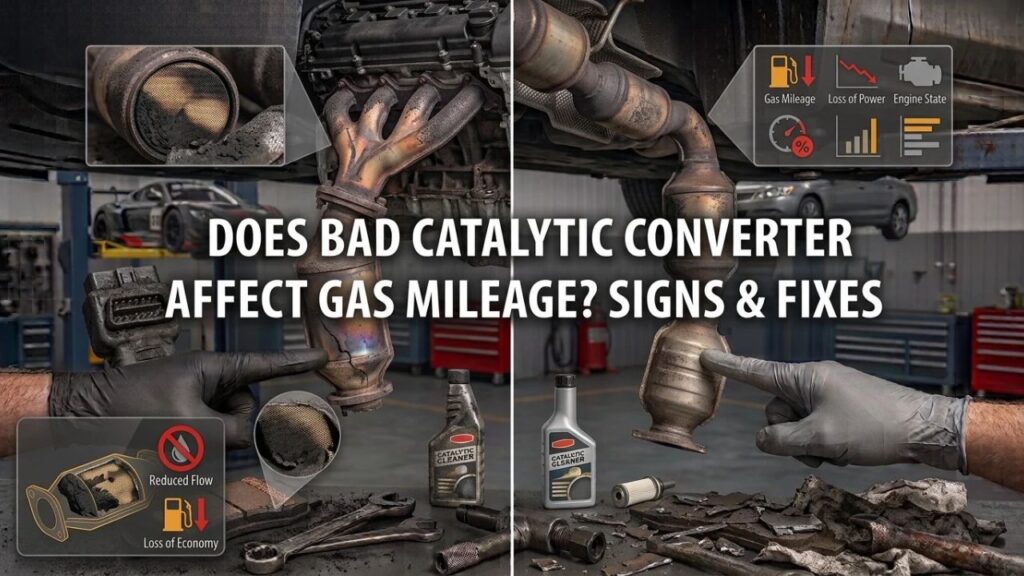
A catalytic converter has a honeycomb or similar internal substrate coated with catalyst material. Exhaust passes through small passages while chemical reactions convert harmful pollutants into less harmful gases. A healthy converter creates some normal exhaust resistance, but it should not choke the engine.
A Clogged Converter Can Lower MPG
A melted, collapsed, or contaminated substrate can restrict exhaust flow. AutoZone lists poor fuel economy among common clogged-converter symptoms and explains that exhaust restriction makes the engine work harder. MagnaFlow also lists decreased fuel economy as a possible result of poor exhaust flow.
An engine is an air pump as well as a combustion machine. Fresh air and fuel enter the cylinders, combustion takes place, and exhaust must leave. When exhaust cannot exit freely, cylinder filling and power can suffer.
You may press the accelerator farther to get the same road speed or acceleration. That added load can increase fuel use even though vehicle performance feels weaker.
A Chemically Weak Converter May Not Change MPG
A converter can lose its ability to clean exhaust without becoming physically clogged.
In that case, the engine may still breathe normally. The check-engine light may come on because the downstream oxygen sensor sees catalyst behavior outside the expected range, yet acceleration and MPG may remain close to normal.
EPA technical material has long distinguished the catalytic converter itself from engine tuning, stating that the converter as a device does not inherently reduce fuel economy. A loss of gas mileage therefore points more strongly toward restriction or another engine-control fault than toward catalyst aging alone.
Key Takeaway: A restricted converter can lower MPG directly, while a converter that has only lost emissions-cleaning ability may trigger a fault code without a noticeable mileage change.
How a Clogged Catalytic Converter Lowers Gas Mileage
A clogged converter affects the engine mainly by increasing exhaust backpressure.
Backpressure means the engine has to push exhaust gases through a restriction instead of releasing them freely into the exhaust system.
The Engine Has to Work Against Exhaust Pressure
During the exhaust stroke, the piston pushes burned gases out of the cylinder. A blocked converter raises pressure downstream of the exhaust valves.
That added resistance can reduce the engine’s ability to clear each cylinder. Residual exhaust gases may occupy space that would otherwise hold a fresh air-fuel charge during the next cycle.
The result can be weaker power, slower acceleration, and greater throttle opening for the same driving task.
The Driver May Use More Throttle
A partially clogged converter often becomes most noticeable during acceleration, hill climbing, highway merging, or higher engine speed.
At light throttle, exhaust volume may be low enough that the restriction is not obvious. As engine speed and load rise, more exhaust has to pass through the same restricted area.
The car may feel normal around town but weak when you ask for more power. Pressing the accelerator farther to compensate can increase fuel consumption.
Severe Restriction Can Affect Engine Operation
A heavily blocked converter can create enough backpressure to cause hard starting, stalling, or a major power loss. Cars.com notes that converter problems can progress from poor acceleration to stalling or a no-start condition in severe cases.
At that point, gas mileage is no longer the only concern. The exhaust restriction needs diagnosis before continued driving creates more heat or leaves the vehicle unable to maintain safe road speed.
Key Takeaway: Converter restriction raises exhaust backpressure, reduces breathing and power, and may make the driver use more throttle to produce the same vehicle performance.
Signs the Catalytic Converter May Be Hurting Gas Mileage
Poor MPG by itself does not prove the converter is bad.
Look for a group of symptoms that fit exhaust restriction or catalyst damage.
| Symptom | What It May Suggest |
| MPG drops with weak acceleration | Possible exhaust restriction |
| Power falls at higher RPM | Restriction becomes worse as exhaust flow rises |
| Check-engine light | Catalyst, sensor, mixture, or misfire fault |
| P0420 or P0430 code | Catalyst performance below the expected threshold |
| Rotten-egg or sulfur smell | Exhaust or catalyst problem may be present |
| Rattle from converter area | Broken internal substrate is possible |
| Excess heat under the vehicle | Converter may be overheating |
| Hard starting or stalling | Severe exhaust restriction is possible |
A clogged converter often produces a combination of reduced power and poor fuel economy. If MPG drops but acceleration remains normal, inspect other fuel-control and mechanical causes before assuming the converter is responsible.
Power Loss Is a Strong Clue
Restriction tends to show up as engine load increases.
A vehicle may accelerate acceptably from a stop and then feel as if it hits a wall as RPM rises. On a severe blockage, top speed may be limited and the engine may struggle on hills.
That pattern is more informative than MPG loss alone.
A Rattle Can Point to Internal Damage
The ceramic or metallic substrate inside a converter can crack or break apart.
Loose pieces may rattle, especially during startup, idle changes, or when the exhaust is tapped during inspection after it has cooled.
Broken material can also move and partially block the outlet, making symptoms change from one drive to another.
Excess Heat Deserves Fast Attention
A converter can become very hot if unburned fuel reaches it from a misfire or rich mixture.
If the check-engine light is flashing, the engine is misfiring badly, or the converter area is showing abnormal heat, continued driving can damage the catalyst further.
Key Takeaway: Poor MPG paired with weak acceleration, high-RPM power loss, excessive converter heat, rattling, or stalling is more suspicious for converter trouble than poor mileage alone.
How Much Can a Bad Catalytic Converter Reduce MPG?
There is no reliable percentage that applies to every vehicle.
The mileage loss depends on the type of converter failure, amount of restriction, engine size, driving load, fuel-control condition, gearing, and how much extra throttle the driver uses.
A mildly degraded catalyst may cause no measurable MPG drop. A partly blocked converter may create a modest loss. A severe restriction can cause a large drop in usable performance and fuel economy.
Be cautious with claims such as “a bad catalytic converter always reduces mileage by 10% or 20%.” Converter failures are too different for a fixed number to be trustworthy.
A better test is to compare fuel economy before and after the fault while also checking diagnostic data. Calculate MPG over several full tanks if the vehicle remains safe to drive, and compare similar routes, temperatures, speeds, and driving patterns.
The Problem That Damaged the Converter May Be Wasting Fuel
A catalytic converter often fails because something upstream has been wrong for a while.
That root fault may be the main reason fuel mileage dropped.
Rich Air-Fuel Mixture
A rich mixture means the engine receives more fuel than needed for the amount of air entering the cylinders.
Possible causes include leaking injectors, fuel-pressure problems, sensor faults, or air-metering errors.
Extra fuel raises consumption directly. Unburned fuel can then enter the converter, where it burns and creates extreme heat that may melt the substrate.
Engine Misfire
A misfire means one or more cylinders are not burning the air-fuel charge correctly.
Ignition problems, injector faults, compression loss, or other defects can cause misfires. Fuel that fails to burn in the cylinder may reach the exhaust and overheat the converter.
A misfiring engine can also lose power and use more fuel for the work it produces.
Faulty Oxygen Sensor or Air-Fuel Sensor
The upstream oxygen or air-fuel sensor provides data used by the engine computer to manage mixture on most modern gasoline vehicles.
Bad sensor data can push fuel control away from the intended range. That may lower MPG and damage the catalyst over time.
The downstream sensor mainly monitors catalyst operation on many systems, though control strategies vary by vehicle.
Oil or Coolant Burning
Engine oil or coolant entering the combustion chamber can contaminate the converter.
Worn rings, valve-seal problems, head-gasket faults, or other engine defects may be involved.
Replacing the converter without correcting the source of contamination can lead to another failure.
Key Takeaway: A rich mixture, misfire, sensor fault, or engine-fluid contamination can reduce MPG while damaging the converter, so diagnosis must go beyond the converter shell.
Does a P0420 Code Mean the Converter Is Causing Poor Gas Mileage?
No.
P0420 means the engine computer has detected catalyst system performance below the expected threshold on Bank 1. P0430 is the related code for Bank 2 on vehicles that monitor two banks.
Those codes do not state that the converter is clogged.
A car can set P0420 and still have normal power and normal fuel economy. The catalyst may no longer store oxygen or clean exhaust well enough to satisfy the onboard monitor while remaining physically open.
P0420 can also appear with conditions such as exhaust leaks, sensor problems, misfires, fuel-control faults, or catalyst contamination. AutoZone notes that restricted exhaust may cause reduced acceleration in some P0420 cases, but the code itself does not prove restriction.
If the vehicle has P0420 plus a clear MPG drop, check fuel trims, misfire data, oxygen-sensor operation, and exhaust restriction before replacing parts.
How to Check if the Catalytic Converter Is Causing Low MPG
A proper diagnosis should confirm both the converter condition and the reason it failed.
I would start with scan data before replacing an expensive converter.
1. Scan All Stored and Pending Codes
Do not stop at P0420 or P0430.
Look for misfire codes, oxygen-sensor codes, fuel-trim codes, air-metering faults, coolant-temperature faults, and other engine codes.
A second code may point to the failure that damaged the catalyst.
2. Review Fuel Trims and Sensor Data
Short-term and long-term fuel trims show how much the engine computer is correcting mixture from its base calculation.
Abnormal trims can point toward vacuum leaks, fuel-delivery issues, air-metering errors, sensor faults, or injector problems.
Oxygen-sensor graphs can also show how upstream and downstream signals behave, though interpretation varies by vehicle and sensor type.
3. Test for Exhaust Backpressure
An exhaust backpressure test is one of the more direct ways to check for a restriction.
A technician can measure pressure in the exhaust ahead of the converter and compare the reading with the vehicle or test-equipment specification.
Do not use a universal pressure number for every car. Engine size, test RPM, exhaust layout, and manufacturer procedure can change the acceptable reading.
4. Use a Vacuum Test as Supporting Evidence
A manifold-vacuum gauge can sometimes reveal restricted exhaust.
Vacuum that drops as engine speed is held above idle may support the restriction diagnosis, but other engine problems can affect the reading.
Use it as one clue rather than proof by itself.
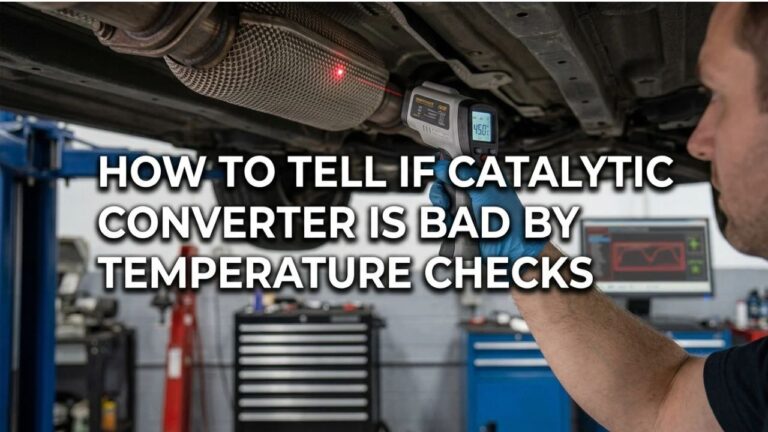
5. Check Converter Temperature Carefully
Inlet and outlet temperature readings can provide useful clues after the converter reaches operating temperature.
A temperature test alone cannot prove every catalyst failure. Engine load, mixture, catalyst design, and test conditions change the numbers.
Use temperature along with scan data and restriction testing.
6. Inspect for Physical Damage
A crushed exhaust pipe, damaged converter shell, rattling substrate, or impact damage may explain restricted flow.
Cars.com notes that impacts can damage the converter or other exhaust parts and raise backpressure.
Key Takeaway: Confirm low-MPG converter problems with codes, fuel trims, sensor data, backpressure testing, and physical inspection rather than replacing the converter from one symptom.
Will Replacing a Bad Catalytic Converter Restore Gas Mileage?
It can if the converter itself is restricting exhaust flow and all related faults are repaired.
Removing a blockage lets the engine expel exhaust normally again. Power and throttle response may return, so the driver no longer needs as much accelerator input for the same task.
If the mileage loss came from a leaking injector, bad sensor, misfire, or another engine problem, replacing only the converter may not restore MPG.
The new converter may also fail again if raw fuel, oil, or coolant continues entering the exhaust.
Before authorizing replacement, check warranty coverage. EPA says catalytic converters are among the major emissions components covered for 8 years or 80,000 miles under the federal defect warranty on applicable light-duty vehicles, subject to the warranty terms.
Can You Improve MPG by Removing the Catalytic Converter?
No legitimate fuel-economy repair involves removing a functioning converter.
A healthy converter is designed as part of the vehicle’s emissions and exhaust system. EPA material states that catalytic converters themselves do not inherently reduce gas mileage, and federal law prohibits emissions-system tampering.
If exhaust restriction is present, the correct repair is to diagnose the cause and replace the failed converter with an approved part when required.
Removing or hollowing out the converter can trigger emissions faults, cause legal problems, increase pollution, and leave the original engine problem unresolved.
Conclusion
For does bad catalytic converter affect gas mileage, the answer is yes when the converter becomes clogged or restricted enough to make the engine work against excess exhaust backpressure. A converter that has only lost catalyst activity may set a fault code without causing a clear MPG loss.
Poor fuel economy often has two layers: the restricted converter and the fault that damaged it. Misfires, rich mixture, bad sensor data, oil burning, and coolant contamination can waste fuel before the converter becomes the obvious symptom.
Check power loss, codes, fuel trims, sensor behavior, and exhaust backpressure before buying a converter. I would not replace an expensive catalyst from a P0420 code or low MPG alone.
Once the restriction and its root cause are repaired, gas mileage can return toward its previous level if no other fuel-economy problem remains.
FAQs About Bad Catalytic Converters and Gas Mileage
Can a clogged catalytic converter cause poor gas mileage?
Yes. A clogged converter can raise exhaust backpressure, reduce engine breathing, and cut power. The driver may use more throttle to maintain speed or accelerate, which can raise fuel consumption. Poor MPG becomes more suspicious for restriction when it appears with weak acceleration or loss of power at higher RPM.
Can a bad catalytic converter cause high fuel consumption without a check-engine light?
It is possible, especially if the problem is a developing physical restriction that has not yet triggered a catalyst-monitor code. A drop in MPG with weak power should still be diagnosed. Fuel-system, ignition, sensor, transmission, tire-pressure, and driving-condition problems can produce similar symptoms.
Will a P0420 code lower gas mileage?
Not by itself. P0420 reports catalyst performance below the expected threshold. A vehicle can have that code and still maintain normal MPG if exhaust flow remains open. Gas mileage is more likely to fall when a restriction or an engine-control problem exists alongside the code.
Can a bad oxygen sensor look like a bad catalytic converter?
Yes. Sensor faults can affect fuel control or catalyst-monitor readings and may contribute to converter-related codes. A rich mixture caused by bad input can also overheat and damage the converter. Scan data and sensor testing should come before replacing parts based only on a code.
Can a catalytic converter get clogged from a misfire?
Yes. A misfire can send unburned fuel into the exhaust. Fuel burning inside the converter can create extreme heat, damage or melt the internal substrate, and eventually restrict flow. A flashing check-engine light associated with a strong misfire needs prompt attention.
Does a new catalytic converter improve MPG?
A new converter can restore lost MPG if the old converter was physically clogged and the cause of the failure has been fixed. Replacing a converter that was not restricting flow may produce little or no fuel-economy change. Diagnose the engine and exhaust system first.
Is it safe to keep driving with a clogged catalytic converter?
A mild fault may still let the vehicle run, but severe restriction can reduce power, create excessive heat, cause stalling, or lead to a no-start condition. If acceleration becomes dangerously weak, the converter glows or overheats, or the engine stalls, stop driving and have the vehicle inspected.