Can a Clogged Catalytic Converter Cause a Misfire? Signs & Fixes
Yes. A severely clogged catalytic converter can contribute to engine misfires by restricting exhaust flow and creating excessive backpressure. The restriction makes it harder for cylinders to clear burned gases, which can interfere with the next combustion cycle. Still, ignition, fuel, air, or compression faults cause misfires far more often than a blocked converter does.
The direction of failure also matters. A misfire can damage a catalytic converter by sending unburned fuel into the exhaust. That fuel may burn inside the converter, overheat the ceramic core, and eventually melt or collapse passages. The original misfire can then be joined by exhaust restriction.
A clogged converter usually produces other drivability symptoms along with misfire. Poor acceleration, weak high-RPM power, difficulty climbing hills, rough idle, stalling, and excessive exhaust heat make a restriction more suspicious.
For drivers asking can a clogged catalytic converter cause a misfire, the answer is yes, but the converter should not be blamed from a P0300-series code alone. A weak ignition coil, worn spark plug, injector fault, vacuum leak, low compression, or fuel-pressure problem is often a more direct explanation.
Catalytic converters are expected to last for a substantial part of a vehicle’s life. Under U.S. federal emissions warranty rules, the catalytic converter is among the major emissions components covered for 8 years or 80,000 miles on qualifying light-duty vehicles. An early converter failure deserves a search for the problem that damaged it.
The sections below explain how exhaust restriction can lead to misfire, how to separate converter trouble from more common causes, what symptoms point toward a blockage, and which tests can confirm the diagnosis.
How Can a Clogged Catalytic Converter Cause a Misfire?
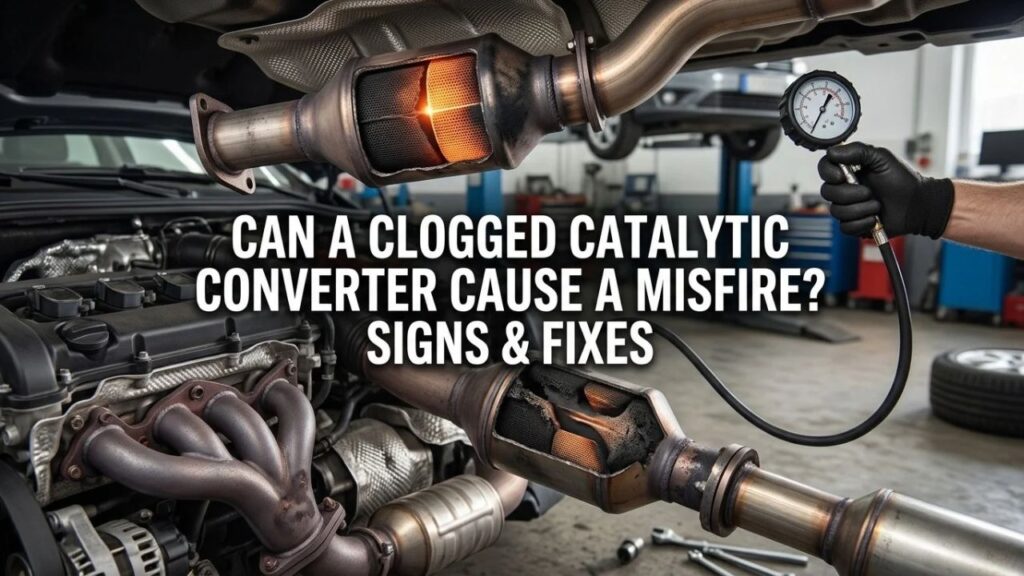
A four-stroke engine has to move exhaust gases out of each cylinder before taking in a fresh air-fuel charge.
A blocked converter interferes with that process.
Exhaust Backpressure Prevents Proper Cylinder Clearing
The exhaust stroke pushes burned gases through the exhaust manifold, catalytic converter, muffler, and tailpipe.
A healthy converter contains many small passages that let exhaust move through the catalyst-coated substrate.
If those passages melt, collapse, or become obstructed, pressure starts building upstream.
The piston then has to work against greater resistance during the exhaust stroke.
Some residual gases may remain in the cylinder and dilute the fresh charge entering during the next intake stroke.
Combustion can become unstable enough to produce a misfire.
Restriction Can Affect Several Cylinders
An ignition-coil failure often affects one cylinder.
A heavily restricted converter may affect every cylinder feeding that exhaust path.
For example, an engine with one converter serving an entire bank may develop poor combustion across several cylinders if exhaust flow from that bank is heavily restricted.
A scan tool may show:
- P0300 random/multiple-cylinder misfire
- Several cylinder-specific misfire codes
- Rising misfire counts under load
- Reduced engine output
The exact pattern depends on the engine and exhaust layout.
The Problem Often Gets Worse Under Load
At idle, the engine produces a relatively small exhaust volume.
During acceleration, exhaust volume rises sharply.
A partially blocked converter may therefore let the engine idle fairly well while causing severe misfire, hesitation, or power loss during acceleration.
As blockage becomes worse, symptoms can begin appearing at idle too.
Key Takeaway: A clogged converter can cause misfire by trapping exhaust pressure and leaving too much residual gas in the cylinders, with symptoms often becoming stronger as engine load rises.
Is the Misfire Causing the Clogged Converter Instead?
Very often, yes.
This is one of the most important distinctions during diagnosis.
A converter may be damaged because the engine had been misfiring for some time before converter symptoms appeared.
Unburned Fuel Can Overheat the Converter
During a misfire, some or all of the fuel in a cylinder may leave the engine without burning normally.
That mixture enters the exhaust.
Once it reaches the extremely hot converter, fuel can burn inside the catalyst instead.
The resulting temperature can damage the ceramic substrate.
Continued exposure may cause it to:
- Melt
- Crack
- Collapse
- Break into pieces
- Restrict exhaust passages
The driver may then have two problems instead of one.
Ignition Problems Can Start the Failure Chain
Common ignition-related misfire causes include:
- Worn spark plugs
- Failed ignition coils
- Damaged plug wires
- Poor electrical connections
- Incorrect spark-plug gap
A vehicle may first develop a slight hesitation or P0301 code.
If it continues driving with the fault, converter temperature can rise until internal damage occurs.
Replacing only the converter does not repair the original ignition fault.
Fuel Problems Can Create the Same Result
A leaking injector or excessively rich mixture can send extra fuel into the exhaust even without an obvious ignition failure.
Fuel-related causes can include:
- Leaking injector
- Incorrect fuel pressure
- Faulty air measurement
- Rich fuel trim
- Injector control fault
The converter can overheat from processing the extra hydrocarbons.
Key Takeaway: Misfire frequently comes first and damages the converter, so the original ignition or fuel problem needs to be found before fitting a new catalyst.
Signs a Clogged Converter May Be Behind the Misfire
A misfire code alone gives very little proof of converter restriction.
Look at the complete symptom pattern.
Engine Power Drops as RPM Rises
This is one of the stronger clues.
A restricted exhaust may let the engine operate at low speed but prevent it from moving enough exhaust at higher RPM.
The vehicle may feel as if something is holding it back.
You may notice:
- Slow acceleration
- Poor highway passing power
- Difficulty climbing hills
- Engine refusing to rev freely
- Power returning after lifting the throttle
A severe restriction can eventually affect idle as well.
Multiple Cylinders Begin Misfiring
A bad spark plug generally creates a cylinder-specific problem.
Exhaust restriction can influence several cylinders sharing the same exhaust path.
Random or multiple-cylinder misfire combined with broad power loss deserves an exhaust-flow check.
The Engine Runs Better Cold Than Hot
A damaged converter can sometimes become more restrictive as heat builds.
Internal pieces may expand or shift as the exhaust system reaches operating temperature.
A vehicle may start and drive reasonably well at first, then lose power as it warms up.
Many other faults can create hot-running symptoms, so this pattern is only one clue.
The Catalytic Converter Rattles
A damaged ceramic core may break apart inside the metal housing.
Loose pieces can produce a rattle during:
- Startup
- Acceleration
- Deceleration
- Road vibration
Broken material can shift and partially block the outlet.
Heat shields can also rattle, so the sound needs inspection before condemning the converter.
Excess Heat Develops Around the Converter
A converter that has been overheated by misfires or excessive fuel may become abnormally hot.
Warning signs include:
- Burning smell
- Smoke near the exhaust
- Heat damage around the floor or shields
- A converter housing glowing red in an extreme case
A glowing converter requires prompt attention.
Stop driving and address the engine fault rather than continuing to operate the vehicle.
Rough Idle or Stalling Appears
A badly clogged converter can interfere with combustion even at low engine speed.
The engine may shake, surge, or stall.
Rough idle by itself is not strong evidence because vacuum leaks, plugs, coils, injectors, and compression problems create the same symptom.
Key Takeaway: Converter restriction becomes more likely when misfire appears with high-RPM power loss, several affected cylinders, excessive exhaust heat, rattling, rough idle, or stalling.
What Misfire Codes Can Appear?
A clogged converter does not have its own special misfire code.
The engine computer identifies combustion irregularities and reports the affected cylinder pattern.
P0300 Random or Multiple-Cylinder Misfire
P0300 indicates random or multiple misfires.
A major exhaust restriction can sometimes contribute to this pattern because several cylinders are struggling to move exhaust properly.
P0300 can also come from many unrelated faults.
P0301 Through P0308
Cylinder-specific examples include:
- P0301 — Cylinder 1 misfire
- P0302 — Cylinder 2 misfire
- P0303 — Cylinder 3 misfire
- P0304 — Cylinder 4 misfire
The sequence continues for engines with more cylinders.
A single-cylinder code usually pushes ignition, injector, compression, or wiring faults higher on the diagnostic list than a clogged converter.
P0420 or P0430 May Also Appear
P0420 generally refers to catalyst efficiency below threshold on Bank 1.
P0430 generally refers to the same issue on Bank 2.
These codes can appear alongside misfire codes if the converter has been damaged.
They do not prove that the converter is clogged.
A converter can lose emissions-processing ability while still flowing exhaust freely.
Key Takeaway: P0300 can fit a broad restriction pattern, while a single-cylinder P0301-series code more often points toward ignition, fueling, wiring, or compression. P0420 and P0430 do not prove blockage.
How to Tell a Clogged Converter From a Bad Ignition Coil
A failed coil and a restricted converter can both cause hesitation and misfire, but their symptom patterns often differ.
| Symptom | Clogged converter | Bad ignition coil |
| High-RPM power loss | Common | Possible |
| One-cylinder misfire | Less typical | Very common |
| Multiple-cylinder misfire | Possible | Less common |
| Exhaust restriction | Yes | No |
| Converter rattling | Possible | No |
| Abnormal exhaust heat | Possible | Can occur indirectly |
| Misfire follows coil when swapped | No | Strong clue |
| P0420/P0430 | Possible | May appear after long-term misfire |
| Poor acceleration | Common | Common |
A Coil Fault Often Stays With One Cylinder
Suppose the engine has P0302.
If the ignition coil from cylinder 2 is moved to cylinder 3 and the code later changes to P0303, the coil becomes a strong suspect.
A blocked converter cannot follow a coil from one cylinder to another.
Converter Restriction Creates a Broader Breathing Problem
A clogged converter usually affects the cylinders feeding the restricted exhaust route.
Power loss is often spread across a bank or the entire engine rather than isolated to one cylinder.
Key Takeaway: A coil fault often creates a cylinder-specific misfire, while converter restriction tends to produce broader power loss and may affect several cylinders.
How to Diagnose a Clogged Catalytic Converter and Misfire
Start with the simplest evidence and work toward direct restriction testing.
Do not order an expensive converter from trouble codes alone.
1. Read All Diagnostic Codes
Use an OBD-II scanner and record stored, pending, and permanent codes.
Look beyond P0300-series faults.
Useful clues may include:
- Catalyst codes
- Fuel-trim codes
- Oxygen-sensor codes
- Airflow codes
- Injector codes
- Temperature-sensor faults
Clearing codes before recording them removes useful diagnostic information.
2. Check Misfire Counts
Many scan tools display live or historical cylinder misfire data.
Identify whether the problem is:
- One cylinder
- One bank
- Several cylinders
- Random across the engine
This pattern can quickly change the direction of the diagnosis.
3. Inspect Spark Plugs and Ignition Parts
Check plugs for:
- Heavy wear
- Oil fouling
- Fuel fouling
- Damaged electrodes
- Incorrect gap
- Cracked insulation
Inspect coils, plug wires where fitted, and electrical connectors.
Fix obvious ignition faults before blaming the converter.
4. Check Fuel Trims
Fuel trims show how much correction the engine computer is applying to fuel delivery.
Large corrections can point toward:
- Vacuum leaks
- Fuel-pressure faults
- Dirty injectors
- Leaking injectors
- Airflow measurement problems
A fuel-control fault can cause both misfire and converter damage.
5. Check Engine Compression if Needed
A cylinder with poor compression can misfire regardless of converter condition.
Possible causes include:
- Burned valve
- Piston-ring wear
- Head-gasket damage
- Camshaft problem
- Valve-timing fault
Compression or leak-down testing may be needed if ignition and fuel checks do not explain a cylinder-specific misfire.
6. Test Exhaust Backpressure
A backpressure test directly checks for exhaust restriction.
A technician can connect a suitable pressure gauge at an approved test location and observe exhaust pressure at idle and higher RPM.
Use the vehicle manufacturer’s specification rather than relying on one universal pressure number.
Pressure that becomes abnormally high as engine speed rises supports a restriction diagnosis.
The blockage could still be in the converter, muffler, or damaged exhaust pipe, so its location needs confirmation.
7. Check Manifold Vacuum Behavior
A vacuum gauge can provide another clue.
During sustained elevated RPM, manifold vacuum that steadily drops can fit an exhaust restriction pattern.
Vacuum readings can also be affected by valve timing, engine wear, altitude, and other faults.
Treat the pattern as supporting evidence rather than a standalone verdict.
8. Inspect the Converter for Physical Damage
With the exhaust fully cool, inspect for:
- Dents
- Impact marks
- Loose heat shields
- Discoloration
- Rattling
- Crushed exhaust pipe
Do not touch or work around a hot converter.
Exhaust components can remain hot long after the engine is switched off.
Key Takeaway: Diagnose ignition, fueling, compression, and scan data first, then confirm suspected blockage with exhaust backpressure or another approved restriction test.
Can a Clogged Catalytic Converter Cause a Single-Cylinder Misfire?
It is possible, but it is not the first explanation I would pursue.
A single-cylinder misfire points more strongly toward a fault local to that cylinder.
Check:
- Spark plug
- Ignition coil
- Fuel injector
- Injector wiring
- Compression
- Valve condition
- Intake leak near that runner
An exhaust restriction can affect cylinders unevenly under certain engine and exhaust layouts, but a converter usually serves more than one cylinder.
A P0302 with no widespread power loss makes the ignition, injector, or mechanical condition of cylinder 2 a more logical starting point than the converter.
Can a Clogged Converter Cause Random Misfires?
Yes.
Severe exhaust restriction can interfere with several cylinders and contribute to P0300 random/multiple-cylinder misfire.
The engine may also show:
- Surging
- Hesitation
- Low power
- Poor throttle response
- Rough idle
- Stalling
Random misfires can also result from low fuel pressure, vacuum leaks, contaminated fuel, timing problems, or several weak ignition components.
The code alone cannot identify the converter.
Can a Bad Catalytic Converter Damage the Engine?
A heavily restricted converter can create serious drivability problems and place extra stress on the engine.
Potential effects include:
- Reduced cylinder filling
- Increased exhaust pressure
- High exhaust temperatures
- Loss of power
- Poor fuel economy
- Stalling
- Hard starting in severe cases
The larger concern is often the engine problem that damaged the converter.
A vehicle running with severe misfires or rich fueling can damage the catalyst quickly and may create further engine or exhaust problems.
Can You Drive With a Misfire and Clogged Converter?
Driving should be limited until the cause is diagnosed.
A mild catalyst-efficiency code with normal engine operation is very different from a severe active misfire combined with exhaust restriction.
Stop driving and arrange service if you have:
- Flashing check engine light
- Severe shaking
- Major power loss
- Repeated stalling
- Converter glowing red
- Smoke
- Strong burning odor
- Trouble maintaining road speed
A flashing check engine light often indicates a misfire severe enough to risk catalyst damage.
Continuing to drive can turn a small ignition repair into an expensive converter replacement.
Will Replacing the Catalytic Converter Fix the Misfire?
Only if the converter restriction is actually causing the misfire.
Replacing it will not repair:
- Bad ignition coil
- Worn spark plug
- Leaking injector
- Vacuum leak
- Low compression
- Fuel-pressure fault
- Valve problem
If one of those conditions damaged the old converter, installing a new converter without fixing the original fault can damage the replacement.
The best repair sequence is:
- Identify the misfire source.
- Repair the engine fault.
- Confirm converter restriction or catalyst failure.
- Replace the converter only if testing shows it is damaged.
- Verify that the engine runs normally after repair.
This order lowers the chance of repeat failure.
Conclusion
So, can a clogged catalytic converter cause a misfire? Yes. Severe exhaust restriction can create enough backpressure to interfere with cylinder clearing and stable combustion, producing random or multiple-cylinder misfires.
The symptom pattern matters. A clogged converter becomes more suspicious when misfires appear together with weak acceleration, poor high-RPM power, rough idle, stalling, excessive heat, or rattling from the converter.
A single-cylinder misfire with otherwise normal engine power is more likely to come from a spark plug, coil, injector, wiring fault, or compression problem. Diagnose those areas before replacing the converter.
The reverse failure pattern is also common: an existing misfire overheats and damages the catalytic converter. Fix the original engine problem first so a replacement converter does not suffer the same fate.
FAQs About Clogged Catalytic Converters and Misfires
Can a clogged catalytic converter cause P0300?
Yes. Severe exhaust restriction can affect several cylinders and contribute to a P0300 random or multiple-cylinder misfire code. P0300 has many other causes, including vacuum leaks, fuel-pressure problems, ignition faults, and engine mechanical issues, so the converter should be tested before replacement.
Can a clogged catalytic converter cause P0301?
It can, but P0301 specifically identifies a cylinder 1 misfire. A spark plug, ignition coil, injector, wiring fault, intake leak, or compression problem in cylinder 1 is usually a better starting point. Converter restriction tends to affect more than one cylinder.
Can a catalytic converter clog because of a misfire?
Yes. A misfire can send unburned fuel into the exhaust. That fuel may burn inside the converter and create extreme heat, which can melt or break the internal ceramic substrate. The damaged material may then restrict exhaust flow.
Will a clogged catalytic converter cause poor acceleration?
Yes. Poor acceleration is one of the stronger symptoms of severe exhaust restriction. The engine produces more exhaust as load and RPM rise, so a blocked converter may limit power more noticeably during hard acceleration, hill climbing, or highway driving.
Can a clogged catalytic converter cause rough idle?
Yes, if the blockage is severe. Excess backpressure can interfere with exhaust scavenging and leave residual exhaust gases in the cylinders. That can make combustion unstable and produce shaking, surging, or stalling at idle.
How do I know if the converter is clogged or the spark plugs are bad?
Spark-plug problems often create a cylinder-specific misfire. A clogged converter more often causes broader power loss, especially as RPM rises. Scan-tool data, plug inspection, ignition testing, fuel checks, and an exhaust backpressure test can separate the two faults.
Can I drive with a clogged catalytic converter and a misfire?
Driving is risky if the engine is misfiring severely, losing substantial power, stalling, or showing a flashing check engine light. Unburned fuel can overheat the converter further. A glowing converter, smoke, or strong burning smell calls for stopping the vehicle and arranging repair.