How Long Does It Take to Replace a Catalytic Converter at a Shop?
Most catalytic converter replacements take about 1–3 hours of hands-on shop labor. A simple direct-fit converter can sometimes be replaced in around an hour, while welded units, manifold-mounted converters, multiple-converter systems, rusted hardware, or difficult access can stretch the job to 3–5 hours or longer.
The amount of time your car stays at the repair shop can be longer than the actual installation. Diagnosis, engine cool-down time, waiting for the correct converter, dealing with seized exhaust bolts, and final testing can turn a two-hour repair into a half-day or full-day shop visit.
A straightforward bolt-on replacement gives the technician the shortest path: disconnect sensors as required, remove the old assembly, fit new gaskets and hardware, install the replacement, and check the exhaust for leaks. A universal converter takes longer because the old unit may need to be cut out and the replacement welded into the exhaust.
Real U.S. manufacturer labor allowances show how much vehicle design changes the answer. Ford documentation filed with NHTSA lists 0.9 hours for some individual F-150 catalytic converters and up to 3.3 hours for replacing both converters on certain F-150 hybrid applications.
For someone asking how long does it take to replace a catalytic converter, I’d use 1–3 labor hours as a practical planning range for a normal professional repair. Current repair-time guides commonly place direct-fit jobs around that range, with welded or complex installations taking longer.
The converter design, its location, corrosion level, number of converters, oxygen-sensor condition, and the reason the original converter failed all influence the final timeline. Those details also explain why two cars needing the same basic repair can have very different labor quotes.
How Long Does It Take to Replace a Catalytic Converter?
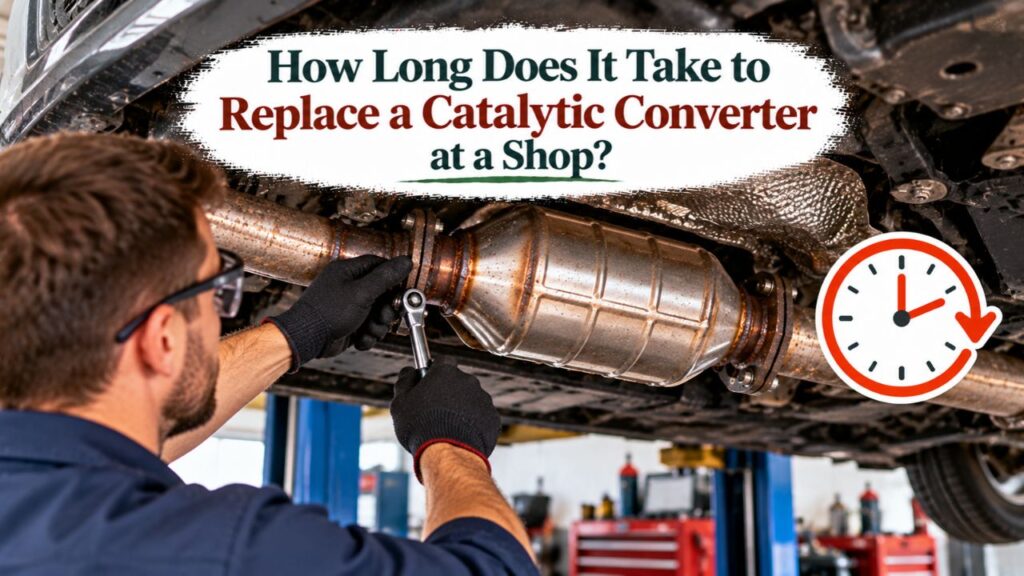
A professional technician can often replace a standard accessible converter in 1–3 hours. That figure refers mainly to repair labor rather than the complete time between dropping off and collecting the vehicle.
Current repair references place many direct-fit replacements in roughly this range, while universal weld-in converters can take around 2–4 hours because fabrication is added to the job.
Direct-Fit Catalytic Converter: About 1–2 Hours
A direct-fit converter is shaped for a specific vehicle application. It normally includes correctly positioned flanges, pipes, brackets, and hangers.
Walker describes direct-fit converters as bolt-on components that require no specialized fabrication or welding.
If the vehicle has clean hardware and easy access, replacement may involve:
- Raising and supporting the vehicle.
- Disconnecting any oxygen sensors that interfere with removal.
- Removing flange bolts or clamps.
- Removing the old converter assembly.
- Installing new gaskets and required hardware.
- Bolting the replacement into position.
- Reinstalling sensors.
- Checking for exhaust leaks.
A simple setup can fall near the low end of the time range.
Universal Weld-In Converter: About 2–4 Hours
A universal converter is not shaped as a complete bolt-on replacement for one specific vehicle.
The installer may need to cut the original exhaust pipe, position the converter correctly, modify pipe length, and weld the replacement into place. Walker’s installation guidance for universal converters specifically describes cutting the existing exhaust and welding the replacement into the system.
That extra fabrication adds labor.
The shop also needs to preserve oxygen-sensor locations, converter direction, exhaust alignment, and proper sealing.
Manifold-Integrated Converter: Often 2–4+ Hours
Some catalytic converters are built into or directly attached to the exhaust manifold.
These can take longer because the technician may need to work in a cramped engine bay rather than simply unbolting a converter underneath the car.
Removal may involve heat shields, intake components, brackets, sensors, manifold fasteners, or other parts blocking access.
Walker confirms that direct-fit converter products can include complete manifold-converter assemblies that attach at the cylinder head.
Labor varies greatly by engine design.
Multiple Catalytic Converters: About 2–4+ Hours
V6, V8, turbocharged, and some high-emissions-control vehicles may have more than one converter.
Replacing both can take considerably longer than replacing one accessible unit.
Ford’s published F-150 recall labor allowances illustrate the difference. Certain individual converter replacements receive 0.9 to 3.1 hours, while replacing both can receive 2.5 to 3.3 hours, based on engine and converter position.
Key Takeaway: Expect roughly 1–2 hours for many clean direct-fit jobs and 2–4 hours or more when welding, manifold access, multiple converters, or added disassembly is involved.
Why Catalytic Converter Replacement Can Take Longer
A converter may look like a simple exhaust component from underneath the car, but removal conditions can turn a short job into a much longer repair.
Rusted or Seized Exhaust Bolts
Exhaust hardware lives through repeated heat cycles, water, road salt, dirt, and corrosion.
Nuts and bolts may be heavily rusted by the time the converter needs replacement.
Instead of simply removing a fastener with a socket, a technician may need:
- Penetrating oil
- Heat
- An impact tool
- A breaker bar
- A cutting wheel
- Replacement studs
- New flange hardware
A seized stud that snaps can add substantial labor because the remains must be extracted or drilled out.
This is especially common on older vehicles from areas that use road salt.
Seized Oxygen Sensors
Modern converters often have oxygen or air-fuel sensors mounted near them.
A sensor may need to come out before the converter is removed.
Years of heat can make the threads difficult to release. If the sensor is damaged during removal or was already faulty, replacement adds another task to the repair.
The technician also needs to protect sensor wiring from twisting or heat damage.
Tight Converter Location
Some underbody converters are exposed and easy to reach.
Others sit near the firewall, between the engine and subframe, beside a transmission, or deep inside a crowded engine compartment.
Access can require removal of nearby shields, braces, pipes, or engine components.
A converter on one side of an engine may even take much longer than the matching converter on the other side. Ford’s current recall labor data shows this clearly: some F-150 left-side converter jobs receive a 0.9-hour allowance while right-side replacements receive 2.3 or 3.1 hours.
Welding or Exhaust Fabrication
A universal converter adds measuring, cutting, fitting, alignment, and welding.
Walker notes that universal-fit parts can require pipe cutting, resizing, fabrication, or welding, while direct-fit parts avoid those steps.
Exhaust alignment also matters.
Poor positioning can place stress on flanges, hangers, welds, or the converter shell and may create leaks or rattles.
Key Takeaway: Corrosion, stuck sensors, restricted access, broken hardware, and fabrication are the main reasons a one-hour converter replacement can become a multi-hour repair.
How Long Does Diagnosis Take Before Replacement?
Replacement time should not be confused with diagnosis time.
A P0420 or P0430 code does not automatically prove that the catalytic converter needs replacement. Engine faults, exhaust leaks, sensor problems, oil consumption, coolant contamination, and misfires can affect catalyst operation or its monitoring system.
Initial Scan and Inspection
A technician normally begins by checking diagnostic trouble codes and vehicle history.
A basic code scan may take only a few minutes, but finding the actual cause can take much longer.
Walker recommends correcting other diagnostic codes and inspecting exhaust leaks before installing a converter.
The technician may also examine:
- Fuel trims
- Misfire data
- Oxygen-sensor signals
- Exhaust leaks
- Fuel pressure
- Engine temperature
- Oil consumption
- Coolant loss
- Converter temperature
- Exhaust backpressure
Testing a Suspected Clogged Converter
If the complaint is poor acceleration or power loss, the shop may perform an exhaust-backpressure test.
That adds diagnostic time before replacement starts.
A physically clogged converter and a converter that has merely lost emissions-cleaning ability are different failures.
Testing prevents a shop from replacing the converter when the real restriction is farther downstream or when the fault comes from the engine.
Finding Why the Converter Failed
This step can save the replacement converter.
Walker states that converters generally fail because another problem affects them and calls for correcting the underlying fault before replacement.
Possible causes include:
- Persistent misfire
- Rich fuel mixture
- Leaking injector
- Oil burning
- Internal coolant leakage
- Exhaust leak
- Physical impact
If a misfire melted the original converter, installing another one without correcting the misfire risks damaging the new part.
Key Takeaway: Diagnosis may add 30 minutes, several hours, or a separate shop visit depending on the fault. Converter replacement should begin only after the cause has been identified.
How Long Will the Car Actually Stay at the Shop?
A repair with two hours of labor does not necessarily mean you will get the vehicle back two hours after arrival.
Shop time and technician labor time are different.
Scheduling Can Add Time
Your vehicle may wait before entering a service bay.
The technician may also be working on several vehicles during the day.
A shop that quotes “three hours of labor” is describing the repair allowance or expected working time, not promising a three-hour drop-off-to-pickup period.
The Exhaust May Need to Cool
Catalytic converters operate at very high temperatures.
A vehicle arriving immediately after highway driving may need cooling time before a technician can safely handle the exhaust.
Manufacturer service notices can account for this issue. A Ford owner notice filed with NHTSA stated that additional time might be required to let the engine cool before catalytic-converter-related work.
Parts Availability Can Delay the Job
A converter must match the vehicle’s engine and emissions configuration.
Some cars have separate Federal and California emissions applications.
A shop may need to order:
- The converter
- Gaskets
- Flange hardware
- Oxygen sensors
- Exhaust clamps
- Heat shields
- Manifold hardware
If the correct part is not in stock, the vehicle may remain at the shop longer even though the physical installation takes only a few hours.
Additional Repairs Can Extend the Visit
Inspection may uncover:
- Broken exhaust studs
- A damaged flex pipe
- Failed oxygen sensors
- Exhaust leaks
- A cracked manifold
- Worn hangers
- A misfire
- Oil or coolant contamination
Those repairs can turn a planned converter swap into a larger job.
For a straightforward case, dropping the car off in the morning and collecting it later the same day is realistic. A difficult repair or unavailable part may keep the vehicle at the shop overnight or longer.
How Long Does DIY Catalytic Converter Replacement Take?
A home repair normally takes longer than professional shop labor.
A first-time DIY job may require 3–6 hours or more, especially if the converter is underneath the car and exhaust fasteners are corroded. Current repair guides commonly place DIY work above professional labor times for this reason.
A Bolt-On Converter Is the Easier DIY Case
A clean direct-fit converter is the most approachable setup.
You may need:
- Floor jack
- Properly rated jack stands
- Wheel chocks
- Socket set
- Breaker bar
- Penetrating oil
- Oxygen-sensor socket
- Torque wrench
- New gaskets and hardware
Never work underneath a vehicle supported only by a jack.
The exhaust must also be completely cool before removal begins.
Weld-In Converters Need Different Equipment
A universal converter usually requires cutting and welding.
That introduces fabrication skill, fire risk, hot-metal exposure, and the need to seal exhaust joints correctly.
For most owners, an exhaust shop makes more sense for a welded installation.
A direct-fit converter may cost more as a part, yet the reduced fabrication can offset part of that difference through shorter installation time.
Does Replacing the Converter Fix the Check-Engine Light Immediately?
It can, but the vehicle’s diagnostic system still needs to verify that the emissions system is operating correctly.
After repair, the technician may clear stored codes.
The OBD system then reruns its emissions monitors during normal driving.
A catalyst monitor may need specific temperature, speed, load, and drive conditions before it completes.
If the original problem was correctly repaired, the catalyst code should stay away after monitoring runs.
If P0420 or P0430 returns, possible causes include:
- Incorrect diagnosis
- Exhaust leak
- Wrong replacement converter
- Sensor fault
- Continued misfire
- Fuel-control problem
- Oil or coolant contamination
The goal is not simply turning the warning light off for the trip home. The repair should address the condition that caused the code.
Should You Replace the Oxygen Sensors at the Same Time?
Not automatically.
Oxygen sensors should be tested rather than replaced solely because a converter is being changed.
A good sensor can often be reused if it comes out without damage and remains within specification.
Replacement may make sense when a sensor:
- Has its own diagnostic fault
- Responds too slowly
- Has damaged wiring
- Has contaminated threads
- Cannot be removed without damage
- Has failed its heater circuit
- Is physically damaged
Walker advises verifying oxygen-sensor operation during converter diagnosis rather than replacing sensors without testing.
Sensor replacement can add labor and parts cost, though access may overlap with the converter job.
Check the Catalytic Converter Warranty Before Paying
U.S. owners should check federal emissions warranty coverage before approving an expensive converter replacement.
EPA states that catalytic converters are among the specified major emissions-control components covered for 8 years or 80,000 miles, whichever occurs first, under applicable federal emissions warranty rules for covered light-duty vehicles.
Coverage conditions matter.
A manufacturer may deny coverage when failure resulted from misuse or lack of required maintenance rather than a defect.
If your vehicle is still within the age and mileage limits, check:
- Vehicle warranty booklet
- Original in-service date
- Current mileage
- Dealer service department
- Emissions-test paperwork, if applicable
I would check this before paying an independent shop to install an aftermarket converter. Once the repair has already been completed elsewhere, pursuing warranty reimbursement can become more complicated.
Typical Catalytic Converter Replacement Timeline
A straightforward professional repair might look like this:
| Stage | Approximate Time |
| Initial scan and inspection | 15–60+ minutes |
| Vehicle setup and cooling | 15–45+ minutes |
| Remove direct-fit converter | 30–60 minutes |
| Install replacement | 30–90 minutes |
| Sensor and leak checks | 15–30 minutes |
| Typical straightforward labor | About 1–3 hours |
| Welded or difficult installation | About 2–4+ hours |
These are planning ranges rather than flat-rate specifications.
The correct labor time for your car comes from its exact year, make, model, engine, drivetrain, converter position, and repair procedure.
Ford’s official recall allowances demonstrate the spread: specific F-150 converter replacements range from 0.9 hours to 3.1 hours for one converter and up to 3.3 hours for both.
Can You Drive the Car While Waiting for Converter Replacement?
That depends on how the converter has failed.
A vehicle with a catalyst-efficiency code and otherwise normal operation is different from one with a physically blocked converter.
Avoid normal driving if you have:
- Severe power loss
- Repeated stalling
- A flashing check-engine light
- Major misfire
- Converter glowing red
- Smoke beneath the vehicle
- Engine overheating
- Severe exhaust restriction
A melted or clogged converter can create high backpressure and heat.
A flashing check-engine light may also indicate a misfire capable of damaging the catalyst further.
If the car still runs normally and has only a steady catalyst-efficiency warning, arrange diagnosis rather than assuming immediate mechanical failure.
How to Reduce Delays Before the Repair
A few steps can prevent unnecessary waiting.
Give the shop your complete vehicle information when booking:
- Year
- Make
- Model
- Engine
- VIN
- Federal or California emissions configuration if requested
Tell the technician about any related symptoms such as misfires, oil consumption, coolant loss, power reduction, rattling, or previous converter repairs.
If the shop confirms the exact converter before your appointment, it may be able to order the part and hardware in advance.
I would also ask if the quoted time includes diagnosis. A “two-hour converter replacement” and “two hours to diagnose and replace the converter” are not the same estimate.
Conclusion
For most vehicles, how long does it take to replace a catalytic converter can be answered with a working estimate of about 1–3 hours of professional labor. A clean direct-fit converter may sit near the low end, while welded, manifold-mounted, multiple-converter, or difficult-access jobs can take several hours longer.
Rust is one of the biggest wild cards. Seized bolts, broken studs, damaged oxygen sensors, exhaust fabrication, and nearby parts that need removal can all extend the repair. The total shop visit may also include diagnosis, cooling time, parts delivery, and final emissions checks.
I’d plan for at least a half-day without the vehicle even when the quoted labor is only one or two hours. Before authorizing replacement, confirm that the converter has actually failed, correct any engine fault that damaged it, and check the federal emissions warranty if the vehicle is within the applicable 8-year/80,000-mile period.
FAQs About Catalytic Converter Replacement Time
Can a Catalytic Converter Be Replaced in One Hour?
Yes, some direct-fit converters can be replaced in about an hour when access is easy and the exhaust hardware comes apart cleanly.
Official Ford labor allowances include some individual converter replacements at 0.9 hours, showing that sub-one-hour or near-one-hour labor is realistic for specific applications.
Rust, sensor problems, or tighter access can quickly extend that time.
Why Does My Mechanic Need the Car All Day for a Two-Hour Repair?
Labor time measures the work required, not the full shop visit.
Your car may need to wait for a service bay, cool down, undergo diagnosis, receive ordered parts, and complete post-repair checks. A two-hour job can therefore occupy part or all of a working day.
How Long Does It Take to Replace a Welded Catalytic Converter?
A welded universal converter commonly takes around 2–4 hours, though the exact time changes with exhaust condition and fabrication work.
The technician must cut out the old converter, prepare the pipes, position the new unit correctly, weld it in, and test the joints for leaks.
Does a Manifold Catalytic Converter Take Longer to Replace?
It often does.
A manifold-integrated converter mounts near the cylinder head and may require removal of heat shields, sensors, brackets, intake pieces, or other nearby components. Engine-bay space can also make the fasteners harder to reach.
Vehicle-specific labor information gives the best estimate.
How Long Does It Take to Replace Two Catalytic Converters?
Replacing two may take roughly 2–4 hours or more, based on access and vehicle design.
Ford’s published F-150 labor allowances list 2.5 to 3.3 hours for certain two-converter replacement operations.
Can I Replace a Catalytic Converter Myself in One Day?
A mechanically experienced DIYer may complete a clean direct-fit replacement in one day.
Corroded hardware, limited ground clearance, stuck oxygen sensors, or a weld-in converter can make the job much longer. Proper lifting equipment and safe vehicle support are required for underbody work.
Do I Need to Wait Before Driving After Catalytic Converter Replacement?
A properly installed direct-fit converter generally does not require hours of waiting before the car can be driven.
The technician should first inspect for exhaust leaks, confirm sensor connections, and verify that no immediate fault is present. The OBD catalyst monitor may require additional driving before it reaches a complete readiness state.
Is Catalytic Converter Replacement Covered by Warranty?
It may be. EPA states that catalytic converters are specified major emissions components covered for up to 8 years or 80,000 miles under applicable federal emissions warranty rules for covered light-duty vehicles.
Check the vehicle’s in-service date, mileage, warranty booklet, and manufacturer requirements before paying for replacement.