Where Are the Numbers on a Catalytic Converter? How to Find Them
Catalytic converter numbers are usually stamped, engraved, etched, or printed on the converter’s outer metal shell or heat shield. Check the broad flat sides, corners, edges near the inlet or outlet pipe, and any attached shield. Aftermarket converters may also carry a manufacturer code, part number, approval number, production date, and flow arrow.
Finding the correct marking matters because an exhaust assembly may contain several numbers that mean different things. One may identify the converter model, another may be a manufacturing date, and another may relate to an emissions approval. Not every stamped code is a unique serial number.
For an original factory converter, the identifying code can be short or long and may appear directly on the converter body, on an outer shield, or near one end of the canister. Dirt, oxidation, road debris, and years of heat cycles can make an otherwise clear stamp difficult to read.
For U.S. aftermarket converters approved under California rules, labeling is much more structured. CARB requires the converter shell to display its Executive Order number, specific part number, production date, and flow direction, and the marking must be placed where it is likely to remain visible after installation. Current CARB rules specify characters at least 1/2 inch high for these labels.
The direct answer to where are the numbers on a catalytic converter is to start with the largest flat surface of the metal shell, then inspect the heat shield, corners, and areas close to the pipe connections. On some Hyundai and Kia units, for example, identifying codes are stamped on the heat shield, while many GM converters carry codes near a corner or on the main shield.
I’d avoid assuming the first number you see is the one needed for replacement or scrap identification. The markings should be read together with the vehicle make, model, engine, emissions certification, and converter position.
The sections below explain where to look, what OEM and aftermarket codes mean, how California converter labels differ, how to uncover hard-to-read markings, and which number you need for replacement, emissions verification, or converter identification.
Where Are the Numbers on a Catalytic Converter Usually Located?
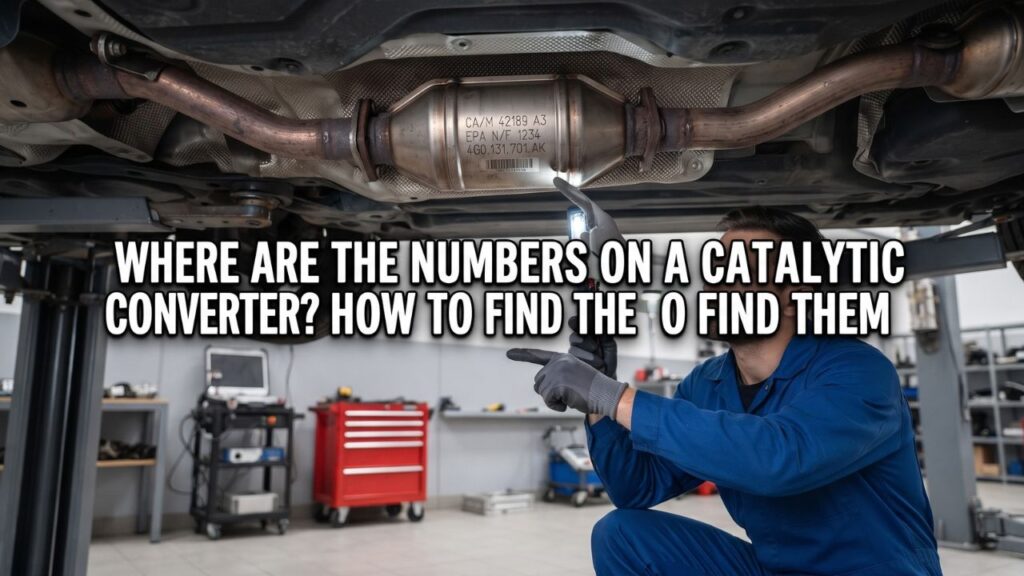
The exact position changes by manufacturer and converter design, but several locations are common.
On the Main Converter Shell
The most common place is the outer stainless-steel shell that surrounds the catalyst substrate.
Look across both large flat faces of the converter. The number may be:
- Stamped into the metal
- Laser-etched
- Engraved
- Printed on a permanent label
- Formed as part of the shell marking
A stamped code may be shallow and difficult to see until the surface is cleaned.
MagnaFlow notes that original converters may have the vehicle brand stamped into the body or a longer multi-digit code etched along the side.
On the Heat Shield
Some converters have a separate metal heat shield around the main body.
The identifying number may be stamped on this shield rather than directly into the converter canister.
This matters when identifying used units. RRCats notes that Hyundai and Kia converter codes are often found directly on the silver heat shield, so removing the shield before recording the markings can make identification harder.
Check both sides of the shield and the portions closest to the inlet and outlet pipes.
Near a Corner or Edge
OEM manufacturers sometimes place codes close to an outside corner of the converter assembly.
GM units are a useful example. RRCats reports that GM converter identifiers are commonly found on one of the converter corners or stamped into the main shield.
This area can collect rust and dirt, so the number may look like a series of shallow scratches at first.
Near the Inlet or Outlet Pipe
Some converters carry part numbers or production markings near the pipe transition where the converter body narrows toward the exhaust pipe.
Look around:
- Inlet neck
- Outlet neck
- Weld seams
- Flange area
- Sensor-bung area
Do not assume a number close to an oxygen sensor is the sensor number. Read the entire marking before identifying it.
On Opposite Sides of an Aftermarket Converter
California rules require some universal aftermarket converters to have markings on both sides so the required information has a good chance of remaining visible after installation.
CARB states that converters capable of being installed in different rotational positions may need two labels placed on opposite sides of the shell.
Key Takeaway: Start with the main shell, then check the heat shield, corners, pipe transitions, and opposite side. OEM placement varies, while regulated aftermarket labels are often easier to recognize.
What Numbers Are Stamped on a Catalytic Converter?
Several types of markings can appear on one converter, and they do not all serve the same purpose.
Part Number
The part number identifies a converter design or application.
This is often the most useful number when:
- Ordering a replacement
- Identifying an OEM converter
- Comparing parts
- Checking an aftermarket application
- Requesting a recycler quote
A part number may contain only digits or a combination of letters, numbers, spaces, and dashes.
It is not always a unique number assigned to one individual converter. Thousands of identical converters may carry the same part number.
Manufacturer Code
Aftermarket converters may include a code identifying the manufacturer.
Older federal aftermarket labeling guidance used a manufacturer code within a structured converter label. EPA documentation gives formats such as N/XX/YYYY/ZZZZ for new converters and U/XX/YYYY/ZZZZ for certified used converters, with the fields identifying status, manufacturer, application or part number, and production date.
The exact appearance depends on the converter’s age and certification system.
Manufacturing Date
A converter may have a production date stamped into the shell.
CARB labeling uses a month-and-year field. Its current procedures show a four-digit production-date format, with an example such as 0105 representing January 2005.
Do not confuse a four-digit date code with the converter’s main part number.
CARB Executive Order Number
A California-approved aftermarket converter carries a CARB Executive Order, commonly called an EO number.
The modern format is typically similar to:
D-XXX-XX
That number links the converter to the California approval covering specific vehicle applications. CARB states that the EO number is permanently labeled on approved aftermarket converter shells.
A converter can physically fit a vehicle and still be the wrong emissions application, so the EO and part number should be checked together.
Flow-Direction Arrow
This is not a serial number, but it often appears beside the converter markings.
An arrow tells the installer which direction exhaust should travel through the converter.
CARB’s aftermarket requirements include a directional-flow arrow as part of the required labeling. Some converters designed for either orientation may use a bidirectional indication.
OEM Production or Casting Codes
Factory converters can carry extra codes that do not appear in a retail parts catalog.
These may relate to:
- Supplier
- Production plant
- Material batch
- Assembly version
- Manufacturing date
- Exhaust-system variant
That is why searching every visible number individually may produce confusing results.
Key Takeaway: The most useful markings are usually the part number, manufacturer code, approval number, and production date. Some extra factory codes are manufacturing identifiers rather than replacement part numbers.
How to Read a California Catalytic Converter Number
California-approved aftermarket converters are easier to decode because the required markings follow a regulated pattern.
Modern CARB Label Format
CARB documentation shows the following core information:
D-XXX-XX — Executive Order number
YYYYYY — Converter part number
ZZZZ — Month and year of manufacture
Arrow — Exhaust-flow direction
The actual number of digits in the part number can vary.
The EO number is the part that connects the converter to CARB’s approval records.
Why the EO Number Matters
California replacement-converter rules are application specific.
Walker explains that the number stamped on a CARB-compliant converter body needs to correspond with the EO approval for the correct vehicle application.
Physical size alone is not enough.
Two converters can have similar dimensions yet be approved for different engine families or vehicle groups.
Older California Markings
Older approved converters can use different labeling formats.
CARB documentation for earlier aftermarket converters shows formats containing:
- New or used designation
- CA approval indicator
- Manufacturer code
- Part or series number
- Production date
For example, an older marking could contain a format resembling N/CA/TA … rather than the newer D-series EO number.
Do not assume an older converter is unapproved solely because its label differs from a current replacement.
Key Takeaway: Modern California aftermarket converter markings usually give the EO number, part number, manufacture date, and flow direction. Older approved units may use a different code pattern.
Is the Catalytic Converter Number the Same as a Serial Number?
Not always.
People often call any converter marking a serial number, but the code may actually be a shared part number.
A true serial number normally identifies one individual item. A part number identifies a design used on many identical items.
OEM converter markings are not standardized across every automaker, so the term “serial number” gets used loosely in recycling and parts discussions.
For identification purposes, recyclers may still ask for the stamped or etched converter number even when that code technically represents a part family.
MagnaFlow’s recycler guidance refers to long multi-digit markings on OEM converter bodies as useful identification information.
If you need an exact replacement, use the code together with the VIN and vehicle application rather than assuming the converter marking alone settles fitment.
Where Is the Number on an OEM Catalytic Converter?
Original equipment converter codes are less standardized than regulated aftermarket labels.
Automakers and suppliers use different marking locations and code structures.
GM and Chevrolet Converters
GM catalytic converters commonly carry a multi-digit identifier around the corner of the converter or on the shield.
RRCats says GM puts identifying numbers on a large share of its OEM converter units and that Chevrolet codes are commonly found in one of two repeated locations around the converter body.
The full sequence is normally more useful than a shorter secondary stamp located elsewhere on the unit.
Hyundai and Kia Converters
Hyundai and Kia OEM converter markings frequently appear on the outer silver heat shield.
These can be relatively short alphanumeric codes.
Do not discard or remove the shield before recording the number if you are trying to identify the converter for recycling.
Other Brands
Ford, Toyota, Honda, Nissan, Subaru, European brands, and other manufacturers use their own supplier and part-number systems.
Possible locations include:
- Center of the shell
- Edge of the shell
- Heat shield
- Welded plate
- Cast manifold section
- Pipe near the converter
If no clear number appears underneath the vehicle, the useful OEM replacement number may be easier to obtain through the VIN and manufacturer parts catalog.
Key Takeaway: OEM converter numbers are not stamped in one universal spot. Brand-specific patterns exist, so inspect the complete shell and shield before deciding the number is missing.
How to Find a Hard-to-Read Catalytic Converter Number
Exhaust parts live in a harsh environment. Surface corrosion and dirt can hide shallow markings.
Let the Exhaust Cool Completely
Never search for numbers on a hot converter.
Catalytic converters can reach very high temperatures during operation and remain hot after the engine is turned off.
Park the vehicle, let the exhaust cool fully, and work only from a safely supported position.
Use a Light From Several Angles
A shallow stamp can disappear under direct lighting.
Move a flashlight across the shell at a low angle. Side lighting creates shadows in engraved digits and can make them much easier to see.
A phone camera can also help. Take several close photographs and enlarge them afterward rather than trying to read the number while lying under the vehicle.
Remove Loose Dirt Gently
Use a rag or soft brush to remove surface dirt.
For heavier oxidation, a mild hand brush may expose the marking.
Avoid grinding aggressively or sanding the shell because you can erase a shallow etched number that you are trying to identify.
Check the Entire Heat Shield
If the shell itself has no obvious marking, inspect the attached shield.
Pay close attention to:
- Flat upper and lower faces
- Folded edges
- Corners
- Areas near spot welds
A stamping can be hidden by the orientation of the installed converter.
Photograph Every Code Before Searching
A converter may have several codes.
Photograph all of them, then compare the complete markings rather than searching a partial number that could match hundreds of unrelated automotive parts.
I’d include part of the converter shape in the photo as well. Body shape, inlet arrangement, sensor locations, and shield design can help distinguish between similar codes.
Key Takeaway: Let the converter cool, clean it gently, use side lighting, photograph both sides, and record every visible code before trying to identify the part.
Which Number Do You Need to Replace a Catalytic Converter?
A stamped converter number can help, but replacement selection should not rely on that marking alone.
The correct converter depends on the vehicle’s complete emissions configuration.
Check the VIN
The VIN identifies the vehicle and allows a manufacturer or parts catalog to narrow the correct exhaust configuration.
This is useful when a model year has:
- Several engine choices
- Federal and California emissions versions
- Multiple converter positions
- Different production dates
The VIN itself does not normally tell you the converter number in plain text. It gives the parts system enough information to identify the correct application.
Check the VECI Label
The Vehicle Emission Control Information label, or VECI label, is normally found in the engine compartment.
Walker lists common locations such as:
- Underside of hood
- Strut tower
- Radiator support
- Fan shroud
- Firewall
The label contains the Engine Family Number, also called the Test Group or Emission Family Number.
That engine-family number is not the same thing as the number stamped on the converter.
It is used to verify the correct emissions system and, in states following CARB replacement rules, can be needed to select the approved aftermarket converter.
Match the Converter Position
A vehicle with several converters may use different parts at each location.
Catalog descriptions may identify them as:
- Front
- Rear
- Left
- Right
- Bank 1
- Bank 2
- Manifold converter
- Underfloor converter
Record which physical converter you are identifying before ordering a part.
Key Takeaway: For replacement, combine the converter marking with the VIN, VECI engine family, emissions certification, and converter position. Do not order from the stamped number alone when several applications exist.
Which Number Is Needed to Identify Scrap Value?
Converter buyers generally need the OEM code or other manufacturer identification stamped on the converter.
That number helps identify the converter family and its expected catalyst content.
A photograph may also be requested because converter shape helps confirm the code.
For a useful identification photo, capture:
- Full converter body
- Stamped number
- Heat shield
- Both pipe ends
- Manufacturer logo if present
Do not remove identification shields before recording their codes.
The scrap value cannot be determined reliably from the vehicle model alone because the same vehicle family may use several converter versions.
The physical condition also matters. MagnaFlow notes that an intact ceramic core is relevant when assessing a converter for recycling.
What If There Is No Number on the Catalytic Converter?
Several explanations are possible.
The code may be hidden by:
- Rust
- Road grime
- Heat discoloration
- An outer shield
- Installed orientation
The converter may also be an aftermarket unit with a different marking system than the original part.
Some OEM units simply have markings that are hard to locate or decode without a brand-specific converter database.
If you need a replacement and cannot find any usable code, use:
- VIN
- Year, make, and model
- Engine size
- VECI engine family
- Federal or California emissions certification
- Converter position
Walker recommends using vehicle emissions information rather than relying only on physical converter dimensions when selecting a replacement.
If the goal is scrap identification, take clear photographs of the shell, shield, and any partial markings and ask the recycler to identify the unit before removing more parts.
Conclusion
The simplest answer to where are the numbers on a catalytic converter is on the outer shell or heat shield, often on a flat side, corner, edge, or area near the inlet and outlet pipes. OEM placement varies by manufacturer, while regulated aftermarket units use more structured labeling.
Look for a part number, manufacturer code, production date, CARB EO number, and flow arrow. Do not assume every code is a unique serial number. Many converter markings identify a part family rather than one individual converter.
I’d photograph every visible marking before ordering a replacement or requesting a recycling quote. For replacement selection, confirm the code against the VIN, emissions label, engine family, and converter position so a similar-looking unit is not mistaken for the correct application.
FAQs About Catalytic Converter Numbers
Does Every Catalytic Converter Have a Number on It?
Many OEM and aftermarket converters have identifying markings, but the style and location vary.
Aftermarket converters sold under regulated certification programs have required labels. OEM converters may use etched, stamped, or shield-mounted codes that can be difficult to find after years of corrosion and heat exposure.
Where Is the Serial Number on a Catalytic Converter?
Check the broad sides of the main shell, heat shield, corners, and areas near the inlet and outlet pipes.
Some manufacturers consistently use certain locations. Hyundai and Kia numbers, for example, are often found on the heat shield, while many GM codes appear on a corner or the main shield.
How Many Digits Are in a Catalytic Converter Number?
There is no universal length.
OEM codes may contain a short alphanumeric sequence or a long string of digits. Aftermarket converter labels can include several separate fields for manufacturer, part number, date, and approval status.
Record the complete code exactly as it appears.
What Is the Number D-XXX-XX on a Catalytic Converter?
That format is associated with a California Air Resources Board Executive Order number on a CARB-approved aftermarket converter.
The EO links the converter design to its California approval. The converter should also have a specific part number and production-date marking.
Is the Engine Family Number Stamped on the Catalytic Converter?
Usually, no.
The Engine Family Number or Test Group Number is normally found on the vehicle’s underhood VECI emissions label. It is used with vehicle information to determine the correct converter application.
Can I Find the Correct Catalytic Converter From the VIN?
Yes, the VIN can be used with an OEM or reputable parts catalog to identify the correct converter configuration.
You may still need to confirm the emissions certification and converter position because some vehicles have several converter assemblies.
Why Can’t I Read the Number on My Catalytic Converter?
Rust, dirt, heat discoloration, shallow stamping, and the installed angle can hide the code.
Let the exhaust cool, wipe the surface gently, use a flashlight from an angle, and take close photographs. Avoid aggressive grinding because it can remove faint markings.
Are Catalytic Converter Numbers Used to Determine Scrap Value?
Yes, OEM converter codes are commonly used by recyclers to identify the converter family and estimate its recoverable catalyst value.
The buyer may also request photos of the complete converter because body shape, shield design, and internal condition can help confirm identification.