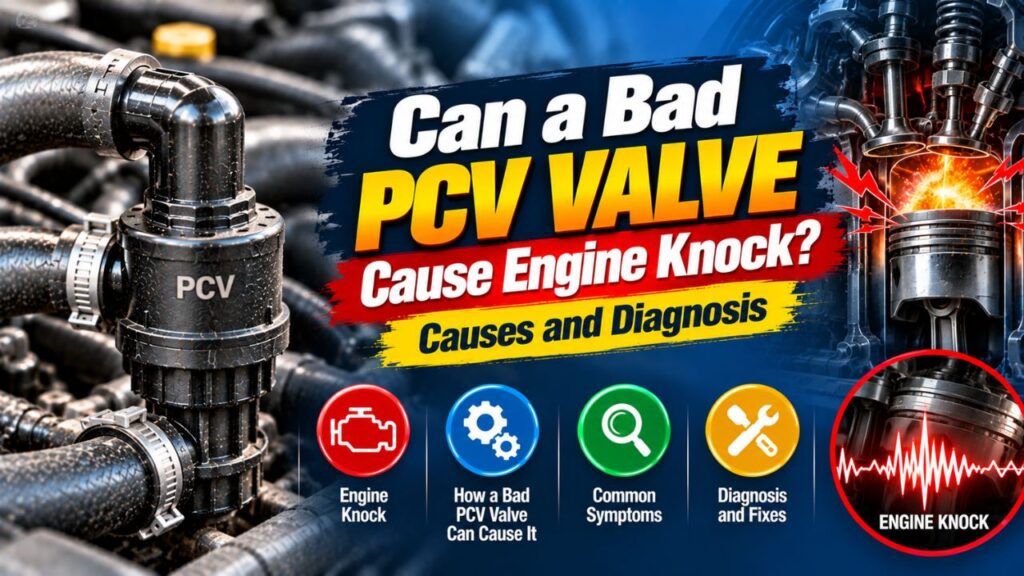
Can a Bad PCV Valve Cause Engine Knock? Causes and Diagnosis
A knocking or pinging sound from an engine can immediately raise concerns about serious internal damage. If you have also noticed PCV-related symptoms such as rough idle, unusual oil consumption, a vacuum leak, or oil around the intake, it is reasonable to wonder whether the two problems are connected.
Yes, a bad PCV valve can indirectly contribute to engine knock or pinging in some situations, particularly if it creates a vacuum leak, causes an excessively lean air-fuel mixture, increases oil consumption, or contributes to combustion-chamber deposits. However, a faulty PCV valve is not a common direct cause of deep mechanical knock such as connecting-rod or bearing knock.
The distinction between combustion knock and mechanical engine knock is important. Combustion knock—often called pinging, spark knock, or detonation—happens when the air-fuel mixture burns abnormally inside the cylinder. A malfunctioning PCV system can sometimes create conditions that encourage this type of noise.
A deep metallic knock caused by worn connecting-rod bearings, crankshaft bearings, piston damage, or other internal mechanical problems is different. Replacing a PCV valve will generally not repair that kind of engine knock.
This guide focuses specifically on can a bad PCV valve cause engine knock, how the connection can happen, which type of knock a PCV fault might produce, what symptoms should appear with it, and how to determine whether the PCV system is actually responsible.
Can a Bad PCV Valve Cause Engine Knock?
Yes, but usually indirectly rather than directly.
A malfunctioning Positive Crankcase Ventilation (PCV) valve can potentially contribute to combustion knock through several pathways:
- Creating a vacuum leak
- Causing an excessively lean mixture
- Allowing excessive oil vapor into the intake
- Increasing oil consumption
- Contributing to carbon deposits
- Changing normal crankcase ventilation
The most plausible connection is a PCV valve or PCV hose that allows uncontrolled air into the intake manifold. That extra unmetered air can make the mixture lean, particularly at idle and low airflow.
A sufficiently lean mixture can increase combustion temperatures and, under certain operating conditions, contribute to detonation or spark knock.
However, modern engine computers can often compensate for relatively small mixture changes by adjusting fuel trims. Therefore, a failed PCV valve does not automatically produce knock.
What Kind of Engine Knock Can a Bad PCV Valve Cause?
The term “engine knock” describes several very different noises.
A PCV problem is most relevant to combustion-related pinging or detonation, not a deep mechanical knock from damaged engine bearings.
Spark Knock or Pinging
Spark knock usually sounds like:
- Metallic pinging
- Light rattling
- Marbles shaking in a can
- Rapid metallic clicking under acceleration
It commonly becomes noticeable when:
- Accelerating
- Climbing a hill
- Towing
- Driving under heavy load
- Engine temperature is high
A PCV-related mixture problem can theoretically contribute to this type of noise.
Rod Knock
Rod knock is usually a deeper, heavier metallic knocking sound caused by excessive clearance between a connecting-rod bearing and the crankshaft journal.
A faulty PCV valve does not normally cause rod knock directly.
Possible signs of rod-bearing trouble can include:
- Deep rhythmic knock
- Noise that follows engine RPM
- Low oil pressure
- Metal contamination in engine oil
- Increasing noise under certain loads
If the noise sounds deep rather than like light pinging, do not assume the PCV valve is responsible.
Piston Slap or Valvetrain Noise
Other noises can also be mistaken for knock, including:
- Piston slap
- Lifter tapping
- Timing-chain noise
- Injector clicking
- Accessory bearing noise
The sound needs to be identified before replacing parts.
How a Bad PCV Valve Can Create a Lean Mixture
The PCV system normally routes crankcase vapors into the intake so they can be burned by the engine.
The PCV valve regulates this airflow according to engine operating conditions.
If the valve becomes stuck too far open or if the PCV hose cracks, too much air can enter the intake.
Depending on the engine’s design, this may act like a vacuum leak.
A vacuum leak introduces air that may not be properly accounted for by the engine’s airflow-management system.
The engine can then run lean.
A lean mixture means there is too much air relative to the amount of fuel being delivered.
Possible symptoms include:
- Rough idle
- High or unstable idle
- Hesitation
- Misfires
- Lean diagnostic codes
- Positive fuel trims
- Whistling or hissing
- Poor acceleration
Under certain circumstances, abnormal combustion associated with a lean condition can contribute to pinging.
Why a Lean Mixture Can Cause Pinging
Normal combustion begins at the spark plug and spreads smoothly across the combustion chamber.
During detonation, part of the remaining air-fuel mixture spontaneously combusts instead of burning normally with the flame front.
The resulting pressure waves create the metallic pinging associated with spark knock.
Factors that encourage detonation can include:
- Excessive cylinder temperature
- Low-octane fuel
- Excessive ignition advance
- Heavy carbon buildup
- Engine overheating
- Lean operating conditions
- Excessive cylinder pressure
A bad PCV valve can contribute if it creates a significant mixture problem, but it is usually one factor rather than the first cause technicians would suspect.
Why PCV Vacuum Leaks Are Usually Worse at Idle
A PCV-related vacuum leak often has its largest effect at idle because intake manifold vacuum is high and overall engine airflow is relatively low.
A small amount of unwanted air therefore represents a relatively large percentage of the total airflow.
At higher engine loads:
- Throttle opening increases
- Normal airflow becomes much greater
- Manifold vacuum usually decreases
The same vacuum leak may become proportionally less significant.
This is one reason a bad PCV valve commonly causes rough idle and lean codes before it causes obvious knock under heavy acceleration.
If an engine only pings under heavy load but idles perfectly and has normal fuel trims, other causes of detonation may deserve attention before the PCV valve.
Can a Bad PCV Valve Cause Oil to Enter the Intake?
Yes.
A PCV system that is malfunctioning can sometimes pull excessive oil mist or liquid oil into the intake.
Possible causes include:
- Incorrect PCV valve
- Failed internal PCV diaphragm
- Excessive crankcase pressure
- Faulty oil separator
- Blocked PCV passages
- Excessive engine blow-by
- Improper PCV routing
Oil entering the combustion chamber can create several problems that may eventually increase the likelihood of knock.
How Oil Consumption Can Contribute to Engine Knock
Engine oil is not intended to be part of the normal air-fuel charge.
If excessive oil enters and burns in the cylinders, it can contribute to combustion-chamber deposits.
Carbon deposits may accumulate on:
- Piston crowns
- Combustion chambers
- Valves
- Spark plugs
Heavy deposits can contribute to knock in more than one way.
Increased Effective Compression
Deposits take up space inside the combustion chamber.
Severe buildup can slightly reduce combustion-chamber volume, effectively increasing compression.
Higher compression can increase the tendency toward detonation.
Hot Spots
Deposits can become extremely hot.
In some circumstances, glowing deposits can contribute to abnormal combustion.
Oil Can Affect Knock Resistance
Oil contamination of the incoming charge may also reduce the mixture’s effective resistance to abnormal combustion.
Therefore, a PCV problem that causes significant oil ingestion can potentially contribute indirectly to pinging over time.
Can a Stuck-Open PCV Valve Cause Engine Knock?
A stuck-open PCV valve is more likely to create a direct connection with combustion problems.
If too much airflow passes through the PCV circuit, the engine may develop a vacuum leak.
Possible symptoms include:
- Rough idle
- High idle
- Lean mixture
- P0171 or P0174 codes on applicable vehicles
- Misfire
- Hissing noise
- Increased fuel trims
- Hesitation
If the mixture becomes sufficiently lean under conditions where knock is already likely, pinging may occur.
However, many modern engines will attempt to correct the lean condition by increasing injector pulse width.
That means a stuck-open PCV valve does not always result in audible knock.
Can a Stuck-Closed PCV Valve Cause Engine Knock?
A stuck-closed PCV valve is less likely to cause immediate spark knock through a lean mixture.
Instead, blocking normal crankcase ventilation can allow pressure to build inside the crankcase.
Possible consequences include:
- Oil leaks
- Oil pushed past seals
- Sludge formation
- Moisture accumulation
- Increased crankcase pressure
- Oil contamination
- Abnormal oil consumption
Depending on PCV system design and engine condition, these problems could eventually contribute to deposits or oil ingestion.
That creates a possible indirect path toward combustion knock, but it is not usually an immediate cause.
Can a Clogged PCV Hose Cause Knocking?
A clogged PCV hose can interfere with normal crankcase ventilation similarly to a blocked valve.
The most immediate symptoms are more likely to involve:
- Crankcase pressure
- Oil leakage
- Sludge
- Ventilation problems
A cracked PCV hose is more likely to cause a lean mixture because it can create a vacuum leak.
Therefore, when investigating a suspected PCV-related knock, inspect the entire PCV system, not only the valve.
Can a Broken PCV Diaphragm Cause Pinging?
Yes, potentially.
Many modern engines no longer use a simple removable check-style PCV valve. Instead, the PCV regulator or diaphragm may be integrated into:
- Valve cover
- Oil separator
- Crankcase ventilation assembly
If that diaphragm tears, it can create an abnormal vacuum path.
Symptoms may include:
- Whistling
- Rough idle
- Lean codes
- Excessive crankcase vacuum
- Oil consumption
- Misfires
If the failure significantly affects the air-fuel mixture, it can potentially contribute to combustion knock.
Symptoms That Suggest the PCV System Could Be Involved
Engine knock alone is not strong evidence of a bad PCV valve.
The PCV system becomes a more credible suspect when the knocking is accompanied by other PCV-related symptoms.
Look for:
- Rough or unstable idle
- Hissing or whistling from the engine
- Lean diagnostic trouble codes
- Excessively positive fuel trims
- Increased oil consumption
- Oil inside intake plumbing
- Oil leaks
- Abnormal crankcase pressure
- Misfires
- Check engine light
- PCV hose damage
The more of these symptoms appear together, the more worthwhile a PCV inspection becomes.
Check Engine Codes That May Appear
A failing PCV system does not always set a specific “PCV valve” code.
Instead, the engine computer may detect the results of the failure.
Possible codes can include lean-mixture or misfire codes such as:
- P0171 – System Too Lean, Bank 1
- P0174 – System Too Lean, Bank 2
- P0300 – Random/Multiple Cylinder Misfire
- P0301 and similar cylinder-specific misfire codes
The exact codes depend on the vehicle.
A lean code does not prove the PCV system is bad. Other vacuum leaks and fuel-delivery problems can produce similar codes.
Fuel Trims Can Help Identify a PCV Vacuum Leak
A scan tool that displays short-term fuel trim (STFT) and long-term fuel trim (LTFT) can provide useful clues.
If unmetered air enters the engine, the oxygen sensors may detect a lean condition.
The engine computer responds by adding fuel.
The scan tool then shows positive fuel correction.
One useful diagnostic pattern is:
- High positive fuel trim at idle
- Significantly lower correction at higher RPM
That pattern can suggest a vacuum leak.
A leaking PCV valve, PCV hose, intake gasket, or another vacuum-connected component could be responsible.
Fuel-trim interpretation varies by vehicle, so factory diagnostic information should be used when available.
How to Check a PCV Valve if the Engine Is Knocking
The correct procedure depends heavily on PCV design.
Inspect the PCV Hose
With the engine off, inspect the hose for:
- Cracks
- Splits
- Collapsed areas
- Loose connections
- Oil saturation
- Disconnected fittings
A damaged hose can cause the same symptoms as a defective valve.
Check for Unusual Vacuum
Some traditional PCV systems can be checked for vacuum at the valve with the engine idling.
There should normally be controlled vacuum through the system.
No vacuum may indicate:
- Blocked valve
- Blocked hose
- Blocked passage
Excessive airflow may indicate a valve stuck open or another PCV failure.
The exact test procedure varies, so vehicle-specific service information is preferable.
Inspect Integrated PCV Systems
If the PCV system is built into the valve cover, do not expect to find a small removable valve.
Testing may involve:
- Crankcase vacuum measurement
- Diaphragm inspection
- Smoke testing
- Scan-tool fuel trims
Some failures require replacing a larger PCV assembly or valve cover rather than a small valve.
Will the Old “Shake Test” Diagnose a Bad PCV Valve?
Not reliably.
Traditional metal PCV valves sometimes rattle when shaken because an internal valve moves inside them.
A lack of rattle may suggest contamination, but hearing a rattle does not prove the valve meters airflow correctly.
Modern PCV designs may also work completely differently.
A proper diagnosis considers:
- Vacuum
- Airflow
- Hose condition
- Crankcase pressure
- Fuel trims
- Manufacturer test procedures
Do not rely solely on whether the valve rattles.
Can You Temporarily Disconnect the PCV Valve to Test for Knock?
Disconnecting vacuum components while the engine is running can change the air-fuel mixture and create additional problems.
A better diagnostic method is to follow the vehicle manufacturer’s PCV test procedure.
When technicians isolate a suspected PCV vacuum leak, they may temporarily block the relevant vacuum path while monitoring:
- Idle quality
- Fuel trims
- Crankcase behavior
However, the test must be appropriate for that particular PCV system.
Do not permanently block the PCV system.
The engine needs controlled crankcase ventilation.
Will Replacing a Bad PCV Valve Stop Engine Knock?
It can if the PCV fault is actually causing the conditions responsible for the knock.
For example, suppose:
- The PCV valve is stuck open.
- It creates a substantial vacuum leak.
- The mixture becomes abnormally lean.
- The engine develops combustion pinging.
- Replacing the valve restores normal airflow.
In that situation, the knocking may disappear.
Likewise, correcting excessive oil ingestion can help prevent additional deposits.
However, replacing the PCV valve will not cure engine knock caused by:
- Worn rod bearings
- Damaged crankshaft bearings
- Piston damage
- Incorrect fuel octane
- Excessive ignition timing
- Overheating
- Faulty knock-control system
- Heavy existing carbon deposits
- Fuel-delivery problems
Diagnosis matters more than simply replacing a cheap part and hoping the noise disappears.
Bad PCV Valve vs Rod Knock
Distinguishing these two conditions is particularly important.
| Characteristic | PCV-Related Pinging | Rod Knock |
| Typical sound | Light metallic ping/rattle | Deep metallic knock |
| Often occurs | Acceleration or load | Often follows engine RPM/load |
| PCV symptoms may be present | Yes | Usually unrelated |
| Lean codes possible | Yes | Generally no |
| Vacuum leak possible | Yes | No |
| Low oil pressure possible | Not typically from PCV alone | Can occur |
| Fixed by PCV replacement | Possibly, if PCV is the cause | No |
A severe deep knock should be evaluated promptly because bearing damage can lead to major engine failure.
What Else Can Cause Pinging if the PCV Valve Is Good?
If testing shows that the PCV system is working normally, investigate other common causes of combustion knock.
These can include:
Fuel With Insufficient Octane
Using fuel below the vehicle manufacturer’s required octane rating can increase the tendency to detonate.
Carbon Deposits
Heavy deposits can increase cylinder temperature and effective compression.
Engine Overheating
Excessive combustion-chamber temperatures encourage detonation.
Incorrect Ignition Timing
On older engines with adjustable distributor timing, excessive ignition advance can cause pinging.
Modern engines control timing electronically, so a timing-related problem requires a different diagnostic approach.
EGR System Problems
On engines equipped with Exhaust Gas Recirculation (EGR), insufficient EGR flow can increase combustion temperatures and contribute to pinging under load.
Fuel-Delivery Problems
Insufficient fuel pressure, clogged injectors, or other mixture problems can contribute to lean combustion.
Knock Sensor or Control Problems
Modern engines use knock sensors so the engine computer can detect detonation and adjust ignition timing.
A malfunction in this system can reduce the engine’s ability to respond to knock.
These possibilities are important because replacing the PCV valve will accomplish nothing if the actual cause lies elsewhere.
Can a Bad PCV Valve Cause Knock Only When Accelerating?
Potentially, although it is not the most typical PCV symptom.
Combustion knock is often most noticeable during acceleration because cylinder pressure and engine load are higher.
If a PCV fault has contributed to:
- Lean operation
- Excessive oil consumption
- Carbon buildup
the engine may become more prone to pinging under load.
However, because intake manifold vacuum generally decreases as the throttle opens, a simple PCV vacuum leak may have less relative influence during heavy acceleration than it does at idle.
Therefore, knock occurring only under load should not automatically be blamed on the PCV valve.
Can a Bad PCV Valve Cause Knocking at Idle?
Detonation-related pinging is generally less common at idle because cylinder loads are relatively low.
A PCV failure can certainly make an engine run badly at idle, producing:
- Roughness
- Misfire
- Shaking
- Hissing
- Surging
These sensations can sometimes be described as “knocking,” even when actual combustion knock is not occurring.
If you hear a distinct mechanical knock at idle, the sound may be coming from another component.
Can a PCV Valve Itself Rattle?
Some traditional PCV valves contain a movable internal plunger that can rattle when the valve is handled.
However, a normal internal PCV rattle should not normally sound like a deep engine knock from inside the cabin.
Loose hoses, brackets, or PCV-related components can sometimes create localized rattling, but that should be distinguished from combustion or bearing knock.
Is It Safe to Drive With PCV-Related Engine Knock?
Do not ignore persistent engine knock.
If the noise is true detonation, repeated knocking can place unnecessary stress on:
- Pistons
- Rings
- Bearings
- Combustion chambers
Modern engines can often reduce ignition timing when knock is detected, but the underlying problem still deserves diagnosis.
If the sound is a deep mechanical knock, continuing to drive can be considerably more serious.
Stop driving and seek diagnosis promptly if you notice:
- Loud deep knocking
- Low oil-pressure warning
- Severe loss of power
- Flashing check engine light
- Heavy misfire
- Overheating
- Metal in the engine oil
Common Mistakes When Diagnosing PCV-Related Engine Knock
Replacing the PCV Valve Without Testing Anything
A PCV valve is often inexpensive, but engine knock has many possible causes.
Check whether PCV symptoms are actually present.
Calling Every Engine Noise “Knock”
Pinging, rod knock, valve tapping, injector clicking, and timing-chain noise are different problems.
Ignoring the PCV Hose
A perfectly good PCV valve connected to a split hose can still create a vacuum leak.
Assuming No Check Engine Light Means the PCV Is Good
A PCV fault can exist without immediately setting a diagnostic code.
Ignoring Oil Consumption
Excessive oil being drawn through the PCV system can be an important diagnostic clue.
Continuing to Drive With a Deep Knock
A mechanical bearing knock is not something a PCV replacement will solve.
FAQs About Can a Bad PCV Valve Cause Engine Knock
Can a bad PCV valve cause pinging when accelerating?
Yes, indirectly.
If a PCV fault contributes to a lean mixture, excessive oil consumption, or carbon deposits, it can increase the possibility of combustion pinging. However, low-octane fuel, overheating, carbon buildup, EGR problems, and ignition-control issues are also common causes.
Can a bad PCV valve cause rod knock?
A bad PCV valve does not normally directly cause rod knock.
Rod knock is usually associated with excessive bearing clearance or internal lubrication-related damage. A PCV problem should not be considered the primary explanation for a deep connecting-rod knock.
Can a stuck-open PCV valve make an engine run lean?
Yes.
On many engines, a PCV valve stuck too far open or a leaking PCV hose can act as a vacuum leak and allow extra air into the intake.
Can a clogged PCV valve cause knocking?
A clogged valve is more likely to cause excessive crankcase pressure, oil leaks, sludge, or ventilation problems than immediate detonation.
It could indirectly contribute to conditions such as increased oil consumption or deposits that make combustion knock more likely over time.
Will replacing the PCV valve stop knocking?
Only if the PCV fault is responsible for the conditions causing the knock.
A new PCV valve will not repair worn engine bearings, damaged pistons, incorrect fuel, overheating, or another unrelated knock source.
Can a bad PCV valve cause a lean code?
Yes.
A leaking PCV system can introduce unmetered air and contribute to lean diagnostic codes such as P0171 or P0174 on applicable vehicles.
Can excessive oil through the PCV system cause engine pinging?
Potentially.
Burning excessive oil can contribute to combustion-chamber deposits, and heavy deposits can increase an engine’s tendency toward abnormal combustion and pinging.
How can I tell if my knock is PCV-related?
Look for additional PCV-related evidence such as rough idle, vacuum leakage, abnormal fuel trims, lean codes, oil consumption, PCV hose damage, or excessive oil in the intake.
If the noise is deep and follows engine RPM, investigate mechanical engine problems rather than assuming the PCV valve is responsible.
Conclusion
So, can a bad PCV valve cause engine knock? Yes, but the most accurate verdict is that a faulty PCV valve is an indirect and relatively uncommon cause of true engine knock.
The strongest connection occurs when a PCV valve, hose, or diaphragm creates a vacuum leak that disrupts the air-fuel mixture. A PCV problem can also increase oil consumption and contribute to combustion-chamber deposits, both of which may make an engine more prone to pinging or detonation. If the engine also has rough idle, lean codes, unusual fuel trims, whistling, oil consumption, or obvious PCV hose damage, checking the PCV system makes good diagnostic sense.
However, a bad PCV valve should not be used as an explanation for every knocking sound. Light metallic pinging under acceleration may potentially be PCV-related; a deep rhythmic rod or bearing knock usually is not. If replacing a confirmed faulty PCV component restores the correct air-fuel mixture, PCV-related pinging may disappear. If the knock remains, the actual cause needs further diagnosis.
The practical bottom line is to diagnose the type of knock first, then test the PCV system rather than replacing parts blindly. That approach helps distinguish a relatively simple crankcase-ventilation problem from fuel, ignition, overheating, carbon-deposit, or serious internal engine problems.