Symptoms of a Bad Oxygen Sensor: Signs, Testing, and Diagnosis
Common symptoms of a bad oxygen sensor include a check engine light, poor fuel economy, rough idle, hesitation, failed emissions testing, unusual exhaust smell, and fuel-mixture problems.
The symptoms of a bad oxygen sensor can vary depending on which sensor has failed and whether it is located before or after the catalytic converter. A faulty upstream sensor can directly affect fuel control because the engine computer uses its signal to adjust the air-fuel mixture. A downstream sensor is used mainly to monitor catalytic-converter performance, so its failure may cause a warning light without creating the same noticeable drivability problems.
This is why diagnosing an oxygen sensor requires more than simply replacing the sensor named in a trouble code. A code may indicate that the sensor signal is abnormal, but the actual cause could be damaged wiring, an exhaust leak, a vacuum leak, fuel-pressure problems, an engine misfire, or even a failing catalytic converter.
If you are wondering how to tell which oxygen sensor is bad or how to check if an oxygen sensor is bad, the most reliable approach is to combine diagnostic trouble codes with live scan-tool data, wiring inspection, and an understanding of how upstream and downstream O2 sensors should behave.
What Are the Symptoms of a Bad Oxygen Sensor?
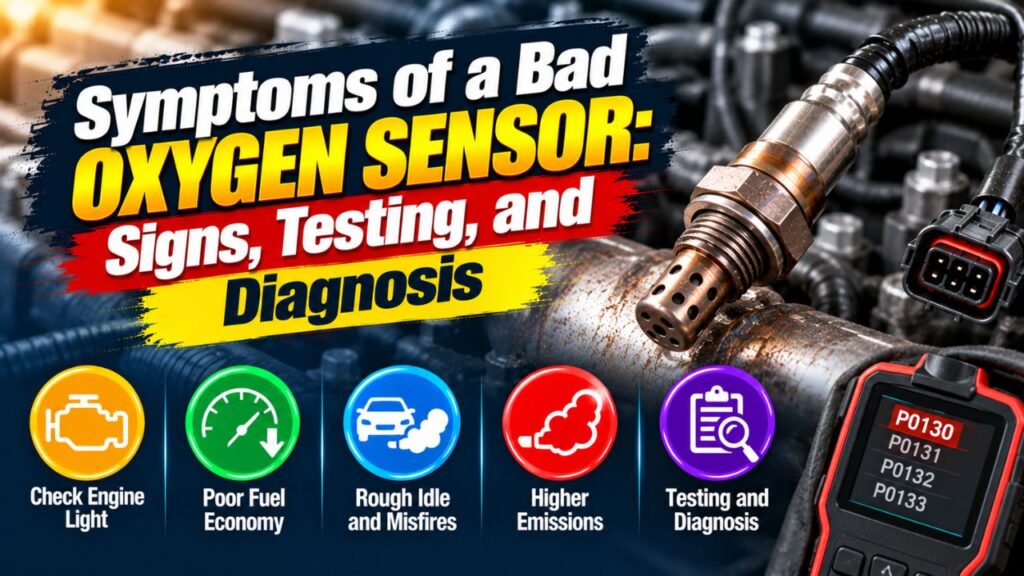
The most common symptoms of a bad oxygen sensor are a check engine light, reduced fuel economy, rough running, hesitation, abnormal fuel trims, and emissions problems.
A failed sensor does not always make the engine run badly. In some cases, particularly with a downstream sensor, the only obvious symptom may be an illuminated check engine light.
The severity depends on the type of sensor and how the engine control module responds to the bad signal.
What Does an Oxygen Sensor Do?
An oxygen sensor, often called an O2 sensor, measures the amount of oxygen in the exhaust gas.
The engine control module, or ECM, uses this information to understand whether combustion is running relatively rich or lean.
A rich mixture contains more fuel relative to air.
A lean mixture contains more air relative to fuel.
On many gasoline engines, the upstream oxygen sensor plays a major role in closed-loop fuel control. The computer continuously adjusts fuel delivery based partly on the sensor’s feedback.
This helps maintain:
- Proper air-fuel ratio
- Fuel economy
- Low emissions
- Catalytic-converter efficiency
- Smooth engine operation
Modern vehicles may use conventional narrowband oxygen sensors, wideband air-fuel ratio sensors, or a combination depending on the engine.
Upstream vs. Downstream Oxygen Sensors
Understanding sensor position is essential before diagnosing a bad O2 sensor.
Upstream Oxygen Sensor
The upstream sensor is located before the catalytic converter.
It may also be called:
- Sensor 1
- Pre-cat sensor
- Front oxygen sensor
- Air-fuel ratio sensor on some vehicles
Its main job is to provide feedback for fuel control.
A failed upstream sensor is therefore more likely to cause drivability and fuel-economy problems.
Downstream Oxygen Sensor
The downstream sensor is located after the catalytic converter.
It may be called:
- Sensor 2
- Post-cat sensor
- Rear oxygen sensor
Its main purpose is typically to monitor catalytic-converter operation.
A failed downstream sensor may turn on the check engine light without causing major drivability symptoms.
Check Engine Light Is One of the Most Common Signs
A bad oxygen sensor commonly causes the check engine light to illuminate.
The ECM constantly monitors oxygen-sensor operation.
It can detect problems such as:
- Slow sensor response
- Signal stuck rich
- Signal stuck lean
- Heater circuit failure
- No sensor activity
- Voltage or current outside expected range
A scan tool may show O2-related diagnostic trouble codes.
However, an oxygen-sensor code does not always prove that the sensor itself has failed.
For example, a lean-reading sensor could be accurately reporting a vacuum leak.
Diagnosis should confirm the cause before replacement.
Poor Fuel Economy
Reduced gas mileage is a common symptom, particularly when an upstream sensor provides inaccurate information.
If the computer receives incorrect feedback, it may add more fuel than necessary.
The driver may notice that:
- The vehicle travels fewer miles per tank.
- Fuel consumption gradually increases.
- The exhaust smells richer than normal.
Fuel economy can change for many other reasons, including tire pressure, driving habits, injector problems, and engine temperature, so poor mileage alone cannot confirm a bad oxygen sensor.
Rough Idle
A faulty upstream oxygen sensor can contribute to a rough or unstable idle if it causes incorrect fuel corrections.
You may notice:
- Engine shaking
- Uneven idle
- RPM fluctuation
- Occasional stalling
- Roughness after the engine warms up
These symptoms can also result from vacuum leaks, worn spark plugs, ignition-coil problems, dirty injectors, or compression issues.
The oxygen sensor should therefore be tested rather than replaced solely because the engine idles poorly.
Hesitation or Poor Acceleration
A bad sensor can sometimes cause hesitation or weak throttle response.
Incorrect fuel-control information may cause the engine to run too rich or too lean under certain conditions.
The result can include:
- Hesitation
- Flat acceleration
- Surging
- Poor response when pressing the accelerator
Severe acceleration problems often have other possible causes, so fuel pressure, ignition, airflow, and exhaust restriction may also need inspection.
Engine Misfires
An oxygen sensor problem can contribute indirectly to misfires if fuel mixture becomes significantly incorrect.
A very rich or lean mixture can make combustion unstable.
However, a misfire can also make an oxygen sensor appear abnormal because unburned oxygen enters the exhaust.
This distinction is important.
If a scan tool shows both misfire codes and oxygen-sensor codes, do not automatically assume the O2 sensor caused the misfire.
The misfire may be the original problem.
Rich Exhaust Smell
A failed upstream sensor that causes excessive fueling may contribute to a strong fuel smell from the exhaust.
Other possible signs of an overly rich mixture include:
- Black exhaust smoke
- Soot at the tailpipe
- Poor fuel economy
- Spark plug fouling
A rich-running engine can also damage the catalytic converter if excess fuel repeatedly enters the exhaust.
Failed Emissions Test
A faulty oxygen sensor can cause a vehicle to fail an emissions inspection.
Possible reasons include:
- Incorrect fuel mixture
- Increased hydrocarbon emissions
- Increased carbon monoxide
- Catalyst-monitor problems
- Check engine light
- Incomplete emissions monitors after repairs
The exact emissions-testing requirements vary by state and location in the United States.
Unusual Exhaust Emissions
A bad sensor can contribute to increased emissions by preventing the engine computer from controlling fuel accurately.
Depending on the failure, the engine may run:
- Too rich
- Too lean
- Inconsistently between rich and lean
This can affect catalytic-converter operation and increase tailpipe emissions.
Can a Bad Oxygen Sensor Cause Black Smoke?
It can, although black smoke usually means the engine is receiving significantly too much fuel.
A faulty upstream sensor that incorrectly signals a lean condition may cause the ECM to add fuel.
However, black smoke can also result from:
- Leaking fuel injectors
- Excessive fuel pressure
- Faulty mass airflow sensor
- Engine coolant temperature sensor problems
A proper diagnosis is necessary before blaming the O2 sensor.
Can a Bad Oxygen Sensor Cause Blue Smoke?
Usually not directly.
Blue smoke generally indicates oil burning, which is more commonly associated with:
- Worn piston rings
- Valve-seal problems
- Turbocharger problems
- PCV system faults
A bad oxygen sensor may react to the abnormal exhaust caused by oil burning, but it is usually not the underlying cause of blue smoke.
Can a Bad Oxygen Sensor Cause White Smoke?
Normally, no.
Persistent thick white exhaust smoke is more commonly associated with coolant entering the combustion chamber or other engine problems.
Condensation can also create harmless white vapor during cold starts.
The O2 sensor may detect changes in exhaust composition, but it does not normally cause white smoke itself.
Can a Bad Oxygen Sensor Cause a Car to Stall?
It can contribute to stalling in some cases, especially if an upstream sensor causes severe fuel-control errors.
However, stalling has many possible causes.
These include:
- Vacuum leaks
- Throttle-body problems
- Fuel-pressure loss
- Crankshaft sensor failure
- Ignition faults
If a vehicle stalls frequently, the oxygen sensor should be considered as part of a larger diagnostic process.
Can a Bad Oxygen Sensor Cause Hard Starting?
Usually, an oxygen sensor is not the first component to suspect for a hard-start problem.
Most engine computers operate in open loop during initial startup and do not rely heavily on oxygen-sensor feedback until the sensor warms up.
Hard starting is more likely to involve:
- Battery or starter
- Fuel pressure
- Ignition
- Engine temperature sensor
- Crankshaft or camshaft sensor
An O2 sensor can affect operation after startup, but it usually has less influence during the initial cranking phase.
Can a Bad Oxygen Sensor Cause Poor Engine Performance?
Yes, particularly if the upstream sensor is inaccurate.
The engine computer may make incorrect fuel adjustments.
Possible effects include:
- Reduced power
- Hesitation
- Rough idle
- Surging
- Higher fuel consumption
A downstream sensor typically has less direct influence on fuel control, although system strategies vary by vehicle.
What Does a Bad Oxygen Sensor Look Like?
A failed oxygen sensor does not always look visibly damaged.
Some bad sensors appear completely normal from the outside.
When removed, however, you may notice:
- Heavy black soot
- White or chalky deposits
- Oil contamination
- Physical damage
- Melted wiring
- Corroded connector pins
Deposits can provide useful diagnostic clues, but appearance alone cannot prove whether the sensor is electrically functioning.
A sensor can look clean while responding too slowly or having a failed heater.
What Causes an Oxygen Sensor to Go Bad?
Oxygen sensors are exposed to extremely hot exhaust gases and eventually wear.
Several conditions can shorten their life.
Normal Aging
The sensing element gradually becomes less responsive over time.
Oil Contamination
An oil-burning engine can coat the sensing element and reduce sensor performance.
Coolant Contamination
Coolant entering the combustion chamber can leave deposits that damage the sensor.
Rich Fuel Mixture
Persistent rich operation can create carbon buildup and contaminate the sensor.
Silicone Contamination
Certain sealants or chemicals can release compounds that damage oxygen-sensor elements if inappropriate products are used around the engine or exhaust system.
Wiring Damage
Exhaust heat, road debris, corrosion, and poor repairs can damage oxygen-sensor wires and connectors.
Sometimes the sensor itself is good, but the wiring is not.
How to Tell Which Oxygen Sensor Is Bad
The first step is to understand bank and sensor numbering.
Diagnostic trouble codes often identify sensors using labels such as:
- Bank 1 Sensor 1
- Bank 1 Sensor 2
- Bank 2 Sensor 1
- Bank 2 Sensor 2
What Does Bank 1 Mean?
Bank 1 is the side of the engine that contains cylinder number 1.
What Does Bank 2 Mean?
Bank 2 is the opposite cylinder bank on engines with two banks, such as many V6 and V8 engines.
Inline engines normally have only one bank.
What Does Sensor 1 Mean?
Sensor 1 normally refers to the oxygen or air-fuel ratio sensor located before the catalytic converter.
What Does Sensor 2 Mean?
Sensor 2 normally refers to the sensor located after the catalytic converter.
So, for example, Bank 1 Sensor 2 usually means the downstream sensor located after the catalytic converter on the bank containing cylinder number 1.
Always confirm the exact vehicle layout because exhaust systems can vary.
Don’t Replace an O2 Sensor Based Only on a Trouble Code
This is one of the most common diagnostic mistakes.
Suppose a scan tool reports a code indicating that an oxygen sensor is reading lean.
That does not necessarily mean the sensor is faulty.
The engine could actually be running lean because of:
- Vacuum leak
- Exhaust leak
- Weak fuel pump
- Restricted injector
- Airflow measurement problem
The oxygen sensor may simply be reporting the condition accurately.
A trouble code should guide testing, not replace testing.
How to Check If an Oxygen Sensor Is Bad
The best method depends on whether the vehicle uses a traditional narrowband O2 sensor or a modern wideband air-fuel ratio sensor.
For most DIY diagnosis, start with a scan tool.
Read Diagnostic Trouble Codes
Connect an OBD-II scan tool and record all stored and pending codes.
Do not erase them immediately.
Codes can provide information about:
- Sensor position
- Heater circuit
- Slow response
- Signal range
- Fuel mixture
- Related misfires
Also note freeze-frame data when available because it shows operating conditions when the fault was detected.
Inspect the Wiring and Connector
Before replacing the sensor, inspect the harness.
Look for:
- Melted wires
- Broken insulation
- Corrosion
- Loose connectors
- Wiring contacting the exhaust
Oxygen-sensor wiring operates near very hot exhaust components, so heat damage is common.
Check Live Oxygen-Sensor Data
A scan tool capable of displaying live data is one of the most useful tools for O2-sensor diagnosis.
A traditional upstream narrowband oxygen sensor normally changes its output as the engine computer moves the mixture slightly rich and lean during closed-loop operation.
A sensor that remains fixed, responds very slowly, or behaves very differently from comparable sensors may be faulty.
However, modern wideband air-fuel ratio sensors use a different signal strategy and should not be diagnosed using traditional narrowband voltage expectations.
Use manufacturer-specific specifications whenever possible.
Compare Sensor Activity
On engines with multiple oxygen sensors, comparing similar sensors can be helpful.
For example, on a V6 or V8 engine, Bank 1 Sensor 1 and Bank 2 Sensor 1 should often show broadly similar responses under comparable conditions.
If one behaves normally and the other is extremely slow or inactive, that may help isolate the faulty side.
Differences can also result from a real engine problem affecting only one bank, such as:
- Intake leak
- Injector fault
- Exhaust leak
- Misfire
Again, sensor data must be interpreted in context.
Check Fuel Trims
Short-term fuel trim (STFT) and long-term fuel trim (LTFT) show how much the ECM is adjusting fuel delivery.
Abnormally positive fuel trims indicate the computer is adding fuel.
Abnormally negative trims indicate it is removing fuel.
Fuel-trim information can help determine whether an oxygen-sensor reading is plausible.
For example, if the O2 sensor reports lean and fuel trims are strongly positive, the engine may actually have a lean condition rather than a bad sensor.
Check for Exhaust Leaks
An exhaust leak before or near an upstream oxygen sensor can pull outside air into the exhaust stream.
This additional oxygen may make the sensor report a false lean condition.
Inspect for:
- Cracked exhaust manifold
- Leaking gasket
- Loose flange
- Damaged pipe
- Failed flex section
Repair significant exhaust leaks before condemning the oxygen sensor.
Check for Vacuum Leaks
A vacuum leak introduces unmetered air into the engine.
This can create a genuine lean mixture.
Possible leak locations include:
- PCV hoses
- Intake manifold gasket
- Brake-booster hose
- Vacuum lines
- Throttle-body gasket
A smoke test can be useful for finding difficult intake leaks.
Oxygen Sensor Heater Problems
Modern oxygen sensors usually contain an electric heater.
The heater helps the sensor reach operating temperature quickly.
A failed heater can cause:
- Delayed closed-loop operation
- O2 sensor heater codes
- Increased emissions after startup
- Slow sensor response
A heater-circuit problem may be caused by the sensor itself, but it can also result from:
- Blown fuse
- Wiring damage
- Bad connector
- Ground problem
- ECM circuit problem
Electrical testing may be required before replacing the sensor.
Can You Test an Oxygen Sensor With a Multimeter?
Sometimes, but the test depends heavily on sensor type.
Traditional narrowband sensors can sometimes be checked with a high-impedance digital multimeter while monitoring voltage changes.
However, modern wideband sensors cannot be accurately diagnosed with the same simple procedure.
Using the wrong testing method can lead to incorrect conclusions.
A scan tool that shows manufacturer-supported live data is generally safer and more informative for beginners.
Can You Test an O2 Sensor by Unplugging It?
Unplugging the oxygen sensor may cause the ECM to substitute default values and set additional trouble codes.
If the engine suddenly runs differently, that observation may provide a clue, but it is not a reliable standalone test.
Many engine-management systems can compensate in ways that make the result difficult to interpret.
Do not use unplugging as the sole basis for deciding that a sensor is bad.
What Is a Slow Oxygen Sensor?
An oxygen sensor does not have to fail completely to cause trouble.
As sensors age, they may become slow to respond.
The signal still changes, but not quickly enough for accurate fuel control.
A slow upstream sensor may contribute to:
- Reduced fuel economy
- Increased emissions
- Sluggish fuel correction
- Check engine light
The ECM may set a slow-response code if it detects this behavior.
Bad Upstream vs. Bad Downstream Oxygen Sensor Symptoms
The symptoms often differ.
| Condition | Upstream O2 Sensor | Downstream O2 Sensor |
| Check engine light | Common | Common |
| Poor fuel economy | More likely | Less likely |
| Rough idle | Possible | Usually less likely |
| Fuel-trim changes | Common | Usually limited |
| Emissions problems | Possible | Possible |
| Catalyst-monitor code | Sometimes | Common |
| Noticeable drivability issues | More likely | Often minimal |
This distinction is useful when trying to determine whether a sensor failure should noticeably affect how the vehicle drives.
Can a Bad Downstream O2 Sensor Cause Poor Performance?
Usually, the downstream sensor has less direct influence on basic fuel control than the upstream sensor.
Its primary purpose is typically monitoring catalytic-converter efficiency.
Therefore, a failed downstream sensor may cause:
- Check engine light
- Emissions-monitor problems
- Catalyst-related diagnostic issues
without creating strong drivability symptoms.
However, control strategies vary by manufacturer, so service information for the exact vehicle should take priority.
Can a Bad O2 Sensor Damage the Catalytic Converter?
Yes, indirectly.
If a faulty upstream sensor causes the engine to run excessively rich for an extended period, unburned fuel can enter the catalytic converter.
This may cause the converter to overheat.
Long-term mixture problems can contribute to catalyst deterioration.
However, the sensor is only one possible cause of rich operation.
Misfires and injector problems can be even more damaging to the catalytic converter.
Can a Bad Catalytic Converter Cause an O2 Sensor Code?
Yes.
A downstream oxygen sensor monitors exhaust conditions after the catalyst.
If the catalytic converter stops storing and processing oxygen effectively, the downstream sensor pattern may begin to resemble the upstream pattern.
This can trigger catalyst-efficiency codes.
The downstream sensor may be working correctly and simply reporting a failing converter.
This is another reason not to replace an O2 sensor solely because an emissions code mentions sensor activity.
How Long Do Oxygen Sensors Last?
There is no single lifespan for every oxygen sensor.
Service life depends on:
- Sensor design
- Engine condition
- Oil consumption
- Fuel quality
- Heat exposure
- Contamination
- Mileage
Many oxygen sensors can last for a very long time, but they are still wear components.
If the manufacturer lists an inspection or replacement interval, follow that schedule.
Otherwise, diagnose them based on symptoms and test results.
Should You Replace All Oxygen Sensors at Once?
Usually, no.
If one sensor has failed, you do not automatically need to replace every oxygen sensor on the vehicle.
Replace the sensor that has been properly diagnosed as faulty.
However, if multiple sensors are the same age and have very high mileage, additional failures may eventually occur.
That still does not justify replacing functioning sensors without a reason.
Can You Drive With a Bad Oxygen Sensor?
A vehicle may continue driving with a bad oxygen sensor, but it should not be ignored.
A failed downstream sensor may cause little immediate drivability change.
A bad upstream sensor can have a larger effect on:
- Fuel economy
- Emissions
- Engine performance
- Catalytic-converter life
If the check engine light is flashing, the engine is misfiring severely, or performance has deteriorated significantly, avoid unnecessary driving until the problem is diagnosed.
Common Mistakes When Diagnosing Oxygen Sensors
One of the biggest mistakes is treating every oxygen-sensor code as proof that the sensor itself is bad. The sensor may actually be detecting a real rich or lean condition caused elsewhere in the engine.
Another mistake is confusing upstream and downstream sensors. Replacing Sensor 2 when the code identifies Sensor 1 will not solve the problem.
It is also common to overlook exhaust leaks, damaged wiring, and heater-circuit faults. These problems can closely imitate a failed O2 sensor.
Finally, do not diagnose a modern wideband air-fuel ratio sensor using voltage expectations intended for an older narrowband sensor. Their operating strategies are different.
FAQs About Symptoms of a Bad Oxygen Sensor
What are the first symptoms of a bad oxygen sensor?
The first signs often include a check engine light, worsening fuel economy, rough idle, or abnormal fuel trims.
Some downstream-sensor failures may produce no noticeable drivability symptoms.
How do I know if my upstream oxygen sensor is bad?
Use a scan tool to check sensor-related codes, live sensor response, and fuel trims. Also inspect the wiring and rule out vacuum and exhaust leaks.
A slow, inactive, or implausible upstream signal can indicate a failed sensor.
How do I know if my downstream oxygen sensor is bad?
A downstream sensor fault may trigger a specific sensor or heater code.
Live data can help determine whether its signal is behaving abnormally, but a failing catalytic converter can also affect downstream sensor readings.
How can I tell which oxygen sensor is bad?
Read the trouble code and identify the bank and sensor number.
Sensor 1 is normally upstream of the catalytic converter, while Sensor 2 is normally downstream. Bank 1 contains cylinder number 1.
Can I tell if an oxygen sensor is bad without a scan tool?
You can inspect wiring, connectors, exhaust leaks, and visible contamination, but diagnosing sensor performance accurately is much easier with a scan tool that provides live data.
Can a bad oxygen sensor cause poor gas mileage?
Yes.
A faulty upstream O2 sensor can cause incorrect fuel corrections and increase fuel consumption.
Can a bad oxygen sensor cause rough idle?
Yes, especially if the upstream sensor contributes to an incorrect air-fuel mixture.
However, rough idle has many other common causes, including vacuum leaks, ignition problems, and dirty injectors.
Will a bad oxygen sensor always trigger a check engine light?
Not necessarily immediately, but the ECM usually detects significant sensor or heater problems eventually.
A sensor can also become slow or inaccurate before setting an obvious fault code.
Conclusion
The overall verdict on the symptoms of a bad oxygen sensor is that the most common signs are a check engine light, reduced fuel economy, rough idle, hesitation, emissions problems, and abnormal fuel-mixture behavior. Upstream sensor failures are more likely to affect how the engine runs because those sensors are directly involved in fuel control, while downstream sensor failures often show up mainly as warning lights or catalyst-monitoring problems.
To determine how to tell which oxygen sensor is bad, use the trouble code to identify the correct bank and sensor position, then confirm the diagnosis with live data, fuel trims, wiring inspection, and checks for intake or exhaust leaks. If you want to know how to check if an oxygen sensor is bad, avoid relying on appearance or a code alone. A sensor may simply be reporting another engine problem accurately.
Replacing an O2 sensor without proper diagnosis can waste money and leave the original fault unresolved. The best approach is to confirm that the sensor itself is slow, inactive, electrically faulty, or producing implausible data before replacing it.