How Long Can You Drive With a Rattling Catalytic Converter? Risks
There is no reliable number of miles or days that a rattling catalytic converter can be driven safely. If the rattle comes from broken material inside the converter, drive as little as possible and arrange an inspection. Loose pieces can shift, restrict exhaust flow, reduce engine power, or leave the vehicle unable to continue driving.
A light metallic rattle near the converter does not always mean the catalyst itself has broken. A loose heat shield, exhaust hanger, clamp, or nearby pipe can make a very similar sound. Those faults usually carry less immediate mechanical risk than a shattered converter substrate.
The reason to have the noise identified early is that internal converter damage can change without much warning. The engine may initially run normally, then lose power if loose ceramic pieces move and partially block the exhaust passage.
For U.S. owners, there is also a warranty detail worth checking before paying for replacement. The Environmental Protection Agency states that catalytic converters are among the specified major emissions components covered for 8 years or 80,000 miles under applicable federal emissions warranty rules for covered light-duty vehicles.
The realistic answer to how long can you drive with a rattling catalytic converter depends on what is rattling. If a technician confirms only a loose external heat shield and the car has normal power, no warning lights, and no overheating, the vehicle may remain driveable until the shield is repaired. If the ceramic core is broken, continued routine driving is a poor choice.
The sections below explain how far you should drive, how to tell internal converter damage from a heat-shield rattle, which symptoms mean the car should be parked, why converters break internally, and what to check before replacing one.
How Long Can You Drive With a Rattling Catalytic Converter?
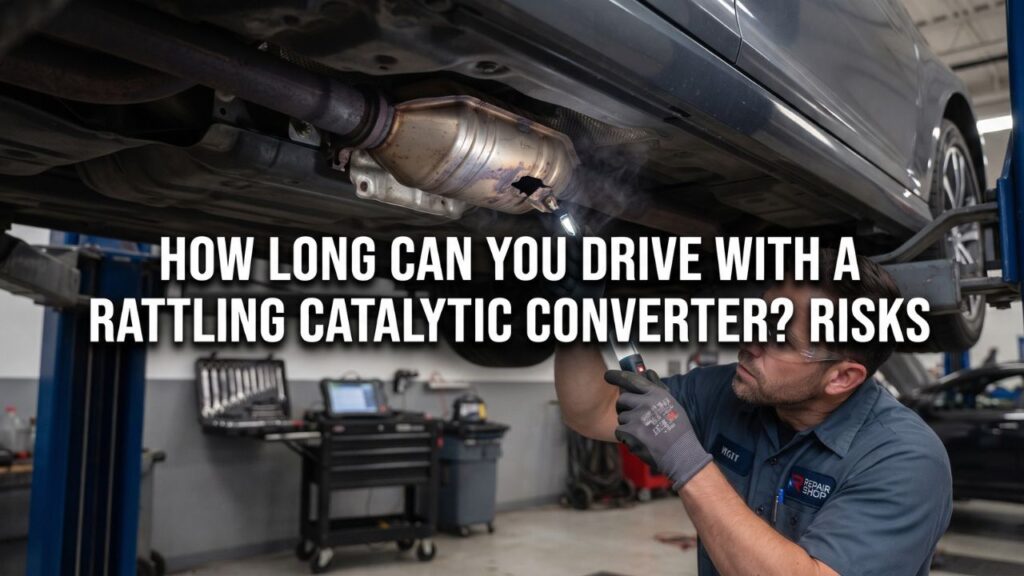
There is no dependable mileage limit for a converter that is rattling internally.
You might drive a short distance with no obvious change, or a loose piece of substrate could move and restrict the exhaust soon afterward. The progression cannot be predicted from the sound alone.
If the Car Still Drives Normally
If the rattle is mild, the engine has full power, there is no flashing check-engine light, the temperature is normal, and no burning smell or smoke is present, a short drive to a nearby repair facility may be reasonable.
That does not mean the car is suitable for another week of commuting or a long highway trip.
O’Reilly notes that broken converter honeycomb can rattle inside the housing and that loose pieces may eventually obstruct the exhaust system.
If Power Has Started Dropping
A noticeable loss of acceleration changes the situation.
Broken catalyst material can shift and restrict exhaust flow. The engine then has to push exhaust gases against increased backpressure.
Stop treating the problem as a noise complaint if the car:
- Struggles to accelerate
- Loses power on hills
- Will not rev normally
- Begins stalling
- Becomes hard to start
- Runs unusually hot
Walker states that excessive backpressure ahead of the converter can indicate converter restriction and that a restricted converter interferes with normal engine operation.
If the Converter Is Confirmed Broken Inside
An internally rattling converter normally needs replacement rather than continued driving.
Walker identifies broken substrate, melted substrate, and structural damage as converter failures and recommends correcting the cause before fitting a new unit.
I would limit driving to what is necessary to reach a repair shop only if the vehicle still operates normally. If drivability has already changed, towing is the safer option.
Key Takeaway: There is no safe mileage promise for an internally rattling converter. A short trip may be possible when the vehicle behaves normally, but power loss, stalling, overheating, or severe rattling calls for stopping normal driving.
What Does a Rattling Catalytic Converter Mean?
A catalytic converter contains a substrate with many small passages that exhaust gases flow through.
On many gasoline vehicles, that substrate is a ceramic honeycomb coated with catalytic materials.
When the honeycomb cracks, pieces can become loose inside the metal shell.
Broken Ceramic Honeycomb
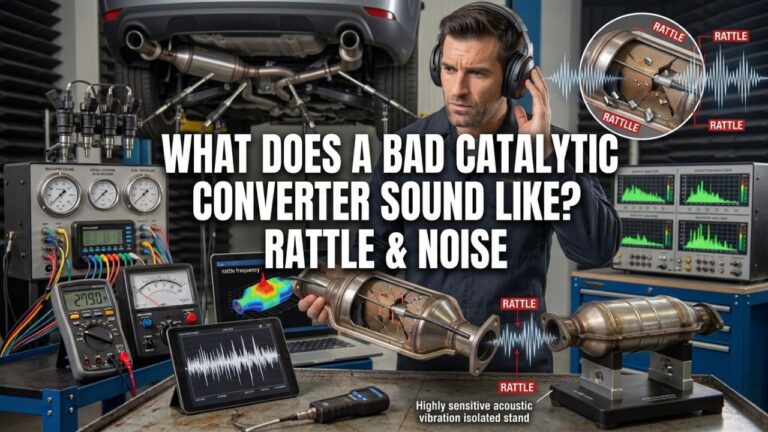
A broken substrate often produces a sound similar to:
- Pebbles inside a metal container
- Loose ceramic pieces
- Metallic clattering
- A coarse rattle at startup
- Rattling during acceleration or deceleration
O’Reilly states that the honeycomb inside a converter can break loose and cause rattling, and loose pieces can eventually interfere with exhaust flow.
The noise may change with engine RPM because exhaust pulses and vehicle vibration move the loose pieces.
Melted Catalyst Material
A converter can also overheat badly enough for sections of its internal passages to melt or collapse.
Walker states that converter temperatures above roughly 1,600°F can damage catalyst coatings and that temperatures above roughly 1,700°F can damage or melt the substrate and matting.
A melted converter may not rattle as much as a shattered one. Its strongest symptom may instead be severe exhaust restriction and loss of power.
Physical Impact Damage
The converter sits low in the exhaust system on many vehicles.
A road impact can dent the outer shell or crack the substrate inside even when the outside damage looks minor.
If the rattle began immediately after the vehicle struck debris, a curb, or another object, inspect the converter and nearby exhaust parts for impact marks.
Key Takeaway: A rattle from inside the converter often means the ceramic honeycomb has cracked, broken loose, or suffered heat or impact damage. Loose internal material can later become an exhaust restriction.
Could the Rattle Be a Heat Shield Instead?
Yes. A heat shield is one of the first things worth checking before buying a catalytic converter.
Heat shields are thin metal panels positioned around hot exhaust components. Rusted fasteners, broken welds, or corrosion can let the shield vibrate.
Heat-Shield Rattle
A loose heat shield often makes a lighter, thinner metallic buzz.
It may be most noticeable:
- At idle
- At one narrow RPM range
- During startup
- When going over bumps
- As the exhaust warms or cools
CarParts lists a loose heat shield alongside broken converter honeycomb as a common source of converter-area rattling.
A shield problem does not automatically mean the converter itself has failed.
Internal Converter Rattle
A broken substrate often sounds heavier, almost like material is moving around inside the converter shell.
A technician may inspect the exhaust on a lift and gently test the converter housing while the system is cool. Walker notes that a cracked substrate or damaged matting may produce loose-component noise when the converter shell is lightly checked during diagnosis.
Do not crawl under a running or hot vehicle to perform this check at home.
Exhaust Hangers and Clamps
Broken rubber hangers, loose brackets, clamps, and pipes can also strike the body or other exhaust components.
The noise may appear to come from the converter simply because sound travels through the exhaust.
A lift inspection can often separate these external rattles from internal catalyst damage quickly.
Key Takeaway: Not every converter-area rattle means the converter is bad. Loose heat shields, hangers, clamps, and exhaust pipes can create similar sounds and may be much simpler to repair.
When Should You Stop Driving Immediately?
The rattle itself deserves inspection, but several additional symptoms raise the urgency.
Major Loss of Engine Power
A converter that breaks apart internally can become restricted.
The car may accelerate normally at first, then feel weak as RPM rises because exhaust volume increases.
Walker states that excessive converter restriction raises exhaust backpressure and can interfere with engine operation.
If the accelerator is pressed and the car can barely build speed, do not continue a long trip.
Stalling or Hard Starting
Loose material can move into a position that blocks more of the exhaust passage.
Severe restriction may cause:
- Rough running
- Stalling
- Difficult restarting
- An engine that starts but will not rev properly
These symptoms mean the problem has moved beyond a harmless external rattle.
Flashing Check-Engine Light
A flashing check-engine light commonly indicates an active misfire serious enough to threaten the catalyst.
Misfires can send unburned fuel into the converter, where it may burn and create extreme heat.
If the light is flashing, reduce load and arrange diagnosis rather than continuing to drive normally.
Converter Glows or Produces Extreme Heat
A glowing converter is an urgent warning.
Excess fuel entering the exhaust can overheat the catalyst, while severe restriction can trap heat in the exhaust system.
Walker states that extreme converter temperatures can damage or melt the internal substrate.
Park in a safe location away from dry grass, leaves, or other combustible material if the underside of the vehicle is abnormally hot.
Smoke or Burning Odor
Smoke from under the vehicle, a strong burning odor, or heat damage around the converter warrants immediate inspection.
Do not assume the smell is simply normal exhaust heat.
A failing converter can be very hot, and nearby shields, wiring, insulation, or debris may also be affected.
Key Takeaway: Stop routine driving if the rattle comes with major power loss, stalling, a flashing check-engine light, extreme heat, smoke, or hard starting. Those signs suggest a more serious exhaust or engine fault.
Why Does a Catalytic Converter Start Rattling?
Catalytic converters often break because another engine or exhaust problem damages them.
Finding that root cause matters before installing the replacement.
Engine Misfire
Misfires are a major converter threat.
When combustion fails, unburned fuel can enter the exhaust and burn inside the catalyst.
That heat can crack or melt the substrate.
NGK identifies misfire-related overheating as a common reason the ceramic converter core breaks apart and starts rattling.
Common misfire sources include spark plugs, ignition coils, fuel injectors, compression problems, and wiring faults.
Rich Air-Fuel Mixture
A rich mixture means the engine is receiving more fuel than it can burn properly.
Extra hydrocarbons entering the converter can raise its temperature.
A leaking injector, fuel-pressure problem, sensor fault, ignition fault, or another engine-control problem can create this condition.
Oil Burning
Engine oil entering the combustion chamber can leave deposits and ash inside the converter.
Oil consumption may come from worn piston rings, valve seals, turbocharger problems, or other internal engine faults.
Walker lists oil-fouled substrate and excessive oil consumption among known converter failure causes.
Coolant Entering the Engine
An internal coolant leak can contaminate the catalyst.
Possible sources include a failed head gasket, cracked cylinder head, or another internal cooling-system fault.
If the car is losing coolant with no external leak, diagnose that problem before replacing the converter.
Road Impact or Thermal Shock
A converter can also break without an engine-control fault.
Hitting road debris can fracture the ceramic core.
Rapid temperature changes, corrosion, metal fatigue, and thermal stress can damage the substrate or its support mat. Walker includes these forms of structural damage among common converter failures.
Key Takeaway: Misfires, rich running, oil consumption, coolant contamination, impact damage, and extreme heat can break the converter core. Repair the cause before fitting another converter.
Can a Rattling Converter Damage the Engine?
It can create engine problems if the damaged substrate restricts exhaust flow.
The greatest concern is not the sound itself. It is what the loose material may do next.
Broken Pieces Can Restrict Exhaust Flow
The converter contains many small channels.
If fractured material shifts and blocks those passages, exhaust pressure rises upstream.
O’Reilly warns that loose converter pieces can clog the exhaust system.
The engine may then lose power because it cannot expel burned gases freely.
Backpressure Can Reduce Engine Performance
Excessive backpressure means the pistons have to work harder during the exhaust stroke.
The engine may feel weak and respond poorly to throttle input.
Walker gives general backpressure reference values below about 1.5 psi at idle and 3 psi at 2,000 RPM, while noting that pressure varies by application. High pressure before the converter points toward converter restriction.
Vehicle-specific specifications should control the diagnosis.
Heat Can Spread Upstream
A serious restriction may raise exhaust temperature.
Prolonged operation can stress the exhaust manifold, oxygen sensors, cylinder-head area, and other nearby components.
The safest response to a rattling converter with clear power loss is diagnosis rather than forcing the engine to keep operating under load.
Key Takeaway: A rattling converter can become an engine problem if loose material blocks exhaust flow. Backpressure and excess heat are the main mechanical concerns.
How Is a Rattling Catalytic Converter Diagnosed?
A proper diagnosis confirms both the source of the noise and the condition of the converter.
Inspect the Heat Shields and Exhaust Hardware
The first step is often a physical inspection with the exhaust cool.
A technician looks for:
- Loose heat shields
- Missing fasteners
- Broken hangers
- Damaged clamps
- Pipe contact with the body
- Impact damage
- Loose converter internals
If an external shield is responsible, converter replacement may not be needed.
Scan for Trouble Codes
A scan tool may find:
- P0420
- P0430
- Misfire codes such as P0300-series faults
- Fuel-control codes
- Oxygen-sensor faults
P0420 or P0430 indicates catalyst-efficiency trouble but does not prove the substrate is physically broken.
A mechanical rattle still needs physical confirmation.
Test Exhaust Backpressure
If the car has lost power, technicians may measure exhaust backpressure.
Walker recommends comparing pressure upstream and downstream of suspected restrictions. High pressure in front of the converter supports a restricted-converter diagnosis.
This test can also reveal if the blockage is actually in the muffler or another exhaust component.
Check the Cause of the Failure
The final step should be identifying why the converter broke.
A new converter can suffer the same damage if the car still has an active misfire, rich mixture, oil consumption, or coolant leak.
I would not treat replacement as complete until those causes have been checked.
Key Takeaway: Diagnosis should separate external exhaust rattles from broken catalyst material, then check codes, backpressure, and the engine fault that caused the converter damage.
Should You Replace a Rattling Catalytic Converter?
If the converter itself is confirmed to have broken substrate, replacement is normally the correct repair.
CarParts states that a rattle originating inside the catalytic converter can indicate that the unit needs replacement.
A chemical additive cannot glue a fractured honeycomb back together or rebuild melted passages.
If the sound comes only from a loose heat shield, hanger, or bracket, repair that component instead.
Before approving converter replacement, U.S. owners should also check the vehicle’s warranty status. EPA says covered catalytic converters on qualifying light-duty vehicles receive federal emissions warranty protection for 8 years or 80,000 miles, whichever comes first, subject to the warranty terms.
The correct replacement also needs to match the vehicle’s emissions configuration. State requirements can add rules for replacement converter certification.
Conclusion
There is no fixed mileage answer to how long can you drive with a rattling catalytic converter. If the converter’s ceramic substrate has broken loose, the safest approach is to minimize driving and arrange inspection soon. Loose pieces can remain noisy without causing an immediate breakdown, or they can shift and restrict the exhaust with little warning.
A short trip to a nearby repair facility may be reasonable if the vehicle has normal power, normal temperature, no flashing check-engine light, and no signs of exhaust blockage. Power loss, stalling, extreme heat, smoke, or hard starting changes that recommendation and makes towing the better option.
I would also confirm that the sound is truly internal before buying a converter. A loose heat shield or hanger can imitate converter failure, while a confirmed broken substrate normally calls for replacement plus diagnosis of the misfire, rich mixture, oil burning, coolant leak, or impact that damaged it.
FAQs About Driving With a Rattling Catalytic Converter
Can I Drive a Week With a Rattling Catalytic Converter?
There is no way to promise that one week is safe if the converter is broken internally.
The loose substrate may stay in place, or it may move and restrict exhaust flow. If the vehicle drives normally, limit use and arrange inspection soon rather than planning around a certain number of days.
Can I Drive 100 Miles With a Rattling Catalytic Converter?
A 100-mile trip is not a sound recommendation for a converter confirmed to be rattling internally.
Longer drives create more heat and give loose pieces more time to move. If you need to travel that distance, have the source of the rattle checked first.
Is a Rattling Catalytic Converter About to Fail?
A rattle from inside the converter usually means physical failure has already started.
The ceramic substrate may be cracked or loose even if the car still drives normally. The unknown part is how quickly the damage will progress or start restricting exhaust flow.
What Does a Broken Catalytic Converter Sound Like?
A broken internal converter can sound like pebbles, ceramic pieces, or loose metal moving inside a can.
The noise may be strongest during startup, idle, acceleration, or deceleration. A thin buzzing sound can also come from a loose heat shield, so sound alone does not confirm the diagnosis.
Will a Rattling Catalytic Converter Cause Power Loss?
It can.
If broken pieces shift and block the converter passages, exhaust backpressure rises and the engine may struggle to expel gases. The driver can notice weak acceleration, poor high-RPM performance, stalling, or hard starting.
Can a Rattling Catalytic Converter Fix Itself?
No. Broken ceramic substrate cannot repair itself.
The sound may temporarily change as pieces move inside the housing, but that does not mean the converter has recovered. A loose heat shield is a separate problem and may be repairable without replacing the converter.
Is a Heat-Shield Rattle Safer Than an Internal Converter Rattle?
Usually, yes.
A loose shield can create an annoying metallic buzz without restricting exhaust flow. It should still be repaired because a badly corroded shield or bracket can loosen further, but it is different from broken material inside the converter.
Should I Tow a Car With a Rattling Catalytic Converter?
Towing is the safer choice if the rattle comes with severe power loss, stalling, a flashing check-engine light, smoke, extreme heat, a glowing converter, or an engine that will not rev normally.
If the vehicle runs normally and the problem is mild, a short drive directly to a repair shop may be reasonable.